DENVER – The leaders of the Covenant Network of Presbyterians saved the last morning of the group’s 2015 national conference for looking ahead. The focus was twofold:
- What will the Covenant Network work on at the 2016 General Assembly?
- What’s ahead for the organization, now that the main policy initiatives for which it worked so hard for the last 19 years have been achieved? The Presbyterian Church (U.S.A.) now permits the ordination of gays and lesbians in partnerships, and allows Presbyterian ministers to perform same-gender marriages, although it doesn’t require them to do so.
STRONGER THAN EVER
 The Covenant Network’s executive director, Brian Ellison, went straight for the positive: “The state of the Covenant Network has never been stronger,” he began in his remarks Nov. 7. And: “Today we begin a new season in a good long life, trusting in God to lead us.”
Among the points Ellison made:
- Despite the changes in PC(USA) policy, work still needs to be done to create “a truly inclusive church” which is “safe and empowering for all God’s children” – and “we really mean all,” Ellison said.
- Making the Covenant Network’s board more diverse is “a huge priority,” and the leadership recognizes that “we have historically operated from a point of privilege.”
- The Covenant Network is spending time in intentional conversations – including with racial and ethnic caucuses in the PC(USA) and with conservatives who disagree with the denomination’s policy decisions involving gays and lesbians. The organization also is considering doing this, as Ellison put it: “In conversation with the World Mission area of the Presbyterian Mission Agency, we have offered ourselves for conversations with global partner churches as those partners take on their own conversations about matters of sexuality and marriage. In places where there needs to be healing, we will seek to be a reconciling voice. And where there needs to be understanding of the biblical, theological and pastoral road we traveled as a church to get where we are, we will tell that story in ecumenical and mission settings.”
- “We will carry the banner for Belhar” – the Confession of Belhar from South Africa, which focuses on justice, reconciliation and unity, and which the 2016 General Assembly will be asked to add to the PC(USA)’s Book of Confessions. The hope is that “it doesn’t sit on a shelf,” Ellison said, but “is lived into powerfully.”
2016 GENERAL ASSEMBLY
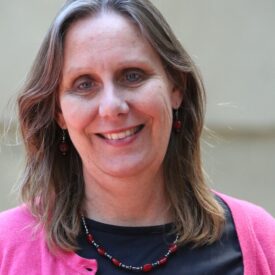
 Tricia Dykers Koenig, the Covenant Network’s national organizer, spoke about some of what the organization will focus on when the 222nd General Assembly meets in Portland June 18-25.
- Kiskiminetas Presbytery has submitted an overture seeking to return to the language previously in the denomination’s constitution defining Christian marriage as being between “one man and one woman” (that was changed to “two people, traditionally a man and a woman”). That proposed overture still needs a concurrence from another presbytery to be considered. Dykers Koenig said “we don’t expect that effort to engage much traction, but we can’t ignore it either … We will be alert to any movement to turn back that clock.”
- Key issues on the Covenant Network’s radar include the vote on the Belhar Confession; a revision of the Directory for Worship; the election of a new PC(USA) stated clerk to succeed Gradye Parsons, who has announced he’s not seeking a third four-year term; discussion of a possible reorganization of the Office of the General Assembly and the Presbyterian Mission Agency; and discussions to discern the future and focus of the denomination.
- The Covenant Network opposes a series of overtures proposed by Foothills Presbytery which would have a significant impact on what types of business a General Assembly could consider and when. Those favoring the overtures say that “the General Assembly sometimes makes controversial decisions, and change happens too quickly,” Dykers Koenig said.
The Covenant Network doesn’t want to limit when the assembly can consider matters of social justice, believing that faithfulness requires Presbyterians “to see where God’s people are hurting and wrestle with how to alleviate that suffering,” she said. Dykers Koenig also said the Foothills proposals could amount to a “freezing in place” of the Book of Order and give a minority of presbyteries the power to block change.
CLARIFICATION: An earlier version of the story stated that the Covenant Network is spending time in intentional conversations, including “about the possibility of representing PC(USA) World Mission in conversations about sexuality and ethics with the denomination’s global partners.”
Brian Ellison, the Covenant Network’s executive director, had described those discussions this way:
“In conversation with the World Mission area of the Presbyterian Mission Agency, we have offered ourselves for conversations with global partner churches as those partners take on their own conversations about matters of sexuality and marriage. In places where there needs to be healing, we will seek to be a reconciling voice. And where there needs to be understanding of the biblical, theological and pastoral road we traveled as a church to get where we are, we will tell that story in ecumenical and mission settings.”