Guest commentary by Art Ross
In Ephesians, Paul – redeemed disciple of Christ, world traveler and inspired writer – prays that the God of our Lord Jesus Christ will give the early Christians “a spirit of wisdom and revelation … so that, with the eyes of your heart enlightened, you may know what is the hope to which God has called you.”
As our nation and world live in a time of great fear – and fearful, even hateful, responses to Muslims and Syrians – I offer this story of an “eyes of the heart” enlightening experience.
The story begins about 12 years ago, sometime after 9/11. A group of Turkish Muslims in the Raleigh, North Carolina, area reached out to our congregation. They wanted to offer a different perspective on being Muslim than the jihadists offer. These Turkish Muslims had come to our region to earn advanced degrees at nearby universities; some stayed, some married. Now, they are working and raising families in the community.
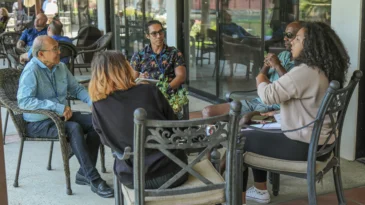
Congregation members began to meet with them. They worshipped with us; we worshipped with them. About a year ago, they invited me to organize a group of seven Presbyterian pastors to visit Turkey as their guests. We went for 10 days last April. We paid our airfare, but we were their guests from the moment we stepped off the plane. We had meals in the homes of their friends. We flew to three different regions beyond Istanbul, including Ephesus and Cappadocia.
The most powerful part of the trip began with a drive from the major city of Gaziantep to Kilis, a town three miles from the Syrian border. It was like leaving Raleigh and driving to Haiti. The city center of Kilis is like a Midwestern farm town with shops and farm equipment for sale, but the refuge areas are like the slums of Haiti, though not as vast. Families live on concrete floors with tattered bed linens as interior walls. Rents are hundreds of dollars a month – for one room and a shared toilet.
 A local Muslim businessperson has organized a soup kitchen/food bank. We delivered boxes of food to “homes,” then went to the soup kitchen, housed in a tractor-trailer equipped as a basic commercial kitchen. Huge pots of rice and beans had been prepared, along with a delicious smelling tomato-based vegetable soup. A Syrian worker at the soup kitchen gives out food cards to the refugees. The number of cards given determines the amount of food prepared. A Syrian chef helps rotate the soup menu daily. They were prepared to serve about 2,500 families or roughly 5,000 people. A crowd was milling about as we arrived and grew steadily as the kitchen prepared to open. One side of the trailer folded down and became both serving window and platform with steps. First, about two thousand women came by. Each had two plastic pails. One was filled with rice and beans, the other with soup. A stack of large Syrian tortillas was handed out in a plastic bag.
We assisted the staff in serving the crowd. It was steady, humbling work. The amount of food and the people matched almost perfectly. When the women had come though, men followed. The staff improvised to find old plastic bags for those who had no containers. We worked for about two hours. Then we went in a small room and the man who started the kitchen met with us. He and a group of business people are committed to raising the $1,500 to $2,000 a day it costs to operate. They receive no government funds, but a Muslim foundation in Turkey helps some.
 We discovered that the Muslims in Kilis, like our hosts from the Divan Center in North Carolina, are part of the Hizmet or Gulen movement within the Muslim faith. That movement has established 17 excellent universities in Turkey, plus a medical school and hospitals. They engage interfaith dialogue. They treasure democracy. They send trained volunteers around the world in response to disasters. And, they invited us to come to their country, to know them as friends.
Thanks to their friendship, I have been to a Syrian refugee camp. I have listened to Turkish leaders speak of the challenge of caring for over 2 million Syrian refugees now living in their country – the challenge is not only to house and feed them, but to educate them so that they become contributing members of the Turkish nation.
Later in the trip, in a discussion on the ways these Muslims live their faith as servants of God, a member of our group said, “Wait a minute – you folks are nothing more than the Presbyterian branch of the Muslim faith!”
We all laughed – and we all agreed. Oh, there are deep theological and cultural issues that divide, but there is something else that unites us. There, in the land of the Ephesians, the eyes of our hearts were enlightened. We came to see these friends as brothers and sisters in faith – not faith in Jesus – but shared faith in the one true God. There, in the land of the Ephesians, we came to see these friends as beacons of hope in the midst of conflict and people of compassion in the midst of horrible suffering.
Our Turkish friends are not going to become Christians; we are not going to become Muslims – but there is something else that binds us together. That something else allows us to share friendship, faith, and hope in a broken and fearful world.
Something else – it is the way the heart, not the head. When Paul’s prayer becomes a reality in our lives, the heart begins to catch a glimpse, an enlightened glimpse of the revelation and wisdom that comes to us through Christ, we see the promised kingdom of God and we have hope. Even as we live in a world filled with fear, we have a hope that the head cannot explain. That hope leads to compassion.
 ART ROSS is a native of North Carolina; he served in the army as in infantry officer and served churches in Brooklyn, New York; Charlotte, North Carolina, Jacksonville, Florida; Morehead City, North Carolina; and St. Petersburg, Florida. For 15 years he was pastor of White Memorial Presbyterian Church in Raleigh, where he now lives; he retired in 2009.