I served as chaplain at Hastings College for four years. During that time, students found their way to my office for two reasons:
- The snacks.
- They had a story to tell.
Most had experienced hurt or trauma from a church or church-related institution. Yet woven into those stories of pain were threads of curiosity and hope — not hope in the church that had failed them, but hope about the possibilities of faith beyond the sanctuary.
Wanting to respond more intentionally to these stories, I decided to undertake an official study. I emailed all Hastings College students, offering a $25 gift card to anyone willing to participate in a filmed interview who fit one of two categories: I used to attend church regularly, but I don’t anymore, or I’ve never been a church attender.
Twenty-one students volunteered. Of those interviewed, 19 had attended church before college, while two said they had either never attended or had only been to church for special occasions such as funerals. All were traditional undergraduate students under the age of 24.
Several patterns emerged. Students who volunteered for interviews included a disproportionately high number of queer, nonbinary and neurodivergent students compared to the broader student population. They also represented a wide range of church backgrounds, from several mainline Protestant denominations to Nebraska’s Cowboy Church.
When I asked the two students who had never attended church why, both gave the same answer: “No one invited me.”
They came from families that had never regularly attended church but were curious about its purpose and community. One student added, “English isn’t my first language, so I’m not sure I’d fit in.”
When I asked the other 19 students why they had stopped attending church, three themes consistently emerged.
Why young adults stop attending church
“I wasn’t welcome.”
Students who identified as queer, transgender or neurodivergent repeatedly described churches where they felt excluded. Some cited explicit preaching condemning same-sex relationships or transgender identities. Others described environments unwilling to make even modest accommodations for neurodivergent worshipers.
Several students struggled with loud music, expectations of physical touch during the passing of the peace, or constant social interaction before and after worship. One student said churches refused to lower the volume or provide alternatives that would allow them to participate comfortably.
Another noted that churches displaying “All Are Welcome” signs were especially painful.
“If I walk into your church and I can’t find anyone who looks like me or speaks like me,” she said, “then your church only thinks it’s welcoming. It isn’t.”
“If I walk into your church and I can’t find anyone who looks like me or speaks like me, then your church only thinks it’s welcoming.”
A student who sometimes uses a wheelchair described churches that could not accommodate wheelchair access during worship as “so very disappointing because this is so very common.”
“I wasn’t allowed to ask questions.”
Students also described churches that discouraged theological curiosity.
When they raised questions about theology or church polity, they felt pastors and church leaders dismissed rather than engaged them.
One student recalled, “When the church called my queerness a ‘political conversation’ that the church wouldn’t have, I didn’t know who would talk to me.”
“When the church called my queerness a ‘political conversation’ that the church wouldn’t have, I didn’t know who would talk to me.”
Others wanted conversations about immigration, racism, biblical historicity or new ways of understanding God’s grace and sovereignty.
One student summed it up this way:
“If Thomas is still a disciple and he had doubts, I would think I could at least have some questions.”
“No one noticed when I left.”
For others, there was no defining conflict.
One student simply said, “No one missed me and my grandpa when we were gone. No one called to check on us. It felt like it didn’t matter if we showed up or not.”
“It felt like it didn’t matter if we showed up or not.”
Another described the church as “ambivalent” toward their presence and contributions.
A former Presbyterian offered a particularly blunt assessment: “The only benefit of membership is that you’re asked to give money. I don’t have any.”
Although these answers were predictable, they didn’t feel very good to this pastor’s heart. In my conversations, I noticed worship style was rarely the issue. The students described churches across four states, representing multiple denominations and worship traditions. Some attended traditional churches with formal preaching, while others worshiped in contemporary congregations where pastors preached in jeans and invited questions during the sermon.
As two students explicitly told me, “My decision to leave the church had nothing to do with worship.”
Instead, they left because they no longer felt welcomed, heard or valued.
Three things that surprised me
None of the themes above surprised me. What did surprise me was the thoughtfulness of the students’ responses and the ways many of them continued to pursue faith outside the institutional church.
Students kept studying religion.
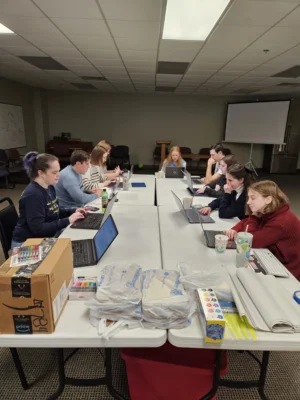
Of the 21 students I interviewed, three were religion minors and two were religion majors. In other words, nearly a quarter had committed to at least 20 credit hours of undergraduate religious studies despite having little or no interest in participating in a church.
One student explained it this way:
“I found one class interesting, so I took a second. Then a third. Before I knew it, I had a minor I wasn’t originally planning for.”
They were deeply curious about religion’s history, development and role in society, even if they had stepped away from organized Christianity.
Students attended chapel — but not church.
Four of the students interviewed regularly attended campus chapel services and participated in chaplain’s retreats.
When I asked why they came to chapel but not church, one student replied, “It doesn’t feel like real church.”
That answer surprised me. I pride myself on following Reformed worship patterns and regularly using the Glory to God hymnal.
So I asked what they meant.
“I can wear my pajamas,” the student said, “and I can ask questions.”
The student went on to describe participating in an impromptu skit about Elijah and the prophets of Ba’al, complete with inflatable sharks standing in for sacrificial bulls because the theater department didn’t have inflatable cattle.
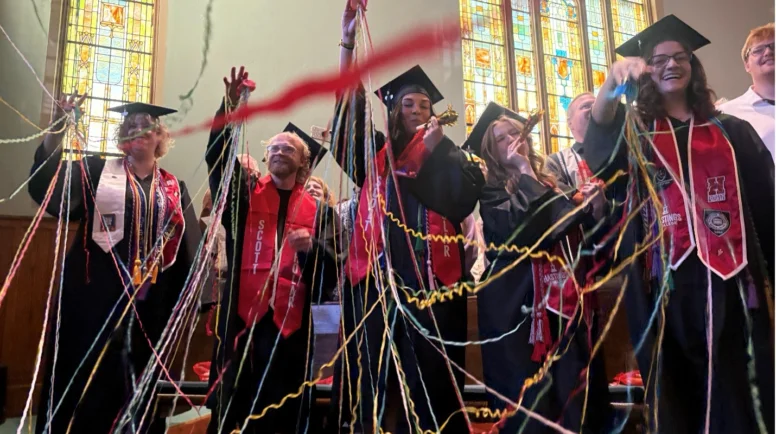
Since conducting these interviews, Hastings has held two baccalaureate services in which graduating seniors were invited to participate.
Of the 10 interviewees who have graduated during the past two years, seven attended baccalaureate, six of whom volunteered to lead portions of the service, including preaching.
When I asked whether anyone had pressured them to participate, every one of them answered no.
One young man laughed and said, “I dragged my unchurched family here. I hope they can figure out what they’re supposed to do.”
Some students pursued ministry.
Two religion minors also enrolled in Hastings College’s Christian Ministry Certificate program, a six-course sequence funded through a Lilly grant that prepares students for internships in local congregations and pulpit supply opportunities.
Both have now completed the program.
One, despite being a confirmed Methodist, is approved by the Committee on Ministry to serve on the pulpit supply list in Central Nebraska Presbytery and now preaches regularly.
The other will begin studies this fall at Austin Presbyterian Theological Seminary.
So why were these students eager to talk about the ways the church had wounded them while also remaining eager to study religion, preach, worship and explore their faith in other settings?
After reflecting on these interviews, I arrived at two conclusions.
Related reading: “Gen Z’s complicated return to faith — and what Presbyterians are seeing” by Gregg Brekke, Outlook reporting
Young adults want to help tell the story.
Stories sit at the center of these students’ spiritual lives, and they want to be participants in telling the story of faith, not merely listeners.
The two students who completed the Christian Ministry Certificate both described a desire to help tell the Christian story rather than simply receive it. For them, the church felt like something inauthentic and foreign to their sense of calling from God.
They perceived the church as demanding conformity, while their own experiences of God felt deeply personal. They wanted companions who would help them wrestle with questions rather than silence them. They longed to witness the faith of others so they could better understand their own.
When those conversations were discouraged, they walked away.
Young adults long for worship that celebrates God’s presence rather than God’s judgment.
The students who helped plan our 2026 baccalaureate service chose Zephaniah 3:14-20 because, as one put it, they wanted to “throw a party” for graduation. They saw God celebrating Israel’s return from exile and wanted their worship to reflect that same joy.
They wanted worship that acknowledged where they actually were in life’s journey and presented a God who was present with them in that place.
More than precise doctrinal formulations, they were searching for a God who delights in people, accompanies them through life’s transitions and invites them into hope.
Twenty-one students from one small liberal arts college cannot speak for an entire generation. Nor are four years enough to make sweeping claims about the future of the church.
Still, these conversations have convinced me of the importance of listening with intellectual humility.
When I was a chaplain, my calling was not to resolve every question these students bring. It was to trust that the Holy Spirit is already at work in and through their questions, to cultivate the next generation of faithful storytellers and worship leaders, and to remember that while the church has often failed these young people, God has not.