 by Grant Wacker
Belknap Press
Cambridge, Mass. 448 pages
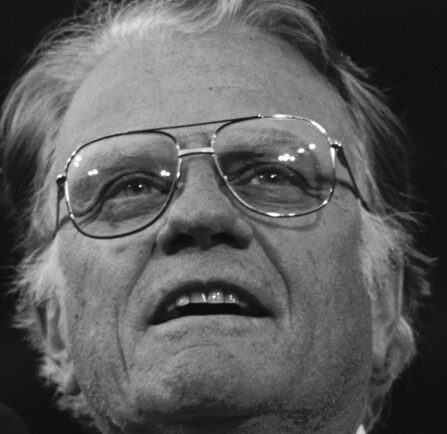
Billy Graham was a major fixture in American culture throughout the second half of the twentieth century, but his exact contribution is difficult to define and assess. Grant Wacker, a professor of church history at Duke Divinity School, attempts to fill this lacuna. His book, however, is not a conventional biography. Instead, Wacker approaches his subject thematically in eight chapters: preacher, icon, Southerner, entrepreneur, architect, pilgrim, pastor and patriarch. The result is insightful and persuasive.
Opinions about Graham expressed over the six decades of his ministry have been overwhelmingly positive. Nonetheless, he has drawn fire at times, and the barbed wit of his detractors can be stinging. Garry Wills belittled him for his “golf-course spirituality.” I.F. Stone referred to him as Nixon’s “smoother Rasputin.” George Will said that he was “America’s most embarrassing export.” Intellectuals belittled him as “the high priest of civil religion” in America. Seeing the handsome, confident evangelist stride through the Atlanta International Airport, a hostile journalist jeered that he was a “walking mannequin who had sold his soul to the devils of modern image-making.”
Graham, it seems, was an easy target. Yet there were those, even among the Christian intellectuals — his sharpest critics — who were sympathetic. In response to Reinhold Niebuhr’s assertion that his message was simplistic, Union Theological Seminary president Henry Pitney Van Dusen remarked, “There are many, of whom I am one, who … would probably never have come within the sound of Dr. Niebuhr’s voice … if they had not been first touched by the message of an earlier Billy.”
Graham’s life is a remarkable pilgrimage from his modest beginnings on a North Carolina dairy farm to becoming “America’s pastor” and the pastor of presidents, who, as Nancy Gibbs said, “came with the office like the draperies.” It was a pilgrimage that included personal growth, for Graham began as a biblical literalist but grew more flexible over time; his sermons in the 1940s and ’50s were fiercely anti-communist, but by the ’80s he was reaching out to the USSR, the Eastern Block and North Korea with the gospel; having been badly burned by Richard Nixon, a chastened Graham eschewed the Christian Right of the ’80s and ’90s as too partisan; and shedding his early fundamentalist purity, he announced an ecumenical openness: “I intend to go anywhere, sponsored by anybody, to preach the Gospel of Christ, if there are no strings attached to my message.”
Wacker is not impressed with Graham as a writer and preacher, finding his prose “clear and accessible,” but unmemorable and often “soporific.” In fact, “He was not flamboyant as Billy Sunday, or dramatic as Aimee Semple McPherson, or soaring as Martin Luther King Jr., or memorable as Harry Emerson Fosdick.” So why was Graham the most successful evangelist of all time, who by 2005 “had preached to nearly 215 million people in person in ninety-nine countries and perhaps to another two billion through live close-circuit telecasts”? Wacker, with his careful analysis of Graham’s life, goes far toward answering this question, but clearly the whole was greater than the sum of its parts. Given the ultimate ineffability of success, Wacker may have summed it up best in his first chapter: He had “the gift.”
MICHAEL PARKER is director of graduate studies and professor of church history at Evangelical Theological Seminary in Cairo, Egypt.