ATLANTA (Outlook) What does it mean to have “faith at the crossroads?”
That’s what nearly 600 Presbyterians spent three days talking about at the NEXT Church national gathering, held Feb. 22-24 at First Presbyterian Church in Atlanta, and which they’ve now gone home to keep unpacking.
While much in the Presbyterian Church (U.S.A.) may be worrisome — a denomination that’s losing members and influence, churches unable to afford paid leadership, changing national demographics that the PC(USA) does not reflect — NEXT is not a place to come for mourning.

NEXT functions as kind of a pitching machine of ideas — trying to envision what can be, what’s already coming to life, tossing out possibilities and priorities on everything from community organizing to art in worship to outreach and mission.
“Presbyterians are at a crossroads — we feel it in our work, we feel it in our communities, we feel it in our lives,” said Karen Sapio of California, co-chair of the NEXT strategy team. Shavon Starling-Louis of Rhode Island, who’s on the NEXT strategy team, said the difficult issues include racism, homophobia, church splits, church decline and divisions between conservatives and liberals.
NEXT itself is “at a crossroads of our identity as well,” Starling-Louis said. NEXT has grown rapidly and is trying to clarify its role and purpose — describing itself as a network of PC(USA) leaders “who believe the church of the future will be more relational, more diverse, more collaborative, more hopeful and more agile.”
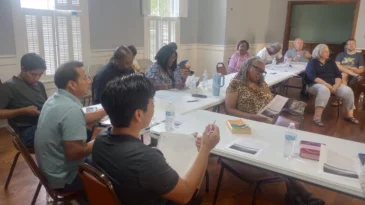
This was the sixth national gathering NEXT has convened, and points of discussion included how to involve more ruling elders (many of whom would to take time off from work and don’t have continuing education dollars to spend); to have greater geographic, age and racial diversity; and how to have a more regional presence in a denomination of mostly small churches. “There aren’t that many churches that are big enough to fit 600 people in the sanctuary with breakout rooms” and are within in walking distance of enough hotels and restaurants, Sapio said during a workshop session.
Still, some who did attend said they felt energized and encouraged by what they heard at NEXT. Renee Roederer of Michigan helped lead a pre-conference gathering for seminarians, and said “it was great, it was well attended. … They love encountering creative ministry ideas. They feel coming here counters a scarcity mindset,” allowing them to set aside their anxiety about what a career in ministry might be like, and think about how to translate the gospel in a new culture and context. Also, “just to connect with friends is huge for them,” Roederer said. “It’s huge. NEXT Church is an extroverted Presbyter-ian’s dream. I am in heaven.”

One emphasis of this gathering was race relations — with speakers and workshops on structural racism and white privilege, and a commitment from NEXT to try to have half of its advisory and strategy teams made up of people of color by 2017. Too often, white Presbyterians are essentially sending this message: “There are brown people outside our doors, and we need them to join our dying church,” said Jessica Vasquez Torres, an experienced anti-racism trainer and speaker at the conference.
Her words pointed to a difficulty: how to move from the reform rhetoric of big gatherings like these to putting those creative ideas to work at the grassroots.
From the pulpit, preachers and speakers spoke directly of the resurgence of racism and the obligation of Christians to respond. “It looks like we’ve stepped into a time machine … where racism is blatant” — an unapologetic 50th anniversary of racism and classism, said Aisha Brooks-Lytle, associate pastor of Wayne Presbyterian Church in suburban Philadelphia.
Some of the evidence she presented:
- The litany of people of color dying at the hands of police — including Samuel DuBose, a 43-year-old father whom a University of Cincinnati police officer shot and killed July 19 after stopping him for having a missing license tag. Brooks-Lytle said she had to explain to her 10-year-old son that that killing didn’t happen decades ago — it was just last summer. “Black males are being shot as if the are target practice,” she said. At any age.
- The gap between the haves and have-nots is explicit and growing. In the name of gentrification, the working class gets pushed out of affordable housing. “The educational divide keeps getting bigger and bigger. And in Flint, we are watching in horror as the basic needs of clean water have been compromised for the poor.” Also in Flint: “It seems like some people in power had knowledge of these issues, but had access to clean alternatives for themselves.”

Allan Boesak of South Africa delivered a blazing challenge to the PC(USA) — saying the church must use its privilege to stand on the side of the poor and oppressed, and the fight against injustice must be “real, radical and revolutionary.”
Boesak, a former president of the World Alliance of Reformed Churches who now serves on the faculty of Christian Theological Seminary in Indianapolis, spoke on the eve of his 70th birthday. He was enthusiastically greeted by Heath Rada, moderator of the PC(USA)’s 2014 General Assembly, who has traveled with Boesak to South Africa and who said what he learned from Boesak has “changed my life.”
Boesak described racism as systemic and oppressive, and he took these Presbyterians to school on the importance and the difficulty of reconciliation — as the denomination approaches the vote expected at the 2016 General Assembly in June to add the Belhar Confession from South Africa to the PC(USA) Book of Confessions, which would make it the first confession the PC(USA) has adopted to come from the global South.
“The signs of the church are the dove and the lion and the lamb and the fish, but never the chameleon,” Boesak told the NEXT crowd.
In the end, Boesak said, God will judge if the church has done enough. If God asks where are your wounds and you have none, the question will be: Was there nothing worth fighting for?
“I pray to God that we will have something to show.”