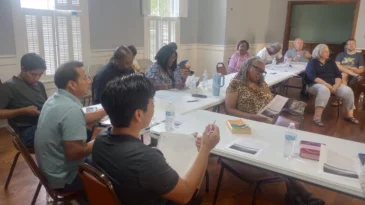
When the General Assembly’s The Way Forward committee finished for the night on June 19, top leaders of the Presbyterian Church (U.S.A.) stood in clusters all around the room, huddled in groups rehashing what had just happened. The mood was not light.
What had just happened was that the committee had dipped its toes into a complicated discussion about how the top levels of the church should be configured – and whether the time has come to begin to strategically discuss the possibility of structural change.
The committee heard presentations from review committees for the Presbyterian Mission Agency (PMA) and the Office of the General Assembly (OGA), both of which are recommending that the assembly create a new committee with specific representation to explore the possibility of a merger between PMA and OGA.
That is not an idea that sits well either with the Presbyterian Mission Agency board or the Committee on the Office of the General Assembly, although for different reasons.
To be clear: the review committees are not recommending merger – “I can’t stress enough, we are not recommending a merger,” said Eliana Maxim, chair of the 12-member Committee to Review the Presbyterian Mission Agency and associate executive pastor of the Presbytery of Seattle.
“Our committee takes no position on the advisability of merger,” said Cliff Lyda, a pastor from the Presbytery of Chicago who was chair of the Committee to Review the Office of the General Assembly.
Instead, the review committees are suggesting that the time is right for an intense, focused, deliberate conversation about what’s going well and not so well at the top levels of the church – and about what structure is best for a denomination that’s smaller, with fewer resources, and trying to do ministry in a much-changed world.

The PMA Review Committee’s guiding questions were: “How is the agency serving the church and its constituents?” and “What is the role of a denominational mission agency in the 21st century?” Maxim said.
“We feel that conversation needs to take place, and it needs to take place now,” Lyda told The Way Forward committee. “Again, there’s no assessment on the advisability of merger, but simply a sense this conversation needs to happen, and needs to happen in a way that’s deliberate and sensible and sensitive.”
Not everyone agrees – that’s for sure. The Committee on the Office of the General Assembly (COGA) has raised concerns that a merger could impede the independence of the stated clerk, the PC(USA)’s top ecclesiastical officer.
Representatives of the Presbyterian Mission Agency board argued that the assembly should proceed with the scheduled all-agency review – which considers the interactions of the PC(USA)’s six agencies, to see if there might be possibilities for new ways of working together or reduction of redundancies.

“Form follows function,” Marcia Zell Anson, the incoming vice-president of the Presbyterian Mission Agency board, told The Way Forward – arguing that before an examination of what structure is best should come an exploration of what local churches and new worshipping communities need. “If we immediately move into a (new) structure, we will make mistakes, we will leave things out,” Anson said.
Melinda Sanders, representing the board’s Governance Task Force, explained that the Presbyterian Mission Agency board has initiated its own process of reconfiguration and wants time and space for that to work.
In part, the discomfort also comes because the PMA Review Committee wrote an unflinching report, naming what Maxim described as systemic problems within the agency.
Maxim said the review committee found a dedicated, hard-working staff at the PMA, but also evidence of deep difficulties, after interviewing more than 60 PMA staff members and others who interact with the agency. She and Eric Beene, a member of the PMA review committee, described:
- An unclear sense of identity and purpose within PMA;
- Conflict avoidance, a lack of transparency, and secrecy;
- A deep lack of cultural humility;
- An unwieldy board and a rigid hierarchy;
- “A tremendous amount of anxiety among the employees we spoke with and a lack of trust,” Maxim said.
Anson told the Way Forward Committee that some concerns the PMA review committee raised involved matters PMA is already working to change, “and we’re not done yet.” She said “this report was done at a very specific moment in our history” and “it was a time of grief and stress and pain. If the report had been done six months before or six months after, there might have been a different result.”
Although Anson didn’t say so specifically, she appeared to be referring to a series of recent controversies at PMA, including an ethics investigation involving some employees with the 1001 New Worshipping Communities; a promotional campaign for Special Offerings that was criticized as being racially insensitive; and spending for the 2013 Youth Triennium that went significantly over budget.
Maxim, however, said the review committee determined those controversies were symptomatic of deeper, entrenched, systemic problems.
Both the review committees praised the dedication, hard work and professionalism of the PMA and OGA staffs. An OGA staff reduction several years ago created more work for fewer people, which hurt morale, Lyda said. As many presbyteries and synods have downsized their staffs, Presbyterians at the grassroots increasingly turn to the OGA workers for help. “They simply have more to do than they can do,” he said.
During question-and-answer periods, it was clear some members of The Way Forward committee were struggling to understand the differences in responsibilities and roles between OGA and PMA, and to determine how discussing the idea of structural changes would effectively address some of the concerns the review committees had raised or set a creative vision for the PC(USA).
How is combining the workloads of two overworked staffs going to lessen the load? asked LaVera Parato of Coastal Carolina Presbytery.
Some asked questions about the process and methodology of the review committees’ work — whether they relied on anecdotes or collected feedback comprehensively from a diverse range of voices.
Both Lyda and Maxim stressed the need for a broader, strategic conversation – not to focus solely or specifically on merger. “We are not in a moment of crisis, contrary to what most people like to tweet,” Maxim said, but are “at the crossroads of a tremendous opportunity to determine what it means to be the PC(USA) in the 21st century,” and to do it now, before the denomination has even fewer resources with which to work.
Well into the discussion, the newly-elected co-moderators of the assembly, Jan Edmiston and Denise Anderson, stopped by for a visit, to thank the commissioners and encourage them in their work.
“We are praying for you fervently,” Anderson told The Way Forward members. “We want you to be fair. We want you to be brave.”