 It’s what Presbyterians all over the country say: We wish more young people wanted to be part of this congregation.
Levels of religious affiliation have been dropping among American adults in recent years — with rising levels of both the “nones” (those who declare no religious affiliation) and the “dones” (those who used to be active in congregations, but no longer are). And in the western part of the United States — where the 2016 General Assembly will meet June 18-25 in Portland — people tend to be even less religious than in other parts of the country, with 28 percent of adults saying they have no religious affiliation, according to a 2014 study from the Pew Research Center.
Scholar Patricia O’Connell Killen, academic vice president at Gonzaga University and an editor of the book “Religion and Public Life in the Pacific Northwest,” described the Pacific Northwest as an “open” religious environment with less expectation for religious participation and bigger percentages of “nones” than in the country as a whole.
So, in 2015 Westminster Presbyterian Church, a progressive congregation in northeast Portland, decided to try to learn more about what young adults in neighborhoods near the church think about religion and spirituality — commissioning a formal research study that the congregation is now using to shape both ministry and outreach.
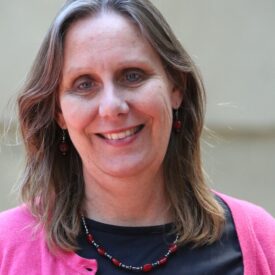
Leslie Lehmann, a ruling elder at Westminster, came up with the idea after attending the NEXT Church national gathering in Chicago in 2015. She then approached Adam Davis, founder of DHM Research, a research opinion firm in Portland and one of the lead researchers conducting the Oregon Values and Beliefs Project, which has measured the views of Oregonians over the past 30 years.
That research has found that people in Portland value natural beauty and outdoor recreation; a sense of community and neighborhood identity; and the temperate climate. “We’re a very blue Democratic city,” Davis said in an interview. “This is Bernie Sanders country.”
Concerns include jobs and the economy; social justice; public transportation; affordable housing; sustainable living. “We’ve got young people who want participatory engagement, and they want to be working on community issues,” Davis said. “That’s not the profile of other parts of the country.”
Davis also said that young adults, both in Portland and across the country, “look at organized religion and traditional religion differently and more skeptically than they do spirituality.”
The 2014 Religious Landscape Study from the Pew Research Center, for example, found that only 41 percent of millennials (born 1981 to 1996) say that religion is very important in their lives, and only about half (52 percent) say they believe in God with absolute certainty. Only about a quarter (27 percent) say they attend religious services weekly, although three quarters (76 percent) have a sense of gratitude or thankfulness, and 55 percent say they think about the meaning and purpose of life.
More than a third of millennials (35 percent) claim no religious affiliation.
In an interview, Lehmann said she’d been tracking national surveys showing declining levels of religious affiliation, and said she suspected that in Portland, “we’re on extreme end of that trend. … Our kids have soccer games on Sundays. It’s not a very churchy culture at all.”
What she was really curious about, Lehmann said, was what people meant when they said they were spiritual, but not religious. And what were the implications of that for congregations?
Spiritual but not religious
With the blessing of Westminster’s session, Lehmann went to talk to Davis — who made her an offer. If she could come up with the money to pay for the direct costs of the research and an honorarium for the participants, he’d donate his time and expertise to the project. The session provided the money, and Davis led two focus groups in May 2015 of young adults ages 22 to 35, randomly selected from neighborhoods in north and northeast Portland, to probe their views on religion and spirituality.
 Among the findings:
- “They distrust institutions across the board,” Lehmann said. “They have high levels of institutional distrust, whether it’s government or business or educational systems, and religion is included in that.”
- Attitudes are shaped not only by personal experience, but also by impressions formed through the media about who Christians are and what they believe. They’re influenced “by stuff they’ve read that portrays Christians as bigots,” she said. “Some said they’re anti-science, they don’t believe in climate change. They’re political conservatives. The stereotypes they’ve picked up from the media — that’s what’s shaping their opinions.”
- Some who chose no religious affiliation did acknowledge that churches and other religious organizations do good in the world — for example, people of faith are involved in feeding the homeless. “But they said there’s an ulterior motive,” Lehmann said. “They are doing these things to lure people into their belief system” — what one young adult described as making “the pitch.” As one focus group participant put it: “There’s always something else that, you know, they want you to join the church, or they want you to be a part of that religion. They’re not just, it’s not just enough for you to come to help out on that specific cause. There’s something else there that they’re wanting you to be a part of, and that’s what, to me, is unnecessary.”
- Participants had different impressions of “religion” versus “spirituality.” Many associated religion “with antiquated institutions and thinking,” and spirituality with individual interpretation of the metaphysical, self-exploration and transformation, the research report states.
- While they were mostly uninterested in listening to a traditional religious service in a formal church space, “participants expressed interest in participatory engagement around art, music, and community issues including social justice,” the report states.
Outside the walls
As a result of the research, the leaders at Westminster decided “our best shot with these people is outside our walls,” Lehmann said. “Doing projects in the community with them, because they are invested in helping the community. They feel that’s important,” and they might be willing to partner with the church in doing the work, even if they didn’t want to come to worship on Sunday mornings.
So Westminster has hired a community engagement coordinator to help the congregation connect with work already underway in Portland — to join forces with and stand beside young adults who are already working for the benefit of their community. Among the issues millennials have identified as concerns: gentrification, education, the environment and income inequality.
“The other thought is there’s a yearning for connection and connectedness,” Lehmann said. So Westminster is starting an experiment with small groups in which young adults connected to the church will invite friends and neighbors into their homes for hospitality and conversation. The goal is to form relationships and to be a place where young adults can talk about spirituality and be honest about what they think.
As part of its research, Westminster also convened a discussion with a small group of young adults who’d grown up themselves in the Westminster community — but many of whom no longer are a regular presence in any church.
 One thing millennials who’d grown up at Westminster said was “you need to be authentic,” Lehmann said. “You shouldn’t change things to market to us. You need to be true to yourself. They don’t necessarily want to get up on Sunday mornings to come to church, but they want to know that traditional service is there,” or the candlelight service at Christmas Eve.
“One of them said — our generation, we’re taking a long time to grow up. Don’t give up on us yet.”
It’s also clear, however, that traditional methods of reaching out to young adults likely won’t work — that other ways of making connections are needed.
Focus group participants said: “To me, one of the first words that comes to mind when I think of religion in general in the world is ‘conflict.’”
And: “I feel like, and I believe that my generation feels that religion has not changed. It is still very much rooted in the old world, and it is inflexible and stubborn. It’s clinging to these ideas that no longer fit the new world. I guess it boils down to three words, ‘Change or die.’”
Lehmann said regarding the research, “If there’s one takeaway, it’s this: Don’t be afraid to fail. Try stuff. If it doesn’t work, you can always quit.”