Editor’s note: The Outlook will run occasional stories talking to Presbyterians involved with grassroots work to address racism and injustice in their communities. The hope: sharing these stories might help people of faith think more deeply about what they are called to do.
Day after day, with the news of violence continuing to pour in from across the country and around the world, Presbyterians struggle with a question something like this: What can I do?
Or maybe that’s not their question – but in other ways they are wrestling with how people of faith should respond in a time when violence and injustice are tearing the hearts of so many. While there’s no single right answer or blueprint for action, Presbyterians at the grass roots are trying to respond – doing so in the contexts of their own communities, not always sure of the right way to proceed but also not willing to do or say nothing.
One of the communities in great pain is Baton Rouge.
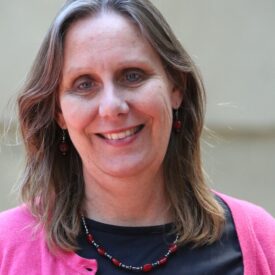
Patti Snyder, senior pastor of University Presbyterian Church in that city, was walking into the church to prepare for worship on July 17 when she began hearing the reports of three police officers killed and others wounded in a Sunday morning shooting. Her congregation turned to prayer – for the police, for the community, for those paying the price of injustice.

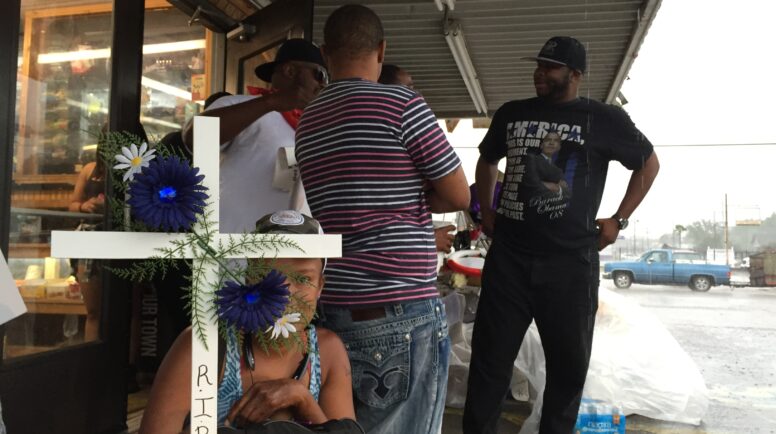
After a police officer shot and killed Alton Sterling outside a convenience store earlier in the month, “we were already all feeling overwhelming sorrow and renewed awareness of the racial divides in our city, and for those of us who call ourselves white, a renewed awareness of our privilege and just how much work we have left to do,” Snyder said told the Outlook.
Her congregation has already been deeply involved in working on issues of justice – as part of a grassroots community organizing effort that is racially diverse; includes a range of faith-based and nonprofit groups; and focuses on building relationships and attempting to initiate change on particular issues or problems. Together Baton Rouge now involves about 350 faith and community leaders from 100 congregations and organizations, and works on issues involving systemic injustice and economic inequality.
“We’ve been doing that for a long time, but this really brings home how important that work is and the pressure of moving that forward with expediency,” Snyder said. “Not that there ever really should have been a luxury of taking our time, because issues of racism have adversely shaped our culture for generations. But for us in Baton Rouge, this is a moment that has lit a fire under us.”
Together Baton Rouge was started about a half-dozen years ago, initiated by a group of African-American pastors who sought funding to hire a community organizer and reached out to some predominantly white churches like Snyder’s – a congregation with a history of being involved in social justice issues. At first, “I was very skeptical,” Snyder said, because University Presbyterian had been involved in other grassroots organizing efforts that didn’t amount to much.
Together Baton Rouge, however, proved to be different. Why?

“We have addressed some significant problems and have chipped away” at matters involving injustice, she said. In part that’s because those involved share responsibility for making things happen – it’s not seen as the work of a staff person. When someone raises a concern within the organization, a working group of others willing to be involved coalesces around that issue and they do research – investigating the problem and its history; talking to affected people; exploring possible solutions and best practices from other areas; proposing a specific plan of action.
Together Baton Rouge has taken on issues including tax fairness; access to health care; expansion of Medicaid services; food deserts; improvements in mass transit; education reform and increasing parent participation in schools. The first project: push for repair of a bridge that had been closed for more than a year for safety reasons, making it difficult for emergency vehicles to get in and out of the neighborhood.
The lessons of that first project, according to Snyder: “It was doable. It was clearly a problem. It was unifying.”
Together Baton Rouge has led to leadership training – so the depth of leadership is growing – and to the creation of a statewide organization, Together Louisiana. Coalitions such as these provide opportunities, Snyder said, for individual Presbyterians or small congregations to get involved – for example, retirees or students can spend time in legislative committee meetings tracking discussion and action on significant issues, “so it’s no longer just the paid lobbyists who are sitting in on committee meetings anymore.”
With all that’s happened in Baton Rouge and across the country, Snyder said she has a sense of renewed urgency about how important the work is, and how much needs to be done. “There’s a part of me that’s just grieving for our city, for the people of color in our city, for all of us. And the other part of me is so grateful for the instances, and there are many of them, where people are trying to work together in a constructive way.”
Snyder also sees this as a moment of opportunity for the Presbyterian Church (U.S.A.).

J. Herbert Nelson, the PC(USA)’s newly-elected stated clerk, visited Baton Rouge after the Sterling shooting and, quoting Isaiah 51, said people of faith are “called to repairers of the breach, of the brokenness and pain that we see in local communities” around police violence and gaps in wealth and prosperity.
Snyder pointed to bellwethers within the denomination – among them, that the 2016 General Assembly adopted the Belhar Confession from South Africa, dealing with racial injustice and reconciliation.
The assembly also elected a diverse group of new leaders – including Nelson, a consistent voice for justice, as the denomination’s first African-American stated clerk. It chose as its co-moderators T. Denise Anderson and Jan Edmiston, both of whom speak and write regularly about racial inequity.
In August 2015, nearly a thousand Presbyterians attended a gathering at Montreat Conference Center called “Dr. King’s Unfinished Agenda,” to mark the 50th anniversary of Martin Luther King Jr.’s 1965 speech at Montreat. Another conference focused on race – DISGRACE: Seeking God’s Grace Amid the Disgrace of Racism – will be held Oct. 10-13 at Montreat.
Along with a need for action, Snyder also cites the importance – particularly for whites – of listening to the voices and understanding of people of color.
“A primary spiritual discipline is paying attention,” she said. “There’s a time for speaking and a time for listening. … It’s not about coming up with an answer or even a very prophetic and powerful sermon. Right now it’s about forming those relationships, listening, learning from one another. That balance between taking time to do that and yet acting – there’s this urgency which we really need to respond to as a church and as a city. And at the same time if we do that without listening to one another across divisions, it’s not going to work.”