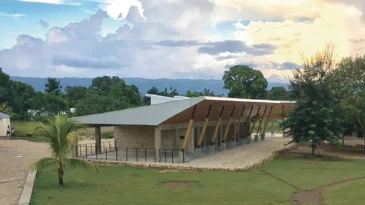
Presbyterian leaders are in conversation about the future of Ghost Ranch Education & Retreat Center in northern New Mexico – and are expected to consider a proposal soon to shift more responsibility for operating the facility and making it financially self-sustaining from the Presbyterian Mission Agency to the National Ghost Ranch Foundation.

Parties to the conversation met in New York on Sept. 1 and reached an agreement in principle they are expected to present at the Presbyterian Mission Agency board who will meet in Louisville Sept. 14-16.
Kathy Francis, director of communications for the Presbyterian Mission Agency (PMA), said she could not provide more details about the agreement struck at the New York meeting.
“Everyone has the best interests of Ghost Ranch at heart,” Francis said. “I know that we all want to ensure the success of Ghost Ranch. That was a common goal that we all share.”
The discussions about the future of Ghost Ranch come at a time when church entities are considering both the costs and the benefits of continuing to run such facilities.
Ghost Ranch is a 21,000-acre property donated to the church in the 1950s and is one of three national conference centers affiliated with the Presbyterian Church (U.S.A.), along with Stony Point Center in New York and Montreat Conference Center in North Carolina.
Ghost Ranch is a distinctive spot – a place of great natural beauty, offering visitors museums of anthropology and paleontology and programming ranging from horseback trail rides and hiking to spiritual retreats and workshops on art, music, writing and more.
Among the underlying questions: What’s the best way for the PMA to support the work of Ghost Ranch, particularly in a time of declining finances? Is it feasible for Ghost Ranch – which has consistently run deficits and receives financial support from the PC(USA) – to become fiscally self-sufficient?
What’s the best balance between independence and some sort of oversight?
And what ideas does the Ghost Ranch Foundation have for doing things in new and perhaps better ways?
The recommendation coming to the PMA board is the result of months of behind-the-scenes conversations between representatives of Ghost Ranch, the PMA and the Presbyterian Foundation – a conversation which the Ghost Ranch governing board initiated by presenting a proposal which would shift more responsibility for running Ghost Ranch from the PMA to the Ghost Ranch governing board.
The PMA board also will consider the most recent financial report for Ghost Ranch, giving budget details through June 30.
“There’s a very cooperative spirit of conversation,” said Mark Hostetter, who serves on the Ghost Ranch governing board. The idea is “let’s figure out what makes the most financial sense going forward to ensure this ministry continues.”
In “the new sort of world of the church where there is diminishing resources, it makes sense to rethink” whether running Ghost Ranch with supervision from the denominational offices in Louisville, Kentucky, makes sense, or results in a duplication of efforts, Hostetter said. The governing board’s basic idea: “Why not see if it make sense for them to operate Ghost Ranch directly, rather than have everything run through PMA.”
The conversation about the future of Ghost Ranch also is part of a broader set of discussions that have taken place in recent years regarding the future of denominational conference centers. That has included the contentious question of whether Stony Point Center outside New York City should be spun off into a separate corporation (the answer reached was no) and whether Stony Point should become financially self-sufficient (a three-year plan was put in place in 2014 to try to achieve that).
When it comes to Ghost Ranch, here are some of the institutional participants in the conversation about what comes next:
- The National Ghost Ranch Foundation, a nonprofit foundation established in 1972 to provide financial and other support to the conference center.
- The Ghost Ranch governing board, which – along with the PMA staff – helps supervise and manage the operations of Ghost Ranch.
- PMA, which is the PC(USA)’s mission agency and has direct responsibility for operating Ghost Ranch.
- The Presbyterian Foundation. While the Foundation is not responsible for operating Ghost Ranch, it technically is the legal owner of the property. That’s because in 1955, Arthur and Phoebe Pack gave the Ghost Ranch property to the Board of Christian Education of the United Presbyterian Church in the U.S.A. – in other words, to the former northern stream of the Presbyterian Church. With the reunion of the northern and southern branches of the church, the legal assets of the Board of Christian Education reverted to the Foundation in 1986, and the Board of Christian Education is now considered a constituent corporation of the Foundation.
“We’re just name-only in terms of title,” said Greg Rousos, the Foundation’s chief operating officer. PMA is responsible for operating Ghost Ranch, Rousos said, and “we do not hold any endowment funds that benefit Ghost Ranch.”
According to Hostetter, the members of the Ghost Ranch governing board have all been elected as to the board of directors of the Ghost Ranch Foundation as well – so “you have the same people, the same expertise,” which includes people with legal and financial expertise.
 Under the proposal, the day-to-day responsibility for running Ghost Ranch would shift – but other pieces of the arrangement would remain unchanged, Hostetter said. “The legal ownership remains where it is,” with the PC(USA). “The management team at Ghost Ranch remains where it is” – led by executive director Debra Hepler.
Hostetter said the Ghost Ranch governing board submitted a five-year business plan to start the discussions, and the conversations since then have included discussions of what kind of connections would remain in place between the national church and the conference center and what kind of fiscal and operational oversight is needed. The hope, Hostetter said, is that a new arrangement could bring greater efficiencies if some responsibilities are moved from the national to the local level.
Among the complexities:
Assets. Ghost Ranch potentially has some assets which could bring in income – including the Plaza Resolana property in Santa Fe, New Mexico, which it has attempted to sell or lease.
Another possibility involves water rights – a complicated issue in a part of the country where water is at a premium and where Ghost Ranch has been in conversation with the Water Authority in Albuquerque, New Mexico, about water storage in Abiquiu Lake.
Deficits. The PMA has kept track of accumulated deficits for Ghost Ranch – money PMA has provided to the conference center and that Ghost Ranch needed in order to keep operating. Before 2005, the national church provided about a quarter of Ghost Ranch’s annual operating budget – but as money became tighter, that funding was eliminated, Hostetter said.
Budget documents presented to the 2016 General Assembly list an operating loss for Ghost Ranch of $609,236 as of Dec. 31, 2015 and a receivables balance of $2.78 million for that same date.
There have been urgent capital needs as well – such as when a flash flood in 2015 caused more than $500,000 in damage at Ghost Ranch and destroyed some buildings.
In the mission budgets for 2017 and 2018, the Presbyterian Mission Agency is budgeting for an expected deficit for Ghost Ranch, Hostetter said. The proposal coming to the Presbyterian Mission Agency board will deal with the accumulated deficit, he said, adding that “Ghost Ranch is very close to being self-sufficient now.”