MONTREAT, N.C. – There’s a body in the room. A black body. Don’t ignore it.
When someone has died, lament is necessary.

Soong-Chan Rah is an associate professor of church growth and evangelism at North Park Theological Seminary in Chicago and the author of “Prophetic Lament: A Call for Justice in Troubled Times.” The litany of lament he pronounced at the DisGrace gathering at the Montreat Conference Center on Oct. 11 was devastating – an accounting of the American church turning its back on inclusion and justice.
Here are some of the verses.
Practice. While the practice of lament can be valuable and necessary, Christians don’t like it. Most of the hymns and contemporary music sung (about 80 percent and yes, folks have gone through and counted) are joyful and celebratory. The lectionary skimps on lamentation, and some congregations will substitute happier Psalms for those of lamentation.
“We end up with a church culture that does not know how to preach lament,” to speak of it, to sing it, Rah said.
“We don’t know what to do with lament,” yet churches and Christians need some disruption in the status quo, something which reminds them that things aren’t quite right. Holy Saturday is a sign that Christians are called to the in-between space, after the tragedy and before the triumph.
Don’t run or hide. Rah turned to the 27th chapter of Jeremiah, when God’s instruction to Jeremiah is to seek the peace of Babylon – the place where God’s people are living in exile. “This must have been so jarring to the exiles,” who are thinking “we can’t wait to get back to Jerusalem,” Rah said.

Jerusalem is the holy city, the city of David. Babylon is “the most wicked place on earth. It is the opposite of Jerusalem.”
Through Jeremiah, “God said you’re still not allowed to give up,” even when you’re in exactly the place you don’t want to be. “We never have the option of running away and hiding. We are to seek the peace of Babylon…We have not had a good record as American Christians of doing that…We’ve usually run away.”
Cities on a hill. The white colonial settlers arrived from Europe and “look at this expanse of country they believe is empty,” Rah said – ignoring six million people and thousands of civilizations already living there. The colonizers said “we want to conquer this land and make it the center of our faith.”
They saw the cities they built– New York, Boston, Philadelphia – as the New Jerusalem or Zion, the “city upon a hill” of which John Winthrop preached, Rah said. That vision held until the 19th century – when the patterns of immigration began to change. “It was no longer western and northern European immigrants,” but people coming from Asia, from the global South. As the cities began to change, so did the view white Protestants had of them. Rah cited a denominational journal from the 1800s warning that “our cities have become caves of rum and Romanism.”
Great Migration. Another change: following slavery and Reconstruction, with the flourishing of Jim Crow, blacks began moving from the South northward and westward. Rah called that a “massive, vibrant renewal,” as fired-up black Christians from the South, who had begun establishing their own churches after the Civil War, moved north and started churches – including the earliest megachurches – during a period of unprecedented evangelistic conversion.
With that, “who gets nervous?” Rah asked. Whites, of course. As blacks moved into the cities, whites responded with an exodus to the suburbs – the strategy of “we need to run and hide,” he said. Church building boomed in the 1950s and 1960s, with whites now seeing the suburbs and not the city as the New Jerusalem.
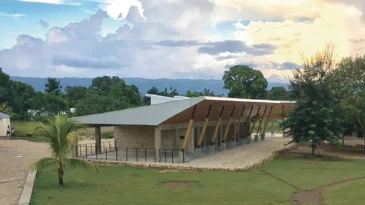
Suburban arks. Many of those white churches in the suburbs shared a common architecture with an arched roof and a rafter going down the center – which one pastor explained to Rah as looking sort of like Noah’s Ark turned upside down. That idea – Noah’s ark-itecture – became a metaphor for how many of those congregations viewed the world as well, Rah said.
The thinking was: “Let the world be destroyed. It’s evil out there. It’s broken out there.” But all is well, “as long as we are safe in Noah’s ark.”

Segregation. In many churches, that insular view and suspicion of difference led to isolation and segregation which persists today, Rah said. Meanwhile, the nation’s demography continues to shift – with changes in U.S. immigration policy ending the quota system in 1965 and opening the doors to immigrants from all over the world.
Now, the U.S. population is expected to become majority non-white by 2042. Despite political rhetoric, “the browning of America is not due to immigration,” but primarily to higher birth rates among people of color already living here, Rah said. That won’t change, “no matter how big a wall Donald Trump builds…It is not tied to immigration. It is tied to birth rates.”
People of color are changing American Christianity as well. He cited someone who complained about a Buddhist temple moving into a suburban neighborhood – but failed to notice the many Chinese and Korean churches, or the Catholic parish with Masses in Vietnamese.
“Maybe that’s an answer to our prayers for mission,” Rah said. When he was a child, people at his church prayed for the fall of the Communist bloc. That happened – and subsequently Rah studied with a seminary professor from Eastern Europe. Now “China has more Christians than the United States,” when those involved in house churches are counted, he said.
For the past decade or two, evangelicals have prayed intently for God’s word to reach Muslim nations, Rah said. “God might have answered that prayer by sending a massive number of immigrants and refugees from the Middle East” – refugees which some Americans now don’t want to let in the county. “God said here, I am bringing them right into our neighborhood. We are saying, ‘we don’t want that.’ ”
Yet the average public school is six times more diverse than the typical American church, he said – saying there are public elementary schools near him with students from dozens of countries. Many American churches, on the other hand, are “birds of a feather” congregations – with people from the same ethnicity and social class.
Rah said he learned from “Schoolhouse Rock” about the melting pot concept (he remembers being shocked “watching all these ethnics get thrown into a boiling pot of water”). Then there’s the salad bowl metaphor, he said, in which all the flavors get mixed together and doused in ranch dressing, so everything (even the kimchi) tastes the same.

The funeral. What’s needed, Rah insists, is real lament – a real accounting and acknowledging of the vast pain experienced by people of color. Too many Americans think of conversations about race like a hospital visit, needing a kind word and a quick prayer for healing, when in reality “we are at a funeral. There’s a dead body in this room,” he said, his voice growing vehement. “Stop ignoring the dead body.”
His lament turned to litany. “You can’t ignore the fact that that body is in all likelihood a black body,” and this “the funeral of a body that got here unjustly. The funeral of a black body that has been killed over and over and over again.”
Blacks were forced into the hulls of slave ships, loaded side by side “like putting bodies into tombs.” Some bodies were thrown overboard, so frequently that schools of sharks knew to follow the slave ships – their time would come.
On the eastern seaboard of the United States, the bodies of slaves were sold at market – and the bell announcing the impending sale would ring in rhythm with the church bells. Whites would come right from glorifying God to the auction block.
On the plantations, black women’s bodies were abused in a culture of rape and sexual abuse. “That’s why we can never, ever joke about this,” Rah said. “We can’t joke about this – the use of black women as sexual objects, the brutality.”
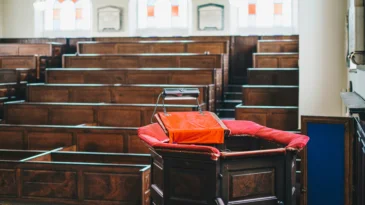
The sound of sobbing – keening – began to rise from one of the pews as Rah continued, someone crying in deep pain.
Strange fruit hanging from the lynching trees. Four little girls killed in a church bombing in Birmingham. Trayvon Martin.
“Body after body, and we can’t say ‘Let’s just get over it.’ Those bodies were in the room.”
A woman shouted: “That’s right.”
The keening continued.
“We cannot move on so quickly,” Rah said. “We have to enter into a deep, funeral dirge lament.”
Silenced voices. Lamentations is a book in the Bible that lifts up the voices of grieving women – but often in the church women’s voices are not heard, Rah said. He told of his mother, intensely faithful, who raised four children on her own after his father left, all of whom now work in ministry; who worked long hours in a service job six days a week and, on the seventh day, prepared food for the elders in her church; whose kneecaps now are cracked in five places because she spent so many hours kneeling in prayer.
“Nobody knows her story,” Rah said. “Her voice has been silenced” – by the immigrant church, by those who deny women power and standing in the church, by those who’d rather spend money to go listen to a 29-year old hipster male pastor at a conference than listen to the voices of women.
Churches can’t be silent either.
When someone has been killed, when someone is raped, when someone is sexually assaulted, when there’s violence in a community, churches can’t be silent, Rah said. Look for places where there is grief and pain. When there is a body suffering, “pastors, you can’t not talk about that.”
Lament.
At the end of the session, Jessica Vazquez Torres, one of the conference planners, invited the participants to sit in silence. She said to the whites in the room: I invite you to sit in your discomfort, and not to quickly seek absolution from people of color.