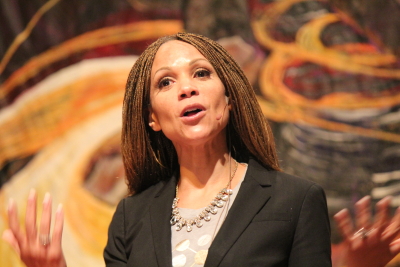
MONTREAT, N.C. – Melissa Harris-Perry gets straight to the point, and she’s not afraid to shift the frame. For example, liberals and progressives “think they have very large and expansive beloved communities” – to use Martin Luther King Jr.’s phrase – but the language some use in criticizing political opponents is the same language many were appalled by when it was applied to President Obama.
“I hope to make you extremely uncomfortable,” Harris-Perry told a crowd at the DisGrace conference at Montreat Conference Center the evening of Oct. 10. In all the conversation about safe spaces, I think your heart, body and soul should be safe, but “I don’t think your brain should be safe from anything.”
Harris-Perry – a writer and political commentator, editor-at-large at Elle.com, a professor of politics and international affairs at Wake Forest University and a former television show host on MSNBC—went on some great riffs (such as: why do whites ever think it’s acceptable to ask black women about their hair? Just Google “how long does it take?”). Harris-Perry walked around so much she threw the microphone system into revolt.
She encouraged her listeners to be curious; to not hate those with whom they disagree – to look instead for their humanity; to draw connections and expand their definitions; to look at the impending presidential election in new ways and to find some potential wholeness in political difference.
Here are some highlights.
Religion and differences. Harris, who described herself as a Christian Unitarian Universalist, spoke of her family as an “interracial Brady Bunch” – finding themselves, like many families, “in conversation across all kinds of differences.” What’s the possibility, she asked, that that could also happen on the national and international political scene? As many experience in their own families, there’s disagreement on ideas but “we might be able to find some wholeness.”
She spoke of following a God “who wants me to ask a lot of questions.”
She told of her father and his brother, the first in their family to go to college and who both became college professors. “They were born at the right time,” Harris-Perry said. She acknowledged the carnage of slavery and Jim Crow with: “It’s not as though they were the first in their family to be capable of college.”
Harris-Perry said she’s also humbled by the faith of her ancestors born into slavery, who only knew slavery, yet who could still envision a God of love, who kept their faith and imagined the possibility of a woman someday like herself. Fully and forever enslaved, they could imagine freedom.
We no longer know what it means to be sane. In the U.S., “the maddening has become utterly ordinary.” Harris-Perry said when she hosted a television show on MSNBC, she tried to avoid playing videos showing the deaths of black men on the streets. When Trayvon Martin died in 2012, “the photograph of his dead body was released by the Drudge Report and it was considered salacious… There was an actual outcry because it was presumed that Trayvon Martin had a right to privacy in his death.”
Flash forward. Harris-Perry said she had a policy not to allow what the news shows call “wallpaper” – rolling tape on a tragedy that’s not related to the specific story, but plays in the background.
“It has become standard practice to play those videos as wallpaper,” she said. “Black death as wallpaper. Think about what wallpaper is in your house. It’s that thing you stop seeing.”
Those kind of discrepancies pull at people, and “it is hard to know what is even crazy or sane,” Harris-Perry said. For example, “there is an enormous gap between African Americans and white Americans in confidence in police.” Blacks continue to be shot by police officers; whites express increasing confidence “that police are likely to police fairly.”
“When you see death and then you see empirical evidence and then you see your fellow citizens saying ‘I don’t see it,’ it makes you feel insane.” She spoke of a sense of schizophrenia, dualism, twoness, “the literal splitting of one’s humanness…two warring souls in one dark body. That grief, that anger, that inexplicable ‘how can you not see it?’ The only thing you can begin to imagine is that someone must be doing it on purpose.”
Blackness. “I want to complicate blackness for you just a little bit,” Harris-Perry said. All people have problems. But how does it feel like to “be a problem,” as W.E.B. Du Bois put it, and as blacks often are portrayed.
Blackness is about those whose bodies are seen as problematic to the state, Harris-Perry said. And she played with the idea of expanding the idea of blackness, to encompass all whose bodies pose a problem – including women, the disabled, LGBTQ, the undocumented. That produces “a broadening of blackness, a big huge absorption of all color,” ending up with “this thing that is so big and catholic with a little c. When I say Black Lives Matter, I mean a much larger idea of blackness,” including all the problematic bodies.
Lynching. She showed a photograph of a dual lynching in Marion, Indiana in 1930 – two deaths – and the assembled crowd. What grabbed her in that photo? “It’s not the American citizens hanging in the trees.” It’s not that no one is hooded – that they’re brazenly in the light, turned towards the camera. It’s the man and woman reaching their hands towards each other, like they’re on a date. They want to connect, to say “we were here together.”
The presidential election. Harris-Perry had a lot to say about that. As in: “So when I got a call on Friday and I was told I was supposed to be appalled because Donald Trump said he likes to grab them by the pussy, I said well, yup, that sounds about right.”
She connected the dots – about the devaluation of women’s bodies more broadly; about fat-shaming; abortion policy; criticism of black mothers; about a higher infant mortality rate for black babies that some scientists suspect is related to internalized trauma in the bodies of back women. “We hate women,” Harris-Perry said. “Especially fat women. Especially flat-chested ones. We grab them by the pussy all the time.”
Curiosity. She showed more photos – of the open casket of Emmett Till. Of the men acquitted of killing him by an all-white all-male jury, laughing with their spouses after the verdict came down.
“I’m going to ask you not to begin with hatred,” Harris-Perry instructed the Presbyterians. Begin “by just asking who the women are.” Be curious about their lives.
She told the story of one of the women in the photo: a complicated marriage, no money, a woman needing to work but longing to stay home with her children.
Harris-Perry studied under Maya Angelou, who taught her “never to say of other people they are monsters. This is a woman who was raped as a child…She said, ‘Anything a human can do, you can do.’ This is the greatness, and the horror.”
Be curious. Dig in. Ask questions.
After the presidential election. Harris-Perry isn’t as concerned as many Americans are which candidate will win. Failure is certain, she said – one candidate will win, and one will lose. On Nov. 9, the morning after the election, “we’ll all wake up together.”
She’s a believer in hope – inspired in part by her students, who’ve learned to trust one another despite their ideological differences. “We are the problem and we are the solution,” Harris-Perry said “We will not rest.”