Several years ago, half quixotically and half courageously, I temporarily left full-time ministry to pursue a Ph.D. in systematic theology. Like many Western Christians, I felt the cultural surroundings and benefits of Christendom were disappearing around me, and the definition and prospect of “the church” was a real question. So with questions in hand, I sought to engage Karl Barth’s ecclesiology and to use it as a model to more deeply understand, describe and participate in the present and future church. Many theologians and ecclesiologists do not think Barth has much to offer in terms of ecclesia. When I was first exploring this topic and my particular interest in Barth’s ecclesiology, I shared this interest with a prominent contemporary theologian, who shot back, “I did not realize Karl Barth had an ecclesiology.” Even if I did not appreciate the flippant response at the time, I certainly understood where it was coming from. And it is not just a Barth problem; it is a problem with Reformed ecclesiology that can be traced back to Calvin’s Reply to Sadoleto in 1539. And really the problem of Reformed ecclesiology goes even further back in time — to the 3rd century and Cyprian’s often misinterpreted declaration that extra ecclesia nulla salus (outside the church there is no salvation), leading one to think that the purpose of the church is mainly to mediate salvation and that our chief end in life is to achieve salvation.
 Strangely, Reformed ecclesiology has insisted on a robust ecclesiology, but one that refuses to make such claims. Alongside (or perhaps in opposition to) the strong Roman Catholic claims made for the church as the vehicle to salvation, modern evangelical Protestantism has made equally strong salvific claims about one’s religious experience or relationship with Jesus as salvific. While the centrality of Christ is to be commended, it makes one wonder if it is possible to have Jesus without the church entirely. One interesting aside to all this is that there are no references in Scripture or anywhere in Christian literature about a “personal relationship with Jesus” or Jesus as my “personal Savior” prior to the second Great Awakening in the mid to late 1800s.
Why bother with the church?
If the purpose of the church is not to enhance my prospects, mediate salvation to me, provide a consumer salvific transaction or otherwise guarantee the certainty of my salvation, then what’s the point and why bother to have it around at all or spend so much time and energy worrying about its vitality and practicing mutual love and forbearance with all its difficult inhabitants? Or perhaps, to 21st century-Americanize the question: If the Christian community cannot give me what I want, then what’s the point?
I completed my postgraduate study, defended my dissertation, and published it in book form with this question in mind. I had heard this question and asked it over and over again in the seminary classroom, in the Bible study, in the small group discussion, in ecumenical conversations. I thought maybe if I could delve into Barth’s theology and Reformed ecclesiology deeply enough, I could help solve this problem and help retrieve and construct an ecclesiology in my tradition to weather the storms of the age. But as so often happens when we open up Scripture and read it, what was found pursuing questions in the life of an academic community was that the questions we bring were answered with different questions, or perhaps we are asking the wrong questions in the first place.
What I found in Barth’s model of the church was not the certainty of ecclesiastical form, identity and unbroken continuity, but that the Christian community is a creature of the Word rather than an extension of the Incarnation. Even in the case of proclamation and sacraments, we pray for the Holy Spirit and trust that while God can speak through a burning bush, a still small voice, a pillar of cloud, as well as a dead dog or flute concerto, the primary way God elects to engage the world is through Jesus Christ and the church’s proclamation of his gospel. That said, the church must constantly be ready and willing to hear the gospel from the outside in ways that challenge, reform and call into question its own proclamation, because Jesus Christ does not subsist within the church or as a possession the church dispenses to the world. Rather, the church subsists in Jesus Christ. To paraphrase the old sacramental formula: The gospel or sacrament does not contain the grace it signifies; rather, we hope, pray and trust that the grace contains the gospel that the sacraments signify. Our hope, our prayer and our confidence is that, once again, the Holy Spirit comes and unites the divine grace in and with the gratitude of a disparate humanity. Not a given, but something that must always be prayed for, and something we believe a gracious and merciful God would never hold back either.
The first mark of the church: hilaritas
So what does a 21st century Reformed ecclesiology look like after Barth? Though Christendom seems to be vanishing in the West, though the traditional identity and form of the church cannot be assumed as a facet and function of the larger culture, attempts to anchor the church’s life to certain habits or a set of virtues and practices smacks of desperate attempts at ecclesial self-preservation. So the first mark of a Reformed ecclesiology is to eschew all attempts at ecclesial self-preservation with a comic refusal to despair. Dietrich Bonhoeffer referred to this element of Barth’s theology as hilaritas, a cheerful refusal to allow the tragedies and troubles of the world to have the ultimate word, and a quiet confidence that presses onward joyfully and faithfully in service of the Lord no matter the triumphs or tragedies of the moment. I know the people at the Barna Group and Pew Foundation who put together the statistics and demographic predictions must be howling to themselves when such sentiments are declared, especially after shaking their heads at Presbyterian denominational statistical reports for the last two generations, but the Reformed and Presbyterian faith insists that “Jesus is Lord” and that “Jesus reigns” and that God will use the church for Jesus’ sake as long as God has need of it.
There is no question that institutions have to change and re-form and downsize or right-size, but I think the most egregious sin of the modern era is to give in to the despair and to waste our valuable time wringing our hands over numbers, or even worse, to think we have got the special formula or that we will acquire the special formula in order to “fix the church,” and we end up gaining the world but losing our souls in the process. If we despair about the future of the church or think how we define success at a given moment is the same thing as the “in-breaking of the kingdom of God,” we need to recognize the nature of our problem. We’re grappling not with a demographic problem or a sociological problem or a numbers problem, but with a theological problem.
The second mark of the church: God’s shanty among ordinary people
One of Barth’s most simplest yet most provocative descriptions of the life of the Christian community came from an early lecture and essay where the church is described as “God’s shanty among men until the world’s end.” Not exactly the magisterial splendor at the cutting edge of society that we often imagine for ourselves, nor does it offer us the architectural sophistication that we can use as centerfolds for the church building campaign. The Word became flesh in a shanty on the outskirts of Bethlehem and also becomes flesh in our hearing in simplicity, creating a humble shanty in the world as the Word is proclaimed and the gospel is heard and lived out faithfully among quite flawed and ordinary people.
A second mark of the church is that it may often look like nothing more than a shanty and the people inside may look even less impressive, but a shanty church does not place its confidence in itself as a dispenser of salvation or as the high- profile institution with the best seats at the table or even as a prophetic community whose sole mission is to “speak truth to power.” Rather, the shanty church prays, proclaims the gospel to each other and to those outside our midst. The shanty church celebrates the sacraments and trusts that through this shanty of a witness the world will be engaged prophetically, evangelically and sacramentally, but also with the provisional understanding that Christ’s fulfillment and perfection are yet to come. That is why the church is full of hope.
The third mark of the church: Lightness
And that is why a third mark of the church is a certain lightness (as opposed to heaviness) to the church’s role and place in the world. Not only do we travel lightly, but we live together with faith and confidence that “the one who began a good work among (us) will bring it to completion by the day of Jesus Christ” (Philippians 1:6). Even in this time between Christ’s resurrection and return, the crucified and risen Christ lives and acts in the world beyond the confines of the church’s existence and witness. Yet always graciously, the crucified and risen Lord makes room for communities of Word and sacrament to live as appendages of his body in the world. So the church is at once completely gratuitous and unnecessary, and yet a miraculous creation and appendage of the risen Christ in the world.
Even in this time between the times, God could accomplish God’s purposes without the church, but chooses not to, choosing instead to incorporate the church in this mission for the sake of the world. If there is a distinctive Reformed ecclesiology, this is part of it, based on the Reformation conviction that the way to change the world is not through the cloister or clerical vows or distinction from the masses, but by forming communities of Word and sacrament where the butcher, baker and candlestick maker, alongside their pastors, share in life together in Christ and in Christ’s mission. In Luke’s Gospel, the crowds are pressing on Jesus and their desire is not salvation or religious enlightenment or even a personal experience with Jesus. Instead Luke tells us “the crowd was pressing on him to hear the word of God” (Luke 5:1). If that Reformation conviction and reason for the church no longer exists or is seen as outdated, then the long-term justification for a “protest”ant church seems to be shaky as well.
The fourth mark of the church: Waiting and working for the Kingdom
A fourth and final mark of Reformed ecclesiology is that it is eschatological. It would be nice to say with confidence “this is the only true church” or “I am completely certain of my salvation” or “this is the set of practices that makes a Christian” or “this church will stand in this place forever.” However, there will always be, no matter the substance of our certainty, no matter the rational clarity of our certainty, no matter the emotional fervor of our certainty, there will always be an unrealized aspect to our Reformed ecclesial identity. God is elusive and dynamic but not malleable. Even when the crucified and risen Christ proclaims himself in the church’s proclamation, when the Holy Spirit actualizes the gospel proclamation and the Word is proclaimed, heard and lived, the church is not complete and its mission is not fulfilled. We await Christ’s coming kingdom and the fulfillment of all creation to fully reflect the grace of our Lord Jesus Christ, the love of God and the communion of the Holy Spirit.
We don’t just wait for that kingdom, we work for it too, but we never confuse its fulfillment with the efforts and witness of the ecclesial community. A fitting illustration of what this Reformed eschatological mark looks like comes at the end of Barth’s own life, the very day he died. He was working on a lecture and was interrupted midsentence by a phone call from his lifelong friend and colleague, Eduard Thurneysen. In their phone conversation, the two friends lamented the turmoil of the world and the tragic occurrences of their time, but Barth ended the conversation by declaring (I paraphrase), “But no matter, Christ will come to reign.” Barth never went back to finish the lecture and was dead the next morning. Though his work was not complete, his ecclesiology and our own will only be complete and fully realized in the coming kingdom of Jesus Christ. In the meantime, even so, come Lord Jesus.
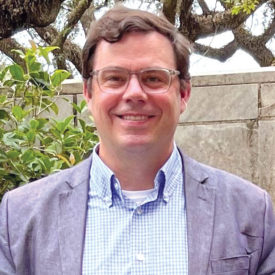
 CHRIS CURRIE is pastor at First Presbyterian Church in Shreveport, Louisiana.