Embracing new structures, welcoming the outsider, looking for Jesus. These are some of the things the church is being called to explore together.

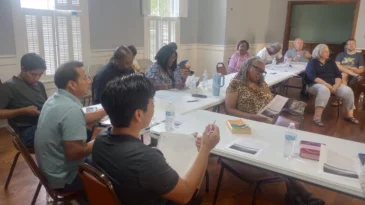
On March 4, Chicago Presbytery hosted an event called “Flourishing Together” that challenged church leaders to consider their call to hospitality and explore how God is calling the church anew in this age. Discussions of hospitality reminded participants that while churches often think of welcoming as the response to people coming to the church, it also involves going out to others.
Denise Anderson, co-moderator of the 222nd General Assembly and pastor of Unity Presbyterian Church in Temple Hills, Maryland, led worship, preaching on the story of Zacchaeus from Luke 19 – a story of Jesus going to Zacchaeus.

Often, Jesus finding Zacchaeus is the focal point of this story, but “Maybe he was just being nosy,” Anderson said, “Maybe Zacchaeus wasn’t looking to be found, but to find.” Anderson said Zacchaeus didn’t expect that Jesus would invite himself into his house, into his life.
That’s what’s amazing about grace: “It seeks us out and calls us in,” Anderson said.
We all want to see Jesus, she said, “what lengths are we willing to go to see him?” “What will keep us from climbing the tree?”
DIANA BUTLER BASS ASKS: TO WHAT STRUCTURE IS THE CHURCH CALLED?
Diana Butler Bass is a scholar and author specializing in religion and culture. Her most recent book, “Grounded: Finding God in the World” she described as “God who is with us here in nature and neighbor.”

Speaking with the Chicago Presbytery audience, Bass continued the discussion of how the church is called to relate with community and neighbor. The church needs an awareness of the way the world around it is changing, said Bass. She referenced the historically vertical nature of the church seen in the historical conception of a literal, geographic stacking of hell, earth and heaven, where God lives separated from creation above the world in a “three-tiered universe.” Likewise, she talked about vertical, hierarchical constructions of the world where the powerful and most holy are the highest. Bass pointed out that Scripture calls God’s people away from this structure. The whole story of the exodus, she said, is saving the people from a hierarchical structure seen in God giving new land where everyone would be a farmer – a vertical structure replaced with a horizontal structure. Likewise, Bass reminded, Adam and Eve didn’t build steeples or structures toward heaven; God was walking in the garden among them.

Bass said churches today don’t yet have the history or skill to embrace a fully horizontal structure, but that may be what Christians are being called to create. Referencing 2015 data from the Public Religion Research Institute, Bass noted a trend showing growth in in worshippers agers 18-29 who are black, Hispanic and Asian. “We have to learn from them – what they know about religious that crosses boundaries and is separate from imperialism,” she said. The older the worshippers, the more likely they are to be committed to the vertical structure, though Bass noted that these younger worshippers from various backgrounds are most likely to be comfortable with a horizontal structure or to embrace more flexible ways of being church – which might be the very thing the church needs in this new day.
Bass encouraged church leaders to become more self-aware. “Structure isn’t just external,” she said. Also: “Get a language” that speaks to those outside of the current structure. This is the challenge for all church leaders and a unique opportunity for the church, Bass said, so that “the future could perhaps come with less pain and more joy and more hope.”
“The worst thing we can do is give in to the flow,” she concluded, challenging, “Set new tables, live into the future.”
CO-MODERATOR Q&A

When asked what they were seeing and hearing during their travels around the church, Anderson and Jan Edmiston, co-moderator of the 222nd General Assembly and associate presbyter for Chicago Presbytery, both talked about hope in the midst of change. Anderson said, “God is calling us to public witness in some anxious times.” Edmiston added, “A lot of churches are having difficult conversations,” and noted that these conversations are leading to fruitful ministry.
One participant asked how Presbyterian churches are responding to the political climate. Anderson noted that Presbyterians need to remember their first allegiance is Christ, though they may be called upon to work together to continue working for justice, even in the midst of deep divide. “We have to love each other, even if we disagree,” Edmiston said, adding, “Scripture is an equal opportunity offender. … We are called to feed the poor and welcome the stranger. That has no political stripes.”