KANSAS CITY, Mo. (Outlook) – “If you want your denomination to die, remain 90 percent white.”
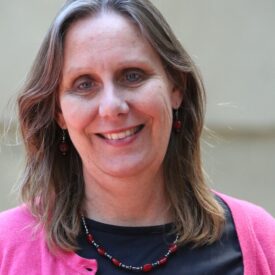
Soong-Chan Rah, a professor of church growth and evangelism at North Park Theological Seminary in Chicago and the author of “Many Colors: Cultural Intelligence for a Changing Church” (among other books), speaks of realities, including that “the constant reality is change.” On March 14, he told the NEXT Church national gathering in Kansas City that the church in the United States often isn’t prepared to deal with what change will bring.
For example: In the 1950s, the typical Christian was a white, upper-middle-class male from the suburbs of a U.S. city.
 Now, with the astounding growth of Christianity in the southern hemisphere, the typical Christian is a Nigerian peasant woman in Lagos; a teenager in Mexico; a student in Seoul, Korea, Rah said.
His implication: White churches can’t keep doing the same things when all around them the world is changing. The mindset that white modes of Christianity are normative or preferable isn’t true, and is damaging. And the demographic changes in Christianity bring opportunities – but will require confronting the hard truths of inequity and injustice as well.
Rah addressed some of the same themes, and the need for lament and to recognize the presence of a body in the room – “a black body that has been killed over and over and over again” – when he spoke at the DisGrace conference in October 2016 at the Montreat Conference Center.
Here’s some of what he said to the 550 people gathered at the NEXT Church conference, which runs through March 15 in Kansas City.
Doctrine of Discovery. For the past 500 years, the majority of Christians lived in the predominantly white nations of Europe – and that reality shaped a lot more than religion, Rah said.
“The idea of this blending and fusing of European and Christian culture going out into the world” had repercussions around the globe, he said.
Rah is working on a book with a colleague who is a Navajo Christian about the Doctrine of Discovery – papal bulls issued in the 15th century that advanced the idea that white, European Christians “are the real image-bearers of God.” The result of that “dysfunctional Christianity” was to send white explorers out into the world with the idea that “we can treat non-Europeans any way we want,” Rah said.
Africans were seen as chattel, property, future slaves. Europeans set sail to the “New World” – Rah spoke of “the irony of that language,” considering that millions already lived there. But the church essentially said, “You can go and take these lands,” he said. “You have the true image of God, and these people do not.”
Changing demographics. From roughly 1900 to 2050, the demographics of global Christianity will have flipped, Rah said. For example:
- In 1900, two thirds of the world’s Christians (68 percent) lived in Europe; by 2050, projections are that only 16 percent of the Christians will be European. The growth areas are in the southern hemisphere – in Africa, Asia and Latin America.
- In 1900, more than 8 of 10 Christians (83 percent) were considered white and 16 percent non-white. By 2050, the Christian population is projected to be 71 percent white and 29 percent non-white.
The Immigration Reform Act of 1965 also led to dramatic shifts in the U.S. population, Rah said. “It’s not that we threw open the doors and said anybody and everybody can come in,” but the legislation lifted previous restrictions (such as the Chinese Exclusion Act) written to keep out people from certain parts of the world.
The 1965 legislation addressed “a number of blatantly racist laws” then on the American books, Rah said.
The result of that legislation was a redistribution of immigration, he said. Over time, in part because of differences in birth rates, the U.S. population has shifted – and now is expected to become majority non-white by 2042.
“The browning of America, the diversity of America, is not due to immigration,” Rah said. “It is due to birth rates.”
Consequently, building a wall between the United States and Mexico in an effort to keep out illegal immigrants won’t change the reality of a diversified nation, Rah said. “Forget the wall. Let’s build a dome,” and get Canada to pay for it. “We’ll hermetically seal this nation, and you’ll still end up with a diverse nation. … You’ll still end up with a brown America.”
He added: “We are a diverse nation. Let’s learn to deal with it.”
Answered prayers. Christians have been praying for years to evangelize Communist countries and, more recently, the Muslim world, Rah said. Some estimates place the number of Christians in China now at 67 to 100 million or more.
And with refugees coming to the U.S., “God is once again answering or prayers,” Rah said, bringing Syrians and Iraqis here and saying “they’re going to be your neighbors. … That’s why it’s stunningly hypocritical for Christians to be at the forefront” of saying they don’t want Muslim refugees as neighbors. “That’s insane. That’s hypocritical. … We are failing to see that God is doing things.”
Accepting differences. Many white churches in the U.S. are experiencing declining membership, so the salvation of American Christianity might well come through immigrant churches, Rah said. But too often, “we will accept diversity as long as we can be kind of monocultural at the same time” – in other words, expecting those of different races or ethnicities to look like us and act like us, he said.
 In American culture, black males are treated as either the pet – the athlete, the entertainer – or the threat, he said. If a black athlete kneels during the playing of the national anthem, “that person becomes a threat,” Rah said.
And, according to the nightly news, the biggest threat is the “unidentified black male” – the phrase newscasters often use when saying the police are seeking a black suspect of undetermined age, size or description. “That’s why a 17-year-old kid in a hoodie with Skittles and iced tea in his pocket is a threat,” Rah said (referring to what Trayvon Martin was carrying when George Zimmerman shot him in Florida in 2012). “Even if he is unarmed, he is automatically a threat.”
And “we’ve done that not only to the black male but to the Arabic male and the Latino male,” Rah said. If that man gazes at a white female – or is accused of doing so – then “he’s killed, he’s lynched,” like Emmett Till.
It’s no accident that Donald Trump began a speech “with the characterization of Mexicans as rapists,” Rah said. “That was not an accident. … That was a racist comment.”
Acts 15. Rah challenged the church to act as the early church did as described in the 15th chapter of Acts, at a historic moment of demographic shift, from Christians being a subset of the Jewish population to becoming increasingly Gentile.
There was a willingness then to yield power to one another; to hear stories of how the Holy Spirit was moving in different contexts and communities, Rah said. But a survey from the Public Religion Research Institute found that for white Americans, 91 percent of the people in their core social networks were white. Many white Americans have never had a significant mentor from a different race or ethnicity, he said. Many don’t have close friends of color or non-white cultural influences.
That separation plays out in church life as well. Some say “we need to all get together” – but for people of color who have so often been told “we don’t want you here,” a church where most people look like they do can provide a much-needed safe place, Rah said.
When he pastored a multicultural church, his own mother preferred to worship in a Korean congregation – although sometimes she would come to the service where he was preaching and sit in the back and read her Korean Bible.
In church, “she needs a place where her identity is more affirmed,” Rah said. “Because she spent six days a week where her identity as an Asian woman, a Korean woman, was trampled on and diminished. Just a half a day a week, she was allowed not to be the woman who changed the bedpans” or worked in the food service line.
Rah was asked: How can churches build the skills of cultural engagement?
Look for what’s missing, was part of his reply. After the 2016 presidential election, Rah realized that “my idea of justice was fairly narrow” – focusing on the urban context, not the problems of those in rural areas who felt left behind by job growth that increasingly tilted towards those with advanced education and not those who had previously been able to support their families working at good-paying union jobs or in factories or in industry. Increasingly, those jobs had disappeared, “and that community is feeling left behind,” Rah said.
He had not noticed issues of rural economic injustice, “and I had to repent of that.”
Look for the larger narrative, Rah said.
Look for the places of change, where God is at work.