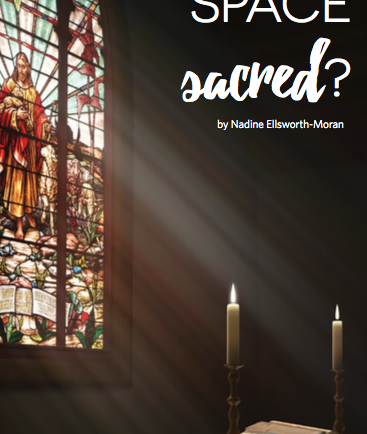
 I once lived on the edge of a small town in Europe. Near my apartment was a graying church whose heavy, wooden doors were always open. I never went there on a Sunday or during daily Mass, although I think they still held these services. Instead, I would slip in at odd times and see the black-shawled widows bent in the pews praying their rosaries. I would dip my fingers in the font, even though I’m not Catholic, because I liked the feel of the water slipping down my fingers as I held them up and signed the cross as I had seen others do. It was always a bit damp inside those old stones and more than once a pigeon flew up suddenly from somewhere in the chancel and was silhouetted against the blue – all blue – stained glass. The flap of wings against still air was the only soft musical sound I ever heard there. Then I would find a pew for myself behind the widows and pray silently and fervently to my God while blue-tinged light poured over us. To me, it is a sacred space, this church that is not Protestant, much less Presbyterian, progressively falling down, on a street I cannot remember in a foreign country. Trying to define the reasons why I say “sacred” and not just special or peaceful or any other number of adjectives to describe it is at the heart of the question: What is sacred space?
Surely the Lord is in this place!
In attempts to speak about sacred space, we often run into the twin dilemmas of definition and tangibility, or perhaps, lack thereof. What makes any space sacred, set apart, holy or “other” for us? Is it the structure? Does it have to be a structure? Or is it an intersection of the concrete and ineffable? There are certain points throughout the biblical canon that we look to and think of as sacred moments, and usually the places where those events occurred become imbued with the sense of sacred though the event is long past.
Moses on Mt. Sinai, Jacob at Bethel, the Jordan River, Golgotha and the empty tomb all come swiftly to mind — places associated most directly with the presence of God in some perceptible form like thunder, cloud, or fire — or actually incarnate in Jesus — that cause one to declare, as Jacob did: “Surely the Lord is in this place — and I did not know it! … How awesome is this place! This is none other than the house of God, and this is the gate of heaven” (Genesis 28:16-17). Those are fixed “God moments” in Scripture through which we receive a special revelation or teaching; however, we remain so far removed from these events ourselves that they are relegated to the category of sacred story, outside of our ability to traverse the page and enter into that space ourselves.
Architecturally sublime
Then there is the temple: the place where the ordinary believer could at least approach the holy of holies and be “God adjacent” while the priests entered the inner sanctum on their behalf. This seems our best entry point as well if we are attempting to identify created places as sacred space. According to “The Dictionary of Biblical Imagery,” the temple was “not only the place of sacrifice but also the art gallery, music plaza, and poetry library” for the people. Does the design and use of space then contribute directly to our interpretation of “sacred”?
Museums, for example, have carefully employed the use of light, confined or expansive spaces, sound, art and artifacts to create a particular experience for the patron. The manipulation of the aesthetic aspects of cultural or religious objects has the potential to elicit a response of reverence, peace, reflection, sorrow, empathy, and perhaps a sense of the sacred. If, that is, we believe that sacred space can be something created in the first place. Gretchen Bugglen, in her article “Museum Space and the Experience of the Sacred” published in Material Religion, writes, “In the “Experience of Place,” Tony Hiss wrote about a particular kind of visceral reaction that humans have to hushed, vast, open space, especially when it contrasts with the hustle and bustle of life on the outside. … It is an architectural sublime; we feel expanded at the same time we sense a relationship to something much bigger and more powerful than ourselves.”
We come across such spaces in a variety of contexts, whether or not it was designed with the sacred in mind, where the human being becomes small in comparison with the vaulted expanse of ceiling or sky and our minds turn to questions of mortality, truth, or the “otherness” of the divine. Such spaces tend to channel the imagination toward something akin to the psalmist reflection: When I look at your heavens, the work of your fingers, the moon and the stars that you have established; what are human beings that you are mindful of them, mortals that you care for them? (Psalm 8:3-4)
Sacred space unspecified
When I asked some congregants and friends from other denominations how they defined sacred space, the answers were (not surprisingly) varied. Several noted that sacred space held a special memory or had a personal or corporate history attached to it that was remembered each time they entered that space. Some cited spaces that encouraged a willingness to be awed or to find beauty and imagination at work in their midst. Others recalled spaces that allowed for openness to God’s presence — where one might even feel compelled to set a stone marker like the Hebrew tribes after crossing the Jordan and say, “God was here with us, right here at this spot.” Yet others equated a profound sense of safety, belonging or peace with sacred space, which might be at the bedside of a dying loved one as much as in any church. All of them are correct in their definitions because sacred space is not that on its own; it becomes sacred because of events that take place in it, where there is a tangible interaction between the divine and human. Therefore, sacred space defies unequivocal specificity.
 What does our space communicate?
What then is the role of physical space and are churches called to address this? The Book of Order speaks of created space for worship as locations arranged in such a way as to “invite and express God’s presence” while recognizing that God cannot “be confined to any one place.” Churches are now faced with competing ideas of “worship space,” and spaces that are serving as sanctuaries may look and feel like anything but the traditional church in its architecture or interior design. With some congregations meeting in alternate, secular venues such as coffee houses, movie theaters or warehouse-style buildings with little to no ecclesial reference points, are we undermining congregants’ ability to attend to the sacred?
Allan Effa noted, “Humans are context-sensitive communicators; the aesthetics and symbols that surround us convey an important part of a given message.” It then becomes incumbent on churches and church leaders to think carefully about what their space is actually communicating and whether the structure and design of their space is helping or hindering understanding of the theological perspective of the denomination as well as creating room for reflection on what is not seen. Churches do this by providing visual cues or other auditory or kinesthetic stimuli that direct the focus away from secular concerns to consider more deeply the work, relationship and presence of God in our lives and in our world, as well as in the immediate space. A physical space can facilitate our encounter or awareness by encouraging us to be drawn outside ourselves, focused on the holy and open to God’s presence with us.
We are called to remind our congregations that God is always in our midst; in fact, God precedes us into every space and time. Therefore, the space where we worship and celebrate the sacraments should serve as a reminder of this and convey at least the possibility of encountering the real presence of God. Even so, there is still the uncontainable, uncontrollable, unmanufactured factor that belongs to God alone. Only when and where our lives intersect with our living God does space become sacred, with God nearer than we hoped, perhaps even nearer than we feared.
Meeting the sacred
Can we create sacred space? Not really. Because the part that makes it truly sacred is not anything we can manufacture. The sacred meets us there and abides with us in that space in a way we often cannot hold onto once we leave, but may find again and again when we return. Does that mean that God is contained somehow? Not at all, but in those spaces, which are not the same for everyone, we are opened to receive the presence of the holy.
So, if I were to conjecture about why that broken down church in Europe is sacred space to me, I might say it was the watery blue stained glass light flowing over stone, or the pulse of the silent prayers, or maybe the click of rosary beads; whatever it was, it stopped me long enough to want to know who created that light, that pulse, that sound, and why. And when we want, desire, yearn for that knowledge, to know and to be known by our God, then we may find ourselves in sacred space, where we recognize there is the thinnest of veils between our worlds and God is palpably present. So much so, that we sometimes catch our breath lest we tear the veil by our mere exhalation. These are the places where our prayers push through and are taken up so quickly that we almost feel them being extracted from our bodies from hidden places that we didn’t even realize were crying out to God within us. Then we know, surely God is in this place, this sacred space.
 NADINE ELLSWORTH-MORAN is the pastor of St. Andrews Presbyterian Church in Charlotte, North Carolina, and also works on staff at Union Presbyterian Seminary’s Charlotte campus.