KANSAS CITY (Outlook) – “The wall of otherness.”
“The wall of separation.”
The walls of the comfortable, air-conditioned rooms where those with power and privilege make decisions for others.

Alonzo Johnson, coordinator of the Presbyterian Church (U.S.A.)’s Self Development of People program, preached during opening worship at the NEXT Church 2017 national gathering about those on the outside.
The mentally ill. The drug addicted. People of color. Immigrants. Those going into or coming out of prison. People without food or a decent place to leave. “Invisible people.” The Samaritan woman.
And he preached about hope, and a message of redemption from the God “who sees value and possibility in all of us.”
Johnson spoke of Jesus of Nazareth, Jesus of Detroit, Jesus of Mosul, Jesus of Baltimore.
“Own the way we hurt one another,” he said.
He urged those attending to go forth – to visit prisons, stop sex trafficking, to advocate for justice. “People of faith, the power is in your hands”

About 550 have come to this NEXT Church national conference – including about 220 attending for the first time, said Jessica Tate, NEXT’s executive director. With many conservatives having left the PC(USA) after the denomination decided it would permit the ordination of gays and lesbians who are sexually active and allow its ministers to perform same-gender marriages, lobbying around those perennial issues has faded away – and NEXT has emerged as a locus in the PC(USA) for conversation about what a faithful, progressive, innovative church can and should be.
The theme for the 2017 national gathering, which is being held at a hotel in downtown Kansas City March 13-15, is “Wells & Walls: Well-Being in a Thirsty World,” with the preachers in worship working from the fourth chapter of John’s Gospel, the story of Jesus encountering the Samaritan woman at the well.
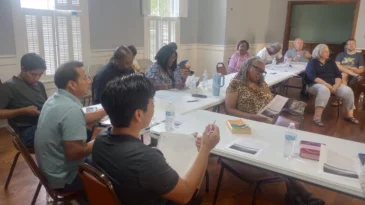
During some pre-assembly workshops, participants began to dig in to the questions of why they’d come and what their hopes are for their denomination.

Denise Anderson and Jan Edmiston, co-moderators of the 2016 General Assembly, convened a session to gather feedback for the Way Forward Commission, which met March 6-7 at Columbia Theological Seminary and approved a new “Affirmation of Approach” for its work. The work is daunting, said Sara Dingman, a mid council executive from Indianapolis and one of the 12 Way Forward members. “It’s daunting but it’s also exciting,” said Eliana Maxim, a mid council executive from Seattle, who also serves on the commission.
Within the PC(USA), “it’s a really anxious time,” Edmiston said. “It’s a tender time,” with many who work for Presbyterian churches and entities worried about losing their jobs. Despite that, Edmiston said she’s inspired by “acts of faith, and not hand-wringing.”
She asked those in the room “what makes you excited about the way forward? What makes you happy?”
Several in the room said Presbyterians can’t afford to wait until the Way Forward Commission, the 2020 Vision Team and the All Agency Review Committee finish their work or make reports to the General Assembly in 2018.
In the PC(USA), “we move at a glacial pace,” said Timothy Black, co-pastor of Central Presbyterian Church in Downington, Pennsylvania. “I would encourage the Way Forward Commission to not be so careful, to truly be bold” – in some ways, to take heart from the innovation evidenced by some new worshipping communities and local congregations trying to connect with the communities around them in new ways.

Too often, denominational committees and task forces meet and when they’re done, “very little has changed,” said Marianne Rhebergen, transitional leader at the Presbytery of the Palisades.
“I believe we have to not wait for the commissions and committees to report to the General Assembly a year and a half from now, but to work within our presbyteries to empower experiments,” Rhebergen said. If there’s a message for the church, it’s “don’t wait. Start experimenting. We’ll learn from failure.”
Some in the room said they’re taking inspiration from community organizing; from those serving outside the church, in nonprofits and specialized ministries; from lessons learned in improvisational theatre.
Don Meeks, who is pastor of Greenwich Presbyterian church in Nokesville, Virginia, and who described himself as an evangelical, said he’d recently attended the national gathering of The Fellowship Community.

“What is the way forward for evangelicals in the denomination?” he asked. Meeks said he sees “a deep grieving of the evangelical community” for those who’ve stayed in the PC(USA), and “for some evangelicals, the only way forward is out.” He said he draws energy from coming to NEXT – and wants new ways of finding common ground between evangelicals and progressives.
In another session, with first-time attendees at the NEXT conference, the question was asked about whether NEXT basically represents progressives in the PC(USA).
John Wilkinson, pastor of Third Presbyterian Church in Rochester, New York, responded: “I think we’ve chosen to be congregation and ministry focused and less about theological stripes.” He noted that NEXT participants may lean left, but that is not intentional of the organization and that the leadership team has been in continued conversation withThe Fellowship Community.
Lori Raible, co-pastor at Selwyn Avenue Presbyterian Church in Charlotte, North Carolina, said NEXT is “open for anyone and everyone who believes God is not done with the church” and stressed two goals: equipping leaders for work in ministry and strengthening the church’s relational fabric.
Shannon Kershner, pastor of Fourth Presbyterian Church in Chicago, talked to the first-time attendees about NEXT’s newest goals: providing resources for new pastors (including initiating the Trent Conference at Montreat Conference Center in North Carolina, which provides practical resources and support for pastors in the first years of ministry), and identifying “what we believe and why.”
Kershner said NEXT is “not an advocacy organization within the denomination.”
Another challenge NEXT is tackling: “It’s difficult to know how to measure effective ministry,” Kershner said. Now, there is a metrics team that is looking for new tools to start talking about when ministry “is healthy and effective and headed in the right direction,” said Kershner.
Don’t be surprised if you hear something you disagree with, Kershner warned, “we have purposely invited speakers that are provocative and evocative. … It’s OK if we’re uncomfortable sometimes.”
When asked why he chose to attend this year’s gathering, Brian Emery, a ruling elder and clerk of session at Rose City Park Presbyterian Church in Portland, Oregon, answered, “It’s an opportunity to attend some workshops and see some other exciting ideas that are going on outside of our church.”