 SAN JUAN, Puerto Rico – What can Presbyterians learn from changes in the culture and from trends in church and religion? And what are the distinctions, and the connections, between faithfulness and sustainability?
Meeting jointly on the morning of March 22, the Committee on the Office of the General Assembly (COGA) and the Presbyterian Mission Agency Board (PMAB) spent time – mostly in small groups – talking about those questions, and the way forward. Not as in the Way Forward Commission, which is considering possible structural changes in the Presbyterian Church (U.S.A.).
But what’s the way forward for the church in a changing world?
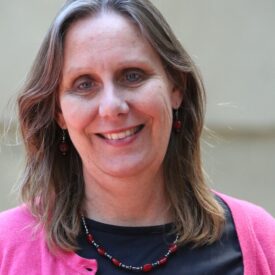
Eliana Maxim, a mid-council executive from Seattle who serves on the Way Forward Commission and was one of the leaders of the discussion, spoke of some cultural shifts including constant connectivity, a suspicion of authority, an emphasis on grass-roots leadership and collective wisdom.
Jo Stewart, a ruling elder from Charlotte, North Carolina, who also serves on the commission, spoke of changes in the world of religion including growing religious pluralism and in the numbers of American adults who claim no religious affiliation.
Chip Hardwick, director of the Presbyterian Mission Agency’s Theology, Formation, and Evangelism ministry area, presented this question: What’s the difference between faithfulness and sustainability? What are the markers of those? How do they relate?
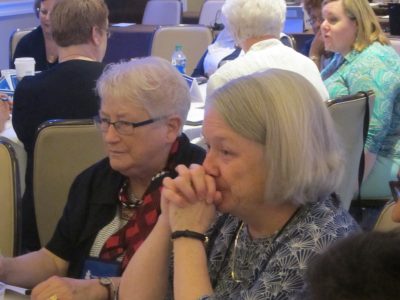
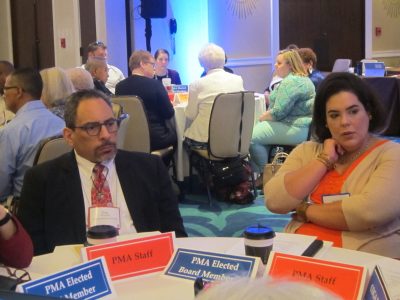 After a time of “community conversation” in small groups on those questions – which included members of both COGA and the PMAB, as well as staff from the Presbyterian Mission Agency and the Office of the General Assembly – some folks reported back bits and pieces of their discussions.
There was discussion of “the need for the church to live into contradictions,” such as people who are both suspicious of authority and have the desire to be connected, said Marci Glass, a pastor from Boise, Idaho, who serves on PMAB. They also spoke of how endings can bring beginnings – how when a tree dies in the forest, “it becomes a nursery for new life.”
Warren Lasane Jr., a PMAB member and stated clerk of the Synod of the Mid-Atlantic, spoke of the importance of the practice of faithfulness. With that, “money does not then drive mission,” Lasane said. “Budget does not then drive what we don’t do.”
 Denise Anderson, co-moderator of the 2016 General Assembly, said the story of church decline is too much the story of the white church, and doesn’t represent, for example, the growth of immigrant fellowships or Hispanic congregations. Why don’t we celebrate, she asked, “where God is working in communities of color?”
Presbyterians also could benefit from being in conversation with Christians around the world, said PMAB member Nancy Ramsay, a professor at Brite Divinity School in Fort Worth, Texas. “There are a whole lot of ways of being faithful in the world,” she said. “The church is booming” in other places.
J. Herbert Nelson, the PC(USA)’s stated clerk, said he formerly served a congregation in Tennessee that was always on the brink of not making it financially – but that was vital to the community and still survives. “There’s nothing in the Holy Writ that talks about a balance sheet,” Nelson said. “It talks about a man named Jesus.”
Earlier in that joint plenary session, the co-moderators of the 2016 General Assembly also gave a report – describing their travels, their upcoming commitments and some of what they’ve experienced recently that has stuck.
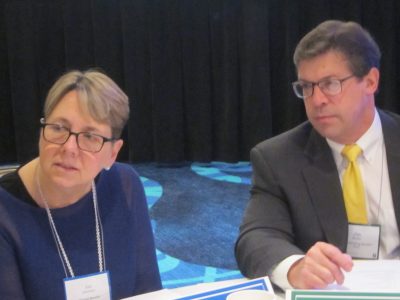 Jan Edmiston said she keeps thinking about a service of lament that Salem Presbytery held in February in Burlington, North Carolina, to remember the victims of lynchings – a service “I continue to think about every single day.” As Presbyterians try to educate themselves about racism, the legacy of lynching and the breadth of that practice is “something we cannot forget,” Edmiston said. “There are lynching trees that intentionally have not been chopped down,” to keep them as living reminders. “It’s important that we continue to remember our historic part in that.”
Anderson said she keeps returning to what she experienced during her trip to Thailand in late 2016. She went to Thailand as part of a delegation learning about issues of human trafficking, “issues of immigration and migration and labor exploitation,” of child sex exploitation, “and how there are so many parallels between what’s happening in Thailand and what’s happening in the U.S.”
In the District of Columbia, about a dozen black and brown teenage girls are missing, and “we have very good reason to believe that trafficking may be at the heart of that,” Anderson said. “Friends, we have a lot of work to do in our contexts. We’re dealing with these issues right here, right now.”
COGA and PMAB will have a joint worship service at Iglesia Presbiteriana de Puerto Nuevo the evening of March 22, but otherwise will follow separate agendas for the rest of their time in San Juan. The COGA meeting continues through March 23. PMAB will conclude its meeting March 24.