ATLANTA (Outlook) – In its second face-to-face meeting, the Way Forward Commission concentrated both on details – how to organize its work and what steps to take next – and also some big picture questions. How, for example, does the structure of the Presbyterian Church (U.S.A.) relate to some of the most heartfelt questions at the grass roots – such as how to support immigrant churches or small congregations that are struggling financially and with leadership?
How can the PC(USA) be responsive to the needs of a constantly changing world?

How does the denomination deal with the enduring problems of racism and economic inequality, and with the fallout of new policies initiated by President Donald Trump involving refugees and deportation of immigrants? Eileen Linder, a teaching elder from New Jersey, asked: How can the church be limber enough to respond to a fast-changing political environment? “The present climate has sent shock waves through most of our immigrant churches,” Lindner said.
“We are called on to be the church of the mid-21st century,” but are operating with a structure developed in the 20th century, said Eliana Maxim, a teaching elder and presbytery executive from Seattle. “Something’s not working, because we’re not meeting the needs of the church we have become.”
Those kinds of questions provide a sense of urgency and grounding to the detailed, process-oriented matters that are central to the commission’s work as it determines what recommendations it will make to the 2018 General Assembly – or decides to take action on its own. So some of the conversation at the commission’s meeting March 6 at Columbia Theological Seminary in Decatur, Georgia, involved the challenges of both the details (organizing the work, setting a timeline, gathering information) and keeping a sense of the bigger picture of what lies ahead for the PC(USA).
Here’s more of what happened on the first day of the commission’s March meeting.

Updates
Commission members heard updates about some of what’s happened since their last meeting. For example, Mark Hostetter, a teaching elder from New York and the commission’s moderator, said he attended a gathering Feb. 9 in Philadelphia of the “chiefs and chairs” of the PC(USA)’s six agencies. Hostetter described that as “a very exciting conversation” with a shared sense of determination to “get ahead of the curve” regarding the future needs of the church.
The All Agency Review Committee, at its meeting in Louisville Feb. 21-23, set up a subgroup to try to work through issues of ambiguity about the role of that committee and the responsibilities of two other groups also at work considering questions of the structure and future of the denomination – the Way Forward Commission and the 2020 Vision Team.
The commission decided to set up a coordination committee of four people: Hostetter, Maxim, Lindner and Sam Bonner, a ruling elder and bank examiner from New Jersey.

Bonner also reported back from conversations held with four of the PC(USA)’s agencies – and with some ideas for “low-hanging fruit” or changes that might be implemented fairly readily. Some examples: more discussion of consolidating Congregational Ministries Publishing into the Presbyterian Publishing Corporation, and involving the Presbyterian Foundation more extensively in working with churches and presbyteries in selling excess property from congregations that have closed and using those proceeds for Presbyterian ministry.
In a number of areas, “the agencies can do a better job of communicating” with mid councils about the services they offer, Bonner said.
The intent of these ongoing conversations is to develop an “emerging consensus,” Hostetter said, rather than having the commission issue directives.
Hostetter said the commission also is discussing a proposal from the Governance Task Force of the Presbyterian Mission Agency Board to reduce the size of the board by more than half – and has heard concern raised by advocacy and advisory committees that the proposed change might dilute their representation and voice.

The board is initiating conversations with those committees around that issue, said commission member Jo Stewart, a ruling elder from Charlotte. And the issue of diversity of voices within the denomination and how they are heard (or not) is an issue the commission is exploring as well.
Closed sessions
The commission held two closed sessions, each for about an hour.
The first was by phone with two former PC(USA) stated clerks: Clifton Kirkpatrick (1996 to 2008) and Gradye Parsons (2008 to 2016). Later, the commission met in closed session to discuss shared or common services in the PC(USA) – such as legal services, accounting, communications, human resources and more.
Hostetter cited exceptions in the denomination’s Open Meetings policy that allow meetings to be closed in order to discuss matters involving litigation, personnel and property issues.
Survey
Bonner presented the results from an online survey the commission conducted, which ended Feb. 28 and gathered comments from 191 people. “We had many people say ‘be bold,’” Bonner said, adding the survey drew a strong response from representatives of advocacy and advisory committees and from mid council leaders.
Some raised questions about the PC(USA)’s public stances – with some contending the denomination is not progressive enough and others saying it’s too liberal, he said.
And a significant number asked for the PC(USA) to support small congregations trying to figure out what their future holds in ministry.

Work ahead
The commission reviewed its mandate from the 2016 General Assembly – trying to be careful to address all the tasks the assembly gave it. If that doesn’t happen, “when we get to the assembly people will cherry-pick pieces of this,” warned Tom Hay, chief of operations for the Office of the General Assembly.
Commission members discussed what work they need to do before their next conference call April 18 and in-person meeting in Chicago May 15-17.
Commission members agreed to set up three new subgroups:
- Evaluation: Commission members want to work with representatives from the All Agency Review Committee to:
- Look at how four PC(USA) agencies (the Presbyterian Publishing Corporation, Presbyterian Investment and Loan Program, the Presbyterian Foundation and the Board of Pensions) have responded to and implemented recommendations from their agency reviews;
- Look at progress in implementing recommendations from the Presbyterian Mission Agency Review Committee, including questions of values, identity and culture in the agency.
Another question that may be up for discussion at some point – although not necessarily by this group – is about whether consideration of a possible consolidation of the Presbyterian Mission Agency and the Office of the General Assembly should be pursued or dropped.
- Structural: This group will look at:
- What can be learned from how other denominations and nonprofit groups operate?
- Should the commission consider using consultants in its work?
- What historical pieces should be considered – including information on how the PC(USA)’s corporate entity is currently structured and how that’s been done in the past.
- Shared and common services: The commission wants to explore questions related to shared or common services in the PC(USA) structure – functions such as accounting, communications, legal series and human resources. Lindner proposed four questions to consider:
- What’s included in shared or common services?
-
- How is it administered?
- How is the cost allocated to the users?
- How do the users participate in the provision of services?
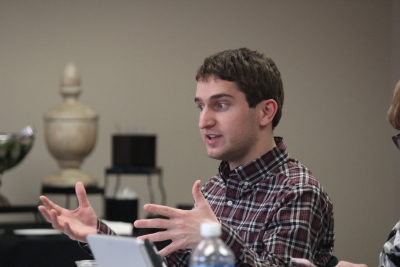
These are complicated questions. Maxim, who lead the Presbyterian Mission Agency Review Committee, said she wants to know not only how shared services would work, but answers to the more holistic question of “how should it work?”
On this and other questions, commission members periodically voiced concerns about getting “lost in the woods” rather than discerning the big picture. Maxim said the review committee, for example, spent an “inordinate amount” of time discussing shared services, and “I walked away just as confused as when I started.”
The commission will continue its discussions March 7, with their meeting concluding by noon.