
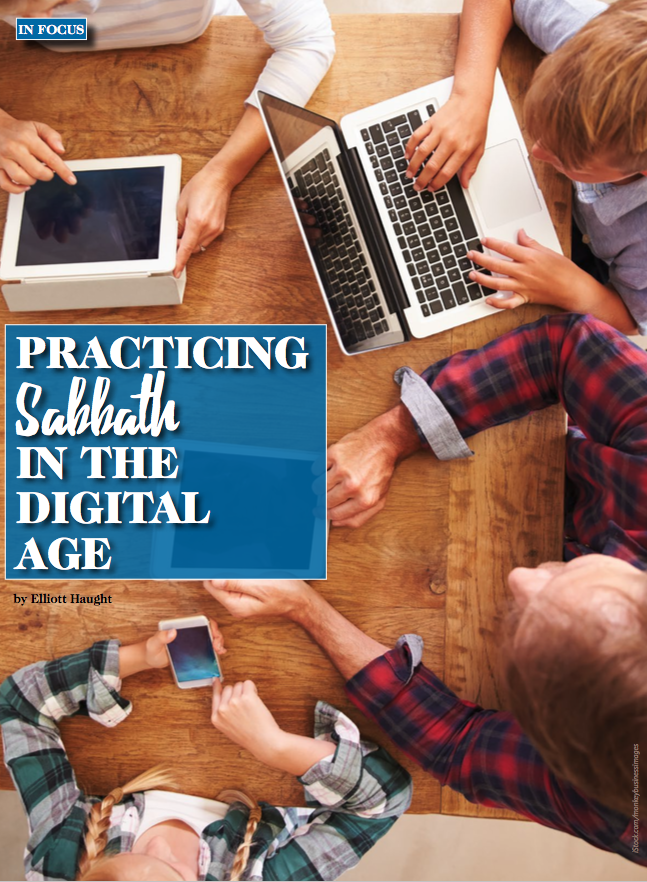
 In her fantastic new book, “Liturgy of the Ordinary,” Tish Harrison Warren describes an all-too-common dynamic of life in the digital age: “My typical morning routine was that shortly after waking, I’d grab my smartphone. Like digital caffeine, it would prod my foggy brain into coherence and activity.”
She continues, “Technology began to fill every empty moment in the day. Just before breakfast, I’d quickly scroll through email, Facebook, Twitter, a blog … I’d return from an errand and sit in the driveway with the car running, scrolling through news on my phone. … Throughout the day I fed on a near-constant stream of news, entertainment, stimulation, likes and retweets.”
Whether this describes your life perfectly, slightly or not at all, the reality is that this information-driven, device-centric and technology-obsessed life of ours is the form of life in which we in the West “live and move and have our being” (Acts 17:28).
I see this form of life everywhere: where my family and I live (in the San Francisco Bay Area — the epicenter of it all), in my work (with college students — who, it seems, are never not on their phones) and in my own life (constantly needing to reply to emails and text messages throughout the day — while also simultaneously reading books to our daughters, cleaning up their messes, doing the dishes, folding laundry and making plans with my wife for dinner that night). Our devices have become so central to our lives that it’s nearly impossible to imagine surviving without them. My guess is that you sense this, too.
In the face of this, there’s sometimes a temptation to cut and run, right? It feels like it would just be easier to pack up and move to a cabin in the woods in Montana in order to escape all of the noise and distraction that our devices bring into our lives. But is that a distinctly Christian response? I’d argue that it isn’t. Instead, I think we need to learn to first, ask the right questions, and second, learn to live into a different way.
Modern technology: Beyond good vs. bad
I’ve been thinking about this stuff for years now. It all started in 2010 when I noticed that everyone I knew was gradually building all of their lives around modern technology — getting smartphones, joining Facebook and Twitter, etc. — but nobody seemed to be asking if modern technology was something that we should be building our lives around. A new phone? I’ll get it! A new social media platform? I’ll start an account! This lack of reflection made me nervous.
So, I started looking around for books or other resources to help me learn more about this new world of modern technology that we seemed to be entering. Enter “The Shallows: What the Internet is Doing to Our Brains” by Nicholas Carr. This was the book that introduced me to the conversation, and I devoured it. I learned a lot of things from this book, but probably the most valuable one was Carr’s willingness to sidestep the debate between technology enthusiasts (e.g., Silicon Valley) and technology skeptics (e.g., Luddites) about whether or not the content of technology is essentially good or bad. Instead, Carr taught me that “in the long run a medium’s content matters less than the medium itself in influencing how we think and act” — and that’s where reflection on modern technology should start.
At the same time, I began to discover a few theologians who were engaging the topic of modern technology. One was Brian Brock, who writes in his masterful “Christian Ethics in a Technological Age” that what is needed today is “an extended inquiry into if and when the church of Jesus Christ might wish to share the world’s faith in the promise of technology, or if and when its own proper faithfulness might set it in opposition to the faith and order of its age.” Beautiful, right?
The other theologian I found was Verity Jones, who, in a little essay for Faith & Leadership, called for deeper theological engagement with the Christian life in the digital age: “Surprisingly, few writers and scholars are pressing theologically — beyond some critics’ legitimate concerns about distraction, alienation and addiction — into the new media world. This absence of theological work may suggest that the church has not yet recognized how significantly the sand is shifting under its feet.” She concluded her essay by suggesting that if the “Christian life is to be lived abundantly, we must take seriously the new realities of living in a digitally networked world.” I couldn’t have agreed more.
If I devoured Carr, then I feasted on Brock and Jones. Together, these three voices helped me formulate a new question: To what extent is the formation that we are undergoing as citizens of the digital age consistent or inconsistent with the formation that we should be undergoing as Christians? It was this question, among other things, that drove me to divinity school, where I wrote a master’s thesis on the subject: “Devices and Discipleship: On Living Faithfully in the Digital Age.” Devoting a semester’s worth of time and energy to researching and writing my thesis under the wise counsel of an excellent professor was nothing short of exhilarating.
 What is going on?
Let’s return to the “right questions” that I mentioned. The first question that we need to learn to ask is: “What is going on?” There’s a lot that could be said about the nature of life in the digital age, but I believe that any good analysis needs to include the fact that the devices of modern technology expose a desire in all of us to remove the limits to our lives — that is, to erase the perceived limitations, boundaries and encumbrances of our humanness, specifically our embodiment. In his book “On the Internet,” Hubert Dreyfus captures this desire well, asking, “Who wouldn’t wish to become a disembodied being who could be anywhere in the universe and make backup copies of himself to avoid injury and death?”
We see this in our constant attempt to use our devices to simultaneously communicate with multiple people in multiple locations. But I really want to answer a work email, post on Facebook, and scroll through Twitter — all while talking with my wife! I’m all things to all people — all the time! We see this in the invention of Soylent. Do I really need to cook and eat three times each day? What a waste of time! We see this in Google’s attempt to treat death as a disease — as opposed to a fact of life. With enough data, I’m sure we can figure that one out! (Don’t believe me on this one? Check out the September 30, 2013 issue of TIME.)
From this perspective, one’s body becomes increasingly peripheral — if not threatening — to living “the good life” here in the digital age. In “From Human to Posthuman: Christian Theology and Technology in a Postmodern World,” Brent Waters insightfully notes, “Embodied personhood is no longer a defining boundary, but an unfortunate limitation on the scope and quality of subjectivity; a limitation which should be overcome, not honored.” Such an unease with the perceived limits of our embodiment, then, can lead to a deep-seated faith in the many devices of modern technology — devices that we believe can save us from the bodies to which we have been so unfortunately confined.
Who are we?
This leads us to our second question. We also need to learn to ask: “Who are we?” I’ll go ahead and spoil the surprise here: The view of the human person that emerges from the desire previously described is deeply at odds with the view of the human person that we see in both Scripture and the Christian tradition. I’d like to suggest that central to a distinctly Christian understanding of the human person is our creatureliness, and central to our creatureliness is an embrace of our limits as finite beings.
 Dietrich Bonhoeffer’s pithy, yet profound “Creation and Fall: A Theological Exposition of Genesis 1-3” reminds us of this reality. To summarize his argument far too quickly: Through the creation and fall of Adam and Eve, we see that humans must learn to see themselves as creatures — that is, creatures for whom embodiment and limitedness are profoundly central to their identity. Because of this, when humans reject their embodiment or the limits inherent in their being creatures, their creatureliness is lost, abolished and no longer recognizable. As Bonhoeffer puts it, “Human beings have lost their creaturely nature; this has been corrupted by their being sicut deus [like God].”
For Bonhoeffer, the Christian understanding of the person is inherently a positive one. Thus, where the digital age sees embodiment as both peripheral and a threat to the identity of the human person, Christians see embodiment as central to that identity. Where the digital age seeks a “flight” from the perceived limitations, boundaries and encumbrances of human embodiment through various technological means, Christians affirm those limitations as constitutive of creatureliness. Where the digital age sees human persons as creators of themselves and their identity, Christians see human persons as creatures who receive their existence and their identity from God, their Creator.
This brings us to the simple, yet important conclusion that Christians are not God. According to Rowan Williams in his beautiful essay “Creation, Creativity and Creatureliness,” this is cause for celebration! He writes, “So we rejoice at not being God. We ought to give thanks to God that we are not God and that God is God.” Such an embrace and such a celebration, however, find a particular challenge for Christians living in the digital age in the many “enterprises in our world and our culture which feed the illusion that we could be God if we tried hard enough. … At level after level, our temptation is to deny that we are finite.”
What should we do?
The third and final question we need to learn to ask is: “What should we do?” Asking and answering this will help us learn to live into the “different way” that I previously mentioned. In order to live into this, however, we’ll need to figure out how to resist the temptation to want to leave our creatureliness behind. This is no easy task: Silicon Valley designs its devices to be nothing short of seductive, so how might Christians seeking to live faithfully in the digital age develop and employ ways to resist that seduction?
 As philosopher of technology Albert Borgmann has noted in his book “Technology and the Character of Contemporary Life,” such resistance can only happen by way of a practice. He writes, “I believe that the more strongly we sense and the more clearly we understand the coherence and the character of technology, the more evident it becomes to us that technology must be countered by an equally patterned and social commitment, i.e., by a practice.” He defines a practice as the regular, habitual and typically communal devotion to a focal thing. Willpower alone won’t get the job done on this one.
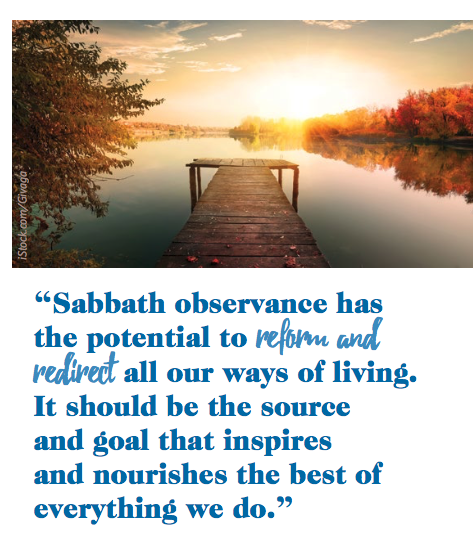
Let me suggest that one practice that Christians might employ in order to imagine and sustain faithful — that is, creaturely — living in the digital age is the Sabbath. In his book “Living the Sabbath: Discovering the Rhythms of Rest and Delight,” theologian Norman Wirzba argues that the practice of the Sabbath is neither simply taking a day off from our busy routines nor is it merely a mode of rest or inactivity. Instead, “Sabbath observance has the potential to reform and redirect all our ways of living. It should be the source and goal that inspires and nourishes the best of everything we do.” For him, the practice of the Sabbath is our participation in the delight that marked God’s response to a creation wonderfully made.
To quote Wirzba one last time: “When we stop from our work, what we are really doing is exhibiting a fundamental trust and faith in the goodness and praiseworthiness of God. … Sabbath rest is thus a call to Sabbath trust, a call to visibly demonstrate in our daily living that we know ourselves to be upheld and maintained by the grace of God rather than the strength and craftiness of our own hands. To enjoy a Sabbath day, we must give up our desire for total control.”
By practicing the Sabbath, contemporary Christians witness to the reality that it is God whom we trust, not ourselves or our technological devices; it is God who is in control, not ourselves or our technological devices; it is God who saves us, not ourselves or our technological devices. By practicing the Sabbath, Christians will be formed to resist the soteriology of Silicon Valley — that is, technological Pelagianism. The Sabbath witness of Christians, then, will be characterized by an embrace of our creaturely embodiment and our creaturely limitedness, as well as a celebration of the fact that we are not God.
My wife and I began to practice the Sabbath weekly during my years in divinity school and we have continued to do so as regularly as possible for nearly five years now. When we first started, it felt crazy to think about giving up time to study — study! — in order to enter into God’s rhythms of rest and delight. Now, we have two daughters and we can’t imagine life without it. May God help us to teach them to be Sabbath people in the digital age. May God teach all of us to be Sabbath people.
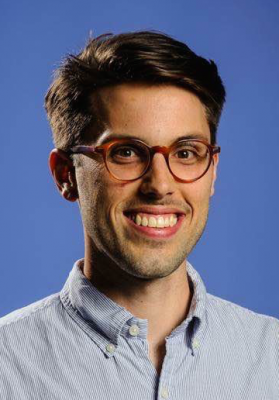 Elliott Haught is a campus staff minister with InterVarsity Christian Fellowship/USA at St. Mary’s College of California. He lives with his wife and two daughters in Oakland, California, where they attend Oakland City Church.