The All Agency Review Committee is trying to figure out how to get to some of the big-picture questions it needs to address in its report to the 2018 General Assembly – including the relationship between the Presbyterian Mission Agency and the Office of the General Assembly (what’s working and what’s not), and if the Presbyterian Church (U.S.A.) needs to have both agencies.
The review committee is preparing for its August 21-22 meeting in Louisville, and trying to figure out who from the denomination’s national structure to talk to there, and what questions to ask.
During a video conference call June 28, the review committee members discussed the progress they’ve made so far, and some next steps.
Several members of the review committee plan to work jointly with a subgroup of the Way Forward Commission on what remains a complex and difficult question: How should the PC(USA) handle shared or common administrative services such as legal affairs and human resources?
How well that system is functioning, or even exactly what’s the correct terminology for describing it, has come up over and over in the discussion of both the review committee and the Way Forward Commission – so now they’ve set up a joint working group to take a closer look.
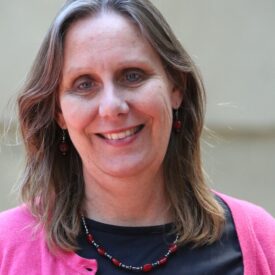
“To share wisdom and avoid redundancy, we thought this would be a point of fruitful collaboration,” said Deborah Block, a minister from Milwaukee who serves as the review commission’s moderator.
Eric Beene, a minister from Georgia, said the review commission had earlier wondered aloud whether the shared services issue “might not be within our purview.”
The General Assembly has not given the review committee much clear instruction, and Beene said there’s been some tension around the question of “are we doing an each-agency review or an all-agency review?”
The All Agency Review Committee is part of a denomination-wide process of review the General Assembly initiated in 2008. This involves a six-year cycle (from 2010 to 2016) of in-depth reviews of each of the PC(USA)’s six agencies – with the reviews done two at a time in two-year cycles. Following that, the all agency review is being conducted from 2016 to 2018.
The committee has been discussing issues of how the six agencies interact with one another, looking for examples of cooperation and collaboration, and considering places where improvements or reconfigurations might be suggested.
Jim Wilson, an elder from Ohio, said his sense was that an advisory opinion which J. Herbert Nelson, the PC(USA)’s stated clerk, issued in March limits what the Way Forward Commission can do acting on its own – and what it would need to try to accomplish by presenting recommendations to the 2018 General Assembly in St. Louis.
“My perception was that an invitation was made to us (to work with Way Forward on the shared services issue) in order to avoid a situation where there are competing recommendations around this,” Wilson said. While he wouldn’t describe common services as “the area we are most interested in,” it is a place where the review committee “could demonstrate good faith and cooperation with the Way Forward” commission, Wilson said.
The issue is “bigger than we could probably tackle ourselves,” Block said. “I think this is a good way to address this.”
The Way Forward Commission released its mid-term report on June 28.
Beene leads a writing team for the review committee that is working to draft a “mission directive” – a statement describing how the committee views the scope and focus its work, including some sort of ethos or vision statement for the PC(USA), and an articulation of standards that could be used to try to measure whether the six agencies are meeting those standards.
Beene reported that the writing team is still at work – the intent is to have a draft ready by the August meeting. Block told Beene she hopes that document will be “manageably short.”
The review committee also spent some time trying to pinpoint what it wants to accomplish during its two-day meeting in Louisville in August – including which Presbyterian leaders to talk with and what kinds of issues to explore.
Some of that still needs to be worked out – Block is asking the committee members to submit further ideas about that.
Committee members did say, however, that they want to speak to the elected chairs of both the Committee on the Office of the General Assembly (Barbara Gaddis) and the Presbyterian Mission Agency Board (Ken Godshall). One question to ask, Block said, is “where do you see tensions” both between OGA and PMA, and within those agencies (including possibly between the boards and staff leadership)?
Committee members referred, for example, to an open letter that Tony De La Rosa, PMA’s interim executive director, recently sent to the Way Forward Commission – and to a response from the PMA board leadership a week later raising concerns about what De La Rosa wrote. The board’s executive committee has scheduled a closed meeting for June 30, although no disclosure has been made about what the subject of the meeting is.
Beene, who served on the PMA Review Committee, said the committee interviewed about 50 people, and needed conversations with people deep within the organization – not just the top leadership – to begin to understand the underlying issues.
At the top levels, “it’s not that everybody was saying everything was cupcakes and sunshine,” he said. “But to get at what was really going on, we had to do more. How deep do we want to go with this, and what are we looking for?”
Another question, Block said, is whether OGA and PMA should be one entity – which was a question raised at the 2016 General Assembly. “This is an opportunity to sit down with these people to explore what they’re thinking,” she said. From their perspective, would some sort of merger work, or not? “Is it a structural issue? Is it a personality issue?”
Committee members also discussed what kind of conversations to have with leaders of the other four PC(USA) agencies – and about the stewardship of conducting some of those conversations by phone or video calls, rather than having people travel for brief presentations. And they’re working to compile lists of groups around the church with whom they want to have conversations as well.