ST. LOUIS – The 2020 Vision Team has come to Big Tent 2017 in St. Louis to listen to the concerns of Presbyterians from across the nation – and to begin imagining a shape for the vision statement the team will craft for the Presbyterian Church (U.S.A.).
The 2016 General Assembly created 2020 Vision Team to develop a “guiding statement” for the denomination by 2020 and to “make a plan for its implementation.” To get a sense of what Presbyterians want that to say, the vision team will hold a series of “listening sessions” at Big Tent, which runs July 6-8 – two during workshops, one informally at lunch and one with the Advisory Committee on Social Witness Policy.
The vision team held its second face-to-face meeting July 6, just before Big Tent convened. The team also is preparing to release a mid-term report this summer, to inform the PC(USA) about its work.
Here’s more of the discussion from the July 6 meeting.
Anxiety and confusion. There is definitely confusion about what the vision team is doing – and tangible anxiety about what lies ahead for the denomination, said Lisa Juica Perkins, a minister from Texas and the vision team’s co-moderator.
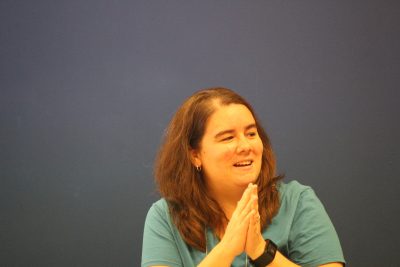
“People still are confused about what all three groups are doing,” Perkins said, referring to uncertainty about the distinctions and precise responsibilities of the 2020 Vision Team, the Way Forward Commission and the All Agency Review Committee, all of which are considering the future of the denomination and will report to the 2018 General Assembly.
The Way Forward Commission, which recently released its mid-term report, has higher visibility and has been more in the news, said Bernie Coffee, an elder from Texas and the team’s co-moderator. Some Presbyterians seem frustrated that the vision team is asking them to express their views via a survey – “here goes another survey,” Coffee said. (Actually, the vision team is using three surveys to collect feedback – one for PC(USA) insiders; one for those close to but not a part of the church; and those outside the denomination).
Some also have questioned how the PC(USA) can find its way forward without setting its vision first, Coffee said.

“There’s a lot of anxiety around the church because so much is unknown,” Perkins said. Some are worried so much could happen so quickly people could get whiplash. And others worry “nothing will happen. … It’s going to fall flat.”
During the July 6 discussion, team members used a variety of analogies to describe the distinctions in the groups’ work – for example, that the Way Forward is “cleaning out the pipes, getting rid of the rust and iron” (from Jerrod Lowry) or that the Way Forward is addressing “things that needed immediate attention,” while the vision team casts a vision that’s more far-reaching and holistic (from Joshua Andrzejewski).
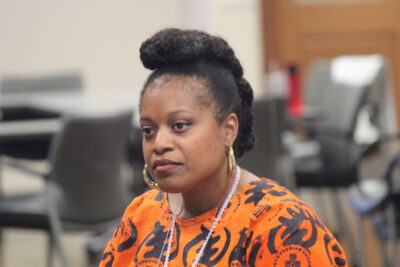
Denise Anderson, co-moderator of the 2016 General Assembly, listens during a small-group discussion.
“We’re dealing with the future, they’re dealing with the present,” Perkins said. Some Presbyterians are anxious about potential structural changes – for example, a possible consolidation or reconfiguration of the Presbyterian Mission Agency and the Office of the General Assembly. “The Way Forward is designed to move a lot faster than we are,” Perkins said. “We need to be cautious not to take on that anxiety.”
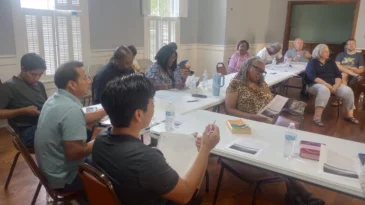
Themes and ideas. For an hour or so, the vision team broke up into small groups to talk about possible themes or ideas for structuring their work. They came back with a platter of ideas, including these:
- Presbyterian elevator speech. When someone asks, “what does it mean to be Presbyterian?” how do you respond, asked Chris McCain, an elder from Atlanta. “What’s particular about being Presbyterian?”
- Presbyterian Disaster Relief. How might the vision team speak about the PC(USA)’s role in disaster relief – broadly interpreted, everything from helping communities recover from hurricanes or tornadoes to assisting undocumented immigrants threatened with deportation to being there for an individual struggling through a divorce. What does it mean for a church to bring hope into the midst of a disaster, asked Andrzejewski, a chaplain from Virginia.
- What’s the value of connectionalism seen in a “life-giving, creative way” – not just as part of the denomination’s structure, asked Karen Sapio, a minister from California.
- What are some good vision statements the PC(USA) might study and from which Presbyterians can learn? For example, Sapio said, think about Barack Obama’s “Yes We Can” speech or Martin Luther King Jr.’s “I Have a Dream.” All were written with a sense of urgency, she said. “They were born out of a crucible” and a sense that “something absolutely vital was at stake, and we have to speak to it.”
- Think about the question “who are you?” – what makes the PC(USA) unique, said Becca Snedeker-Meier, a student at the College of Wooster. And the answer needs to be “grounded in Scripture, not just politics.”
- Put the vision statement to music. “Whatever we produce, it also needs to have a song,” Sapio said. “If it can’t be turned into a fierce hymn, we’re not there yet.”
McCain pushed the vision team to think about one more question.
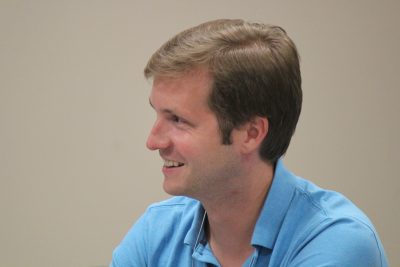
“What if God’s vision for the PC(USA) is that it no longer exists, and we should be about ushering in what God would have for the world” next – whatever that might be, he asked.
What if the PC(USA) “has served a time and place,” but God “calls us on to what is next, and we should be stewards of this institution with a beautiful and complex and messy history, and help to give birth to whatever is next. …. Are we willing to ask that question?”
Debbie Foster, associate stated clerk of Foothills Presbytery, responded immediately: “We have to.”
That led to a conversation about death and resurrection; about declining numbers and influence, but new ways of working ecumenically; about the grief and pain of transformation; about identifying “meaning and hope and purpose,”— perhaps palliative care, as McCain put it – to those watching the old ways dying.
In some ways, “we still want to be the church of the 40s and 50s,” the time when “if we spoke, everyone in the nation listened, and across the world,” Perkins said. “That doesn’t happen any more.”
Like a group of adult siblings trying to figure out what to do with their parents’ house, “we’re still a family,” Sapio said. “How long do we hang onto this house, this structure?”
They also talked about planting seeds. The question is not “are we called to not be Presbyterian,” said Lowry, a minister from Utah, but “who are we called to be?”