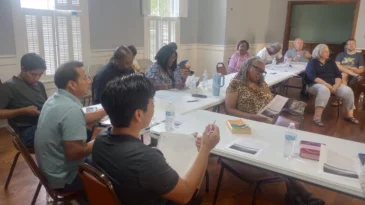
ST. LOUIS – Participants at Big Tent gathered July 7 to hear Denise Anderson and Jan Edmiston, the co-moderators of the 222nd General Assembly, offer their ideas on the conference theme of “Race, Reconciliation, Reformation.”
Anderson and Edmiston have encouraged all Presbyterians to read “Waking Up White” by Debby Irving as part of the “One Church, One Book” initiative they introduced in January of 2017. Many have accepted their invitation, but now are asking: What do we do next?
Anderson and Edmiston devoted their plenary session to suggesting next steps for Presbyterians, churches and mid councils.
Anderson said, “Pay attention to how racism makes its way into entire systems. Remember that racism is not merely personal; it is systemic.”
Drawing from a model set forth by Irving in “Waking up White,” Anderson projected this equation onto a large screen: “Skin color symbolism + favoritism + power = systemic racism.”
 Anderson explained, “Racism is systemic because it has intersections with other parts of life.” As an example, she spoke of how her own experience of being a woman and her experience of being black are constantly intersecting with each other. “For black women, being black and being a woman cannot be understood as separate identities.”
She went on to say that she and Edmiston “want to make the distinction between prejudice and racism. … If you want to fight prejudice, approach it internally. If you want to fight racism, approach it intersectionally.”
Edmiston said, “One of every three African-American children and one of every four Latino children live in poverty” in the United States.
Anderson added: “These are the realities in which we live. The statistics are right there in front of us.”
Anderson and Edmiston said they hope to bring awareness to the New Poor People’s Campaign, a grassroots movement that calls for the revival of Martin Luther King Jr.’s “Poor People’s Campaign,” an initiative started in 1968 to change the unjust economic conditions facing the poor worldwide. The goals of King’s campaign were never fully achieved, but “we could be the ones to change that,” said Anderson.
Poverty is “not just a problem for people who are minoritized,” Anderson said. Edmiston said that associating poverty with race makes it easier to ignore. “About 13 percent of the American population feed themselves with food stamps,” Edmiston said, so “if there are 10 people in a pew, one is likely to be food insecure.” She noted that factors such as education, socioeconomic background or even full-time employment do not make a person immune to poverty. And, those who could be living in poverty include “the person doing our taxes, changing our oil or the person wearing the collar in the pulpit.”
 “For the second time time in our term, we are commending a book” for the entire church to read, said Anderson, presenting the next “One Church, One Book” selection: “Always with Us? What Jesus Really Said about the Poor.” She then introduced Liz Theoharis, the book’s author.
Theoharis said she was compelled to write this book because “there is almost not a week that goes by when someone does not say, ‘you know Jesus said that the poor will always be with us.’” She said that she sensed many Christians believed that this justified the existence of poverty and that little more than “band-aid charity programs” were called for.
If this was true, “was poverty inevitable and God’s will? Did God not make enough?” she asked herself.
Theoharis lifted up Deuteronomy 15:1-2 as one of the most radical teachings in the Bible:
At the end of every seven years you shall grant a release of debts. And this is the form of the release: Every creditor who has lent anything to his neighbor shall release it; he shall not require it of his neighbor or his brother, because it is called the Lord’s release.

If people did these things, “your whole society will be prosperous.” Theoharis said that the solutions the world has are not God’s solutions; “we function from a place of scarcity – not God’s abundance.”
She said she believed Jesus’ statement that the poor would always be with us was a result of people not following God’s commandments. “We must remember … how you treat the least of these is how you treat God.” Jesus did not condone poverty, she said, but reminded the disciples of their failure to follow God’s Law and “to organize society around the needs of everybody.”
“Will we stand together? … And will we do what Jesus asks of us, which is to end poverty for everyone?”
So, what should Presbyterians do next? Anderson and Edmiston made these suggestions for individuals, churches and mid councils:
- Visit poorpeoplescampaign.org and learn about their work;
- Set aside mission dollars to help fund church leaders to attend New Poor People’s Campaign trainings;
- Consider endorsing the New Poor People’s Campaign as a church or mid council;
- Read “Always with Us?” and continue engaging “Waking Up White,” Facing Racism and other opportunities for discussion;
- Pray, preach and advocate for the poor at any opportunity;
- Raise the profile of existing anti-poverty efforts.
“This is our luscious and wonderful calling, my friends,” Edmiston said, encouraging those gathered to reach out to others in their communities and find what’s breaking God’s heart. This often will include those in the intersection of race and poverty, she said.
Anderson added, “What white supremacy does is bastardize us from our humanity. And it hurts every single day.”