I’ve been blessed with good health. When I hit a little bump in the road, like tearing a tendon in my right hand a few months back, I’m very aware that many face much bigger and more lasting struggles.
My dominant hand was immobilized in a splint for two months. Then it was another month of healing and therapy before I could use it reliably. As a writer, I do use that hand. I need it for about half my typing. But this was an inconvenience more than a disability.
I had time to prayerfully ask: “Why did this happen?”
The hand surgeon asked a similar question. I told her I was just chopping an onion, making dinner for the family. Same thing I do most nights. Then: Boing! (Moral of the story: Don’t make dinner for the family.)
She told me my case was odd. She sees injuries like mine now and then, but usually they happen when people were doing something memorable, something that stressed their hand in an obvious way.
Blaming someone, even myself, would be so satisfying — but there was no obvious cause. It was a little like the story in the ninth chapter of John. Jesus came by a man who had been born blind. His socially insensitive disciples asked, “Rabbi, who sinned, this man or his parents, that he was born blind?” Curious people look for causes. Get a random injury and you might end up blaming God.
With our hearty doctrine of providence, it used to be easy to point to God as the cause of such things. This did not always make God look so good. So, these days many of us shy away from crediting God with the bad stuff.
But many passages of the Bible do sound awfully Reformed on the topic: Paul liked to boast about his sufferings (Romans 5:3, etc.). Peter was pleased that our trials reveal how genuine our faith is (1 Peter 1:6-7). And James took it even further, wanting us to count trials as actual joy because of all the growth that follows (James 1:2-4).
Personally, I find the classic Reformed approach of the Heidelberg Catechism helpful on this. What’s the good of knowing about God’s providence? “We can be patient when things go against us, [and] thankful when things go well” because we know that “nothing in creation will separate us from his love” (Q.28).
Knowing how strongly God holds me did help. I learned some patience with myself and with life. It turns out everything actually can be done left-handed. (Cargo pants provided enough pockets for my left hand to reach everything. Voice-to-text software let me write without my hands.) And more to the point, I suspect I grew some compassion for those with disabilities. (How very tiresome to explain multiple times every day about my injury.)
What about Jesus’ answer to the question about why the man was born blind? He deflected a bit. This man’s birth wasn’t about fault for sin. It wasn’t even really about the blindness. The man was born for God’s works to be displayed in him (John 9:3).
And that is true of you and me as well. All our lives, with good and bad, are a canvas for God to paint on.
Or, as Orthodox Metropolitan Philaret of Moscow (d. 1867) prayed, “In unforeseen events let me not forget that all things are under Your care.”
I don’t need a “why” for a random injury. I need to know God’s care extends to me even in the weakness of my body. God walks with me through the journey of healing. In all things, in every step, God’s good works are displayed.
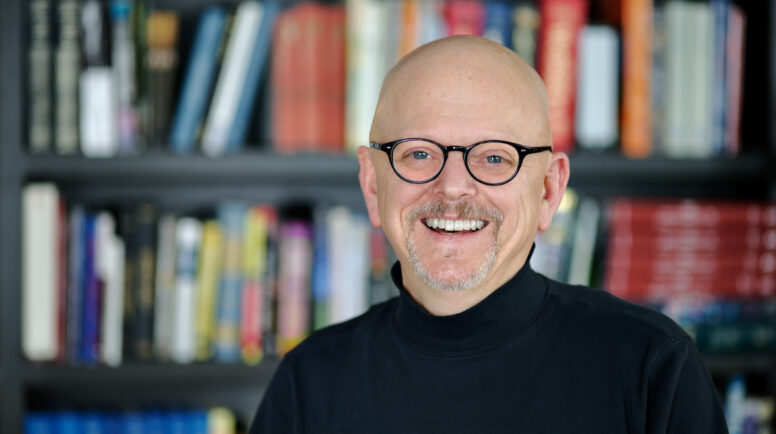
 Gary Neal Hansen, author of “Kneeling with Giants: Learning to Pray with History’s Best Teachers,” is a writer, teacher and retreat/conference speaker. He lives in Pittsburgh with his wife and their two children. You can connect with him and get a free copy of his book on classic lectio divina at garynealhansen.com.