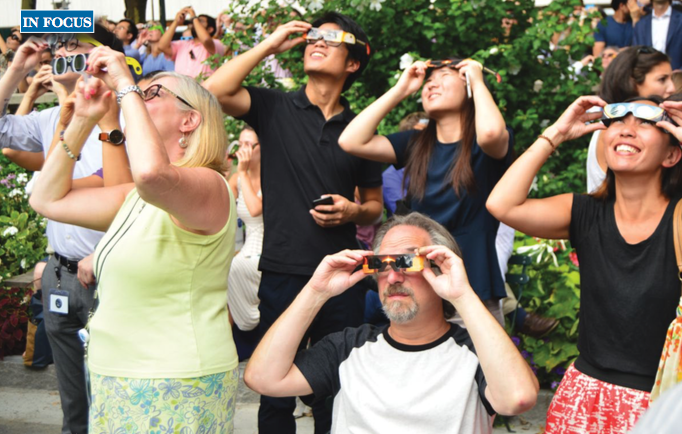
 On August 21, millions of Americans jammed highways, crowded campgrounds and booked up hotels along a narrow corridor stretching from Oregon to South Carolina — all to see the sun vanish for just a few minutes. The total solar eclipse was a disruption of cosmic (if not biblical) proportions as the moon cast its shadow from sea to darkened sea. Rather than an omen sent by angry gods, this spectacular event was accurately predicted and explained by science. Such eclipses have taught us a lot. The one on May 29, 1919, vindicated Einstein’s Theory of General Relativity, proving once and for all that gravity bends light. By exposing the sun’s faint corona and “chromosphere,” such eclipses helped scientists discover the element helium in 1868.
 Solar eclipses have also helped to more accurately date events in ancient history, such as Persia’s preparation to invade Greece as described by Herodotus, during which a solar eclipse occurred (Feb. 17, 478 b.c.). Moreover, we are indebted to the moon not only for solar eclipses and high tides, but also for stabilizing the rotation of Earth, which spun much faster and wobbled more severely in its pre-lunar days. Thanks to the sun, Earth receives 1.74 x 10¹⁷ watts of energy at any given moment (barring, of course, an eclipse). This constant flow helped direct the evolution of life, no less, beginning with the miracle of photosynthesis in cyanobacteria, which began to oxygenate the atmosphere.
The point of all this? Ask anyone who saw the eclipse whether knowing the science behind it diminished their sense of wonder, and you’ll receive a resounding “No!” Quite the contrary.
The overlap of science, art and faith
There is an iconic Venn diagram that has one circle representing science and another representing art, and their overlap is labeled “wonder.” While it’s easy to see wonder as a motivating factor in artistic expression, it may be difficult to imagine science, with its methodological rigor, driven by a sense of wonder. But ask any scientist, and she will tell you that wonder is the spark behind her research, the kind of wonder that weds curiosity and awe of the natural world, from the cosmic to the quantum, with the mystery of life nested somewhere in between.
If science is a journey of wonder (and wondering) as much as art can be an expression of wonder, what then about faith? I’d like to see a more complete Venn diagram that features not two but three intersecting circles: science, art and faith – each distinct, but all sharing the overlap of wonder. Wonder, I believe, lies at the core of the Christian faith. Some have gone so far to say that the church has mistakenly placed belief ahead of wonder, dogma above mystery. In any case, I would say that belief without a sense of wonder is as good as dead. It is no coincidence that Paul called himself and his co-workers “stewards of God’s mysteries” (1 Corinthians 4:1). He did not call himself a doctrinal theologian, much less a master of divinity.
The so-called “conflict” between science and faith is a misnomer of tragic proportion. In 2012, the Barna Group surveyed young adults regarding their reasons for leaving the church. The report (titled “You lost me”) identified the perception that the church is anti-science as a key reason for dropping out. Today, fundamentalists, both religious and scientific, continue to monopolize the conversation, casting ludicrous caricatures at each other. But there is much, I’m happy to say, going on amid the crossfire. Churches, conferences and educational institutions are modeling ways of holding mutually edifying dialogue rather than winner-takes-all debates, and all for good reason.

Science in the light of the incarnation
Christian faith demands a deep appreciation of science. The evolutionary biologist and Russian Orthodox Christian Theodosius Dobhzansky famously observed, “Nothing in biology makes sense except in the light of evolution.” Christians can say something parallel about faith: “Nothing in the Christian faith makes sense except in the light of the incarnation.” Here, in fact, lies common ground: Faith in the incarnate Word calls us to know and honor the physical world in all its remarkable intelligibility and bewildering mysteries, including our bodies, each one “fearfully and wonderfully made” (Psalm 139:14), from the neurons in our brain to the microbes in our gut. Such is the world made flesh. And faith in the Word made flesh acknowledges that God not only deemed the world “very good” (Genesis 1:31), but saw fit to inhabit it (John 1:14). In Christ, the God in whom “we live and move and have our being” (Acts 17:28) has all to do with the world in which we live and move and have our being.
Through the lens of science, we find ourselves more connected to creation than we could ever imagine, countering once and for all the misguided (and sinful) tendency to see ourselves entirely separate from nature. We are connected to a creation that is incomprehensibly large and marvelously complex, strangely diverse and ever in flux. We are part of a creation that at its most fundamental (i.e., quantum) level is fuzzy and indeterminate. At creation’s cosmic level, things we once thought were stable and steady turn out to be dramatically dynamic, both catastrophically (supernovas and black holes) and generatively (the birth of new stars and planets), with every bit of it interconnected, including time and space itself.
Science in the seminary
As for my place in the universe, I confess I am a card-carrying member of the American Association for the Advancement of Science (AAAS), the largest multi-disciplinary scientific guild in the world, as well as an active member of the Society of Biblical Literature, the largest guild of biblical scholars. My dual identity as a biblical scholar and a lover of science, however, is far from dualistic. Columbia Theological Seminary, where I teach, participated in a three-year AAAS grant project aimed at incorporating the best of science into the classroom. (We were one of 10 seminaries across the country to receive this grant, and the only Presbyterian school.) As project leader, I was tasked with bringing scientists into the classroom to talk about their work with students called to ministry. Not only were students awe-struck, so were the scientists, many of whom never had the opportunity to share their work in such a context. Bridges were built, and mutual understanding quickly followed.
Case in point: In our introductory Old Testament course we brought together the unfolding drama of the Bible and the cosmic story of creation, sometimes described as God’s “two books,” a metaphorical framework that has deep roots in Christian tradition, beginning at least with John Chrysostom (ca. 347-407) and Augustine (354-430). As we studied the creation accounts in Genesis and Job, for example, we also learned from astrophysicists and biologists regarding the origins of life and the universe. The conversations were rich and instructive.
Of course, we weren’t the only ones to discover this “double” way of reading. Augustine (in his “Sermon 68”) referred to creation as God’s “great big book,” about which he said, “Look carefully at it from top to bottom, observe it, read it. … Observe heaven and earth in a religious spirit.” That “religious spirit,” however, does not mean rejecting the findings of science in favor of the three-tiered model of the universe as depicted in Genesis. To the contrary, Augustine found it shameful for Christians to make empirical claims about creation by spouting Scripture (See Augustine’s “Literal Meaning of Genesis”). It is, thus, a matter of duty and delight that God’s “two books” be read together, for God is the author of both. As for biblical backing, one need look no further than Psalm 19, which binds together God’s world and word into a seamless whole: as “the heavens are telling the glory of God,” so “the precepts of the LORD” gladden “the heart … enlightening the eyes.” It takes enlightened eyes, the eyes of wonder, to read God’s word and world together.
 To dismiss what science reveals about the natural world is tantamount to tearing out the first pages of the Bible. The biblical story need not have commenced with creation; it could have begun with the exodus event or with the family history of Abraham and Sarah. But it didn’t. The Bible begins with creation, and it ends with creation. Is it coincidental that creation constitutes the Bible’s bookends? Is it merely accidental that in between these bookends the psalmists, sages and prophets often inquired of the natural world in their testimonies to God’s providence? “When I look at your heavens, the work of your fingers …” (Psalm 8:3). “I turned my mind to know and to search out and to seek wisdom and the sum of things” (Ecclesiastes 7:25). “It is the glory of God to conceal things, but the glory of kings is to search things out” (Proverbs 25:2; cf. Jeremiah 31:37). The first sentence of Darwin’s “On the Origin of Species” aptly begins with these words: “When we look to … .”
Looking and searching, observing and studying – the psalmists, sages and scientists are cohorts of wonder. They are practitioners of inquisitive awe. Together they validate the human desire to explore, “to search things out,” to observe and learn about the world that God has created in wisdom (Proverbs 3:19-20). Job implores his friends, who have sold their souls to tradition, to “ask the animals, and they will teach you; the birds of the air, and they will tell you; ask the plants of the earth, and they will teach you” (12:7-8). Creation is its own revelation, the great biblical scholar Gerhard von Rad observed in his study of biblical wisdom, “Wisdom in Israel.” To construe biblical faith as anti-scientific is, frankly, anti-biblical. For the biblical sages, creation was their classroom; this was also true for Solomon (1 Kings 4:33-34). If theology is “faith seeking understanding” (à la Anselm), and science is a form of understanding seeking further understanding, then theology has nothing to fear and everything to gain by engaging the sciences. Science is no hoax. If the task of theology is to relate the entire world to God but does not take into account the world as disclosed by science, then theology fails.
We concluded our Old Testament class with a trip to the Georgia Aquarium. I invited students to reflect on their experience. Here’s what two of them said:
“What amazed me most? The sheer volume of different types of creatures. If we ever for a moment doubt that we need to embrace diversity, all we have to do is look at nature (and Psalm 104). This experience changed my perception of God into a Creator who delights in diversity and expects us to take care of what is around us.” – Rebekah Carpenter
“What a great way to end our deep (no pun intended!) involvement with the Old Testament! This trip combined with the three science lectures helped me enormously with my wisdom of creation. This really enhances my pastoral care with those asking at the end of life, ‘Why are we all here?’ and ‘What was it all about, anyway?’ No answers to those questions, but definitely an expansion of my small knowledge of cosmology and our beginnings. It was not frightening at all that I am such a small speck in the grand scheme of things, as when I was young, but faith and some scientific knowledge have made me feel not apart from the world but a part of God’s universe.” – Jeane Torrence
To which I can only say, “Amen!”
 William P. Brown is the William Marcellus McPheeters Professor of Old Testament at Columbia Theological Seminary in Decatur, Georgia. He is the author of “Sacred Sense: Discovering the Wonder of God’s Word and World” and “The Seven Pillars of Creation: The Bible, Science, and the Ecology of Wonder.”