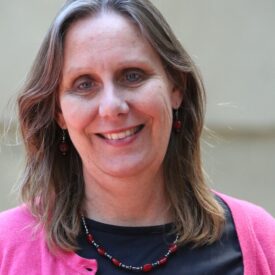
BALTIMORE – Give Denise Anderson, co-moderator of the 2016 General Assembly, a chance to talk about what she sees in the Presbyterian Church (U.S.A.) and the broader world, and she’ll always light the room on fire.
For example, this question: Where does the PC(USA) – which is 91 percent white – stand in its efforts to achieve in racial and ethnic diversity?”
Immediate answer: “Behind.”
Then, Anderson shared ideas on the role immigrant churches play in the PC(USA); the difficulty of getting their leaders ordained; the convergences of racism and the economic system; the challenges of systemic racism; and resistance to reconfiguring the sharing of power.
The Covenant Network of Presbyterians gave Anderson exactly such a platform to talk about the church Nov. 10 during its national conference, being held at First and Franklin Street Presbyterian Church in Baltimore. Brian Ellison, Covenant Network’s executive director, started off asking Anderson questions – then opened the floor to questions from others. Here are parts of that conversation.
Diversity in the PC(USA). The locus of world Christianity has shifted to the global south, with one-fourth of the world’s Christians living in Africa, Anderson said. For the PC(USA), many of the fastest-growing congregations see that growth happening because of immigrants, many of whom grew up Presbyterian in their home countries and seek out a Presbyterian church when they move to the U.S.
“We are going to change, whether we welcome it or not,” Anderson said. “I think it’s important that we poise ourselves to welcome that change. It does mean we will look noticeably different. What does that mean for structural power? … Are we ready to share the center, as it were? How do we do that?”
 Systemic racism. Some point to specific changes as signs of progress – for example, the election of an African-American female as co-moderator or of J. Herbert Nelson as the PC(USA)’s first black stated clerk.
“Let’s be honest,” Anderson said. Do examples such as that signify “that structural power has shifted in significant ways?” In presbyteries, as immigrant pastors go through the ordination process, people are “seeing how many obstacles there are to really being embraced.” Many long-standing immigrant fellowships are not officially counted in the PC(USA) membership or allowed to send commissioners to presbytery meetings. Anderson spoke of “the subtle ways we functionally ignore large parts of our body. We’ve got a long way to go.”
Optimism. In her travels around the PC(USA) and around the world on behalf of the church, Anderson said she’s grown physically tired at times, “but I’ve never come away from a trip drained. … I’ve never felt like the work was for nothing.”
She spoke, for example, about being invited into honest conversations in presbyteries and of accompanying mission co-workers working to fight human trafficking and to participate in healing from the Rwandan genocide, in which more than 800,000 people were killed. “Imagine if Baltimore had just disappeared from Maryland – that is the impact the genocide had on Rwanda,” Anderson said.
In local communities, Presbyterians are doing important work in faith-based community organizing and responding to economic injustice. “It starts in local churches – thanks be to God,” Anderson said.
She also said: “I am just so profoundly in love with this denomination,” because of what she’s witnessed.
LGBTQ inclusion. Clifton Kirkpatrick, a former stated clerk of the PC(USA), asked about two passions he sometimes finds in conflict: that of a commitment to full LGBTQ inclusion and also to unity with Christians around the globe, some of whom theologically oppose that inclusion.
Anderson said she thinks the PC(USA) can learn from immigrant communities. Some of those immigrants are “probably no more affirming of LGBTQ persons than they were when they got here,” but they are also committed to remaining in the PC(USA) family, because “you don’t break up the family.”
That commitment to staying together despite differences resonates deeply in a nation that feels increasingly divided, Anderson said. “We have this bifurcation which is so profound, but which is not necessary,” she said – adding that she grew up with liberals and conservatives sharing a dinner table “without coming to fisticuffs.”
Given the current political harshness, “the church has an opportunity to show the culture a better way, if we would lean into that,” Anderson said.

Reaching out. Jay Summerville, a Presbyterian from St. Louis, asked about ways to build connections – sharing a story about a congregation where he formerly was involved, Second Presbyterian, which became more racially diverse after an African-American congregation split and some of those Presbyterians began to worship at Second.
The increased diversity “has really increased the richness and the depth” of the congregation, Summerville said. But both the whites who were there first and the African-Americans who joined the church share relative affluence, he said – noting the neighborhood surrounding the church is much more low-income than the congregation. Every weekend, about 60 people, most of them black, come to the church as the food pantry hands out boxes of food.
How can Second Church reach out to those neighbors, Summerville asked, without asking them to come to church on Sunday “with a bunch of dressed-up people?”
Susan Haugh, a conference participant, responded with a story of Royster Memorial Presbyterian Church’s congregation, where she formerly served as a parish associate in Norfolk, Virginia. The people at that congregation tended to be “very well-dressed” in worship – the women wearing hats, the men in suits, Haugh said. The congregation also had a connection with Old Dominion University. When a college student showed up in casual clothes one Sunday, a formally-dressed usher told the student he wasn’t welcome at worship if he didn’t come to church dressed up.

The next Sunday, an elder who had overheard that conversation came to church wearing a flowered sports shirt – intentionally challenging the presumption that dressing formally was a requirement for welcome. In the weeks to come, others joined him – and over time, the dress code and sense of welcome at that church completely changed, Haugh said.
Often, “we don’t think about the dynamics of church attendance and the optics,” Anderson said. She also encouraged Summerville to consider what welcome means – and how Second Church might ask its neighbors about their lives and what they want.
“What community do they already have? A lot of times what we do in the church is we assume the position of welcoming. We want to welcome you in. In essence, we are asking to be someone’s host, and there is structural power in being someone’s host. What does it mean to be a guest?”
Presbyterians need to learn to leave “our beautiful edifice” to join the neighbors in their homes, on their street, where they may already worship.
Summerville agreed, saying “the church has got to stop thinking of itself as a building and start thinking of itself as the neighborhood” – learning to hear the stories of those who live nearby.
That may be as simple as eating with folks, rather than just giving them food, “Anderson said. “The answer would lie in us assuming the position of guests.”
#MeToo. What does the church have to say to women who’ve felt the pain of sexual harassment and assault, and have gone public with their stories? one man asked.
The church needs to dig deep on that and on issues of gender inequality, Anderson said. While the majority of parishioners are female, only one-third of PC(USA) ministers are. There’s a gender pay gap in ministry. And the church needs to consider “the myriad ways we devalue women on a daily basis” – including men who feel entitled to comment on and criticize the clothing and appearance of women in leadership.
Also, “we’re failing so profoundly” on understanding and responding to the transgender experience, and “a lot of that has to do with our hatred of all thing feminine,” she said.
Also: How does the church protect women from sexual harassment and assault? “A lot of those #MeToos, my brothers, were women who experienced that in leadership from church members.”
Youth ministry. What can Presbyterians do about young people – particularly African-Americans and mixed-race teenagers – who are pulling away from the PC(USA), saying they’re not finding what the need in the church?
Confirmation curriculum and other material used in youth work needs to address systemic racism and prejudice, Anderson said. She’s heard stories of young people of color going to PC(USA) youth conferences, as recently as last summer, “and the youth of color being deeply impacted and marginalized and having some of the ugliest interactions with other youth.”
Presbyterian young people are feeling the influences of the current, divisive political climate, Anderson said, adding that those working in PC(USA) youth ministry need to “engage the images that we’re seeing in the culture and help our youth interrogate what they’re seeing in the light of the gospel.”
If young people were empowered to use their gifts “in areas they’re really passionate about,” they could make “all the difference in the world” for how they engage their faith as adults.