BALTIMORE – What are the implications, now and through the history of Christianity, of Imago Dei – the belief that all people are created in the image of God?
That question – both in its historical and current contexts – is surfacing at the national conference of the Covenant Network of Presbyterians, being held Nov. 9-10 at First and Franklin Presbyterian Church in Baltimore – a gathering built around the theme of “Our Shared Humanity.”
This is to some extent a time of new terrain for the Covenant Network – which is celebrating the 20th anniversary of its founding and has been a critical player in the long, fractious and ultimately successful battle to change the ordination standards in the Presbyterian Church (U.S.A.) to allow the ordination of gays and lesbians who have partners and to allow PC(USA) ministers to perform same-gender marriages.
With the ordination questions essentially resolved, the Covenant Network is finding new space in which to work – including on matters of racial justice. “The work is not done,” said Covenant Network executive director Brian Ellison as the conference opened, which included pre-conference anti-racism training and an immersion tour of justice and mission work in Baltimore, where the General Assembly will meet in 2020.
But the numbers at this conference are down – probably only about 75 attended the first plenary session Nov. 9. And Presbyterians committed to racial justice struggle with how to be a force for that in a fractured nation and as part of a mostly-white denomination that’s been getting smaller and less influential for years.
What does it mean, for example, that 98 percent of white congregants in the PC(USA) attend churches that are mostly white (meaning 80 percent or more) – a figure cited during the opening plenary by William Yoo.
Yoo teaches about American religious culture and history at Columbia Theological Seminary in Decatur, Georgia – a catbird seat for looking at how Presbyterians from the South viewed slavery and issues of race. His research is also informed by his own family history – he’s the son of Korean immigrants and the father of two Korean-American children.

Yoo struggled to find an answer when his daughter, who was learning about the civil rights struggles of the 1950s and 1960s and the Montgomery bus boycotts, asked him: “Daddy, if we were living at that time, where would we have sat on the bus?”
His Korean-American daughter is growing up and asking questions in a country in which “there has always been the steadfast and enduring belief in partiality and privilege,” Yoo said.
“Many of us are haunted by white Christians,” he said. “We’re haunted by the lack of progress” even in churches that claim to stand for racial justice.
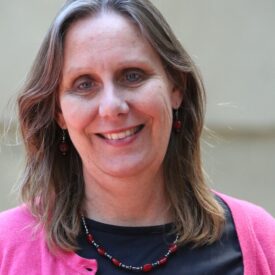
During opening worship, Nancy Benton-Nicol, a Presbyterian minister who formerly worked for the Presbyterian Mission Agency (as associate for gender and racial justice) and for the Presbyterian Foundation (in theological education funds development) spoke of her own Imago Dei dream.
It’s a dream that “sooner rather than later, we might finally, finally grasp that the Imago Dei, the image of God, is made manifest in multiplicity and in equal measure,” Benton-Nicol said “The diversity of humanity does not diminish this reality,” she said, as “all bear the divine imprint.”
That idea – that all are valuable and created in the image of God – has not always been what Presbyterian pastors have taught or Christians have believed. Yoo unpacked some of what he has learned in his study of, as he put it, “why did so many otherwise good white Presbyterians support slavery and segregation?”
He cited Josiah Strong, a Protestant pastor in the 1880s and 90s who believed, Yoo said, that “God created white persons to rescue persons of color.”

And George Armstrong, who posited in the Christian doctrine of slavery in 1857 that “to leave a partially-civilized race in the midst of the Anglo Saxon race would only lead to their destruction” – a conclusion that was “really rooted in the belief that the two races were not equal,” he said.
And Yoo cited the white ministers who criticized Martin Luther King Jr. for being too political, too confrontational – the white moderates of whom King referred to in his “Letter from a Birmingham Jail”:
“First, I must confess that over the past few years I have been gravely disappointed with the white moderate. I have almost reached the regrettable conclusion that the Negro’s great stumbling block in his stride toward freedom is not the White Citizen’s Counciler or the Ku Klux Klanner, but the white moderate, who is more devoted to “order” than to justice.”
Yoo said he’s still trying to sort out the question of how Southern Presbyterians viewed slavery. “Is it just an accident of geography” – where they were born and lived?
And what about whites now who say they don’t understand the Black Lives Matter movement, Yoo asked, or the concerns of immigrants? “It’s not theology – it’s distance,” he said. “It’s social distance” – with many whites having few close friendships or connections with people of color.
Many whites who supported slavery didn’t see blacks as Imago Dei – equal, valued, even civilized. “The only African-Americans they ever saw were in chains,” Yoo said. And many whites today “don’t regularly rub shoulders with people of color,” either in their social networks or in the books they read, the movies they watch, the music to which they listen.
“The question I ask is: Why haven’t we progressed any further?”