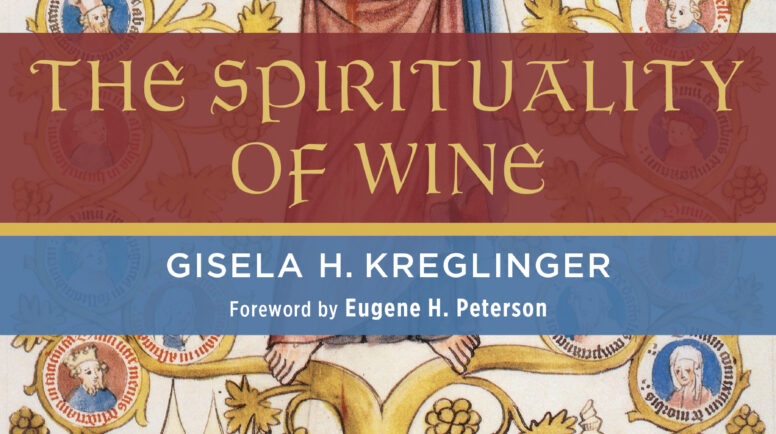
 Gisela H. Kreglinger
Eerdmans, 304 pages
Reviewed by Blake I. Campbell
Gisela Kreglinger was raised on a small family winery in Bavaria that has been in her family for nearly four centuries, and the reader can almost feel the author’s personal connection to the topic of this book. The uniqueness of this book is found in the infusion of personal reflection and a robust reliance on orthodox theology and historical Christian spirituality. Kreglinger begins with an intimate account of her childhood on her grandparents’ Bavarian winery, and introduces the reader to the world of wine, wineries and winemaking, all the while presenting what she calls the “spirituality of wine.” She states her intention to avoid Christian “jargon” at the beginning of the book, making it more accessible to readers who may not have grown up in the Christian faith.
Christian spirituality, Kreglinger states, is a type of theology that pays particular attention to everyday life and the way we live it, in light of our Christian faith. According to her, wine is a material element that has spiritual connotations for the life of the believer, as informed and highlighted by Scripture. Throughout this book, the author “presents an understanding of Christian spirituality that sees all spiritual dimensions of our lives and our world as deeply and thoroughly embedded and engaged in material things.” Sacraments provide familiar examples to Christians; one of which is communion, which incorporates wine (rather than grape juice in some theological traditions). Wine is a physical object, like the water of baptism and the bread of communion, which has a spiritual meaning for believers. This concept is at the heart of Kreglinger’s definition of Christian spirituality in general, and the spirituality of wine in particular. However, she demonstrates that historically, Christian spirituality (at least in Protestant theological traditions) has turned the focus and introspection inward and away from concrete and material things like sacraments, into philosophies and self-reflection. Kreglinger contends that God made us as physical beings in a physical/material world. Therefore, Kreglinger focuses her attention on the spiritual nature and meaning of physical objects, such as wine, in the life of the believer.
Kreglinger also connects the biblical accounts of weddings, in particular the wedding of Cana story at the beginning of John’s Gospel, with the heavenly wedding feast believers will have with Jesus, written towards the end of Revelation. Jesus, she says, chooses this miracle of turning water into wine for a reason, concluding that wine is seen as a source of joy, celebration and fellowship, meant to enrich our relationship with God and each other. This is the reason Christ makes wine for his first miracle at the wedding of Cana, and also why wine is present at the wedding feast of the lamb in the book of Revelation and central to the communion ceremony. Wine is a central element of communion with God and others as highlighted throughout Scripture.
“The Spirituality of Wine” is definitely an insightful read and a study of a long-forgotten topic in Christian spirituality and theology. Kreglinger’s suggestions may seem foreign to many readers, however the reader will find this work to be both a deeply personal and theologically rich book. The author maintains that wine is meant to be consumed slowly and contemplatively, and this is certainly the manner in which the interested reader should read this book.
Blake I. Campbell is a pastor in the Christian Reformed Church of North America (CRCNA) in Marysville, Washington.