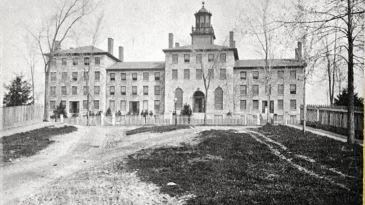

On a Tuesday morning, James Bernhardt stops by a church room to say good morning to a group that gathers twice a month at the Wayside Presbyterian Church in Erie, Pennsylvania. There he sees the classic elements of church fellowship: coffee, snacks and circles of lively conversation. Some in the group recognize him as the pastor of the congregation. Some do not, even though he has stopped by several Tuesdays before. It doesn’t matter; they shake his hand and warmly exchange introductions all over again.
Welcome to the Memory Café.
On the first and third Tuesdays for the past six months, a small but special group of people have been coming to The Memory Café at Wayside. They find a casual gathering uniquely designed for people like them: people who are living with dementia and their care partners. Alzheimer’s disease and related dementias can often isolate people from mainstream society as they lose their ability to follow “customary” social rules. Living with dementia or caring for a person with dementia can take its toll physically, emotionally and spiritually by severing social connection at a time when it is needed most. The Memory Café is an effort to counter these consequences.
The Memory Café is a place where individuals with memory loss and their care partners can get together with other people who are on the same path in a supportive and engaging environment. The Memory Café encourages laughter, support and sharing concerns — all without the feeling of being judged, embarrassed or misunderstood. It gives people with the disease an opportunity to get out of their house and time to share a positive experience with their care partners.
Origins of Memory Café
Two decades ago, Dutch psychiatrist Bère Miesen introduced the idea of a gathering where those with Alzheimer’s disease and related dementias and their care partners could mingle in a comfortable and safe environment. The concept of Memory Cafés spread throughout Europe, successfully making its way to the U.S. In 2008, the renowned Alzheimer’s specialist Jytte Fogh Lokvig established the first Memory Café in Santa Fe, New Mexico. Since then, through a grassroots movement, hundreds of similar cafés have opened across the nation, meeting regularly in places like restaurants, community centers, public libraries, churches and synagogues.
Every 60 seconds, someone in America is diagnosed with Alzheimer’s disease. There are over 6 million people in the U.S. with some type of dementia and this population is expected to increase significantly with the aging of the baby boomer generation. As the U.S. population ages dramatically over the next 40 years, The Alzheimer’s Association estimates that the number of people with Alzheimer’s disease and other dementias is expected to double for people ages 75-84 and triple for those over age 85. Younger onset Alzheimer’s, occurring in people under age 65, is also on the rise. Community institutions and organizations are combining energies to create “dementia-friendly communities” that enable people who are living with dementia and their care partners to thrive and to be independent as long as possible. The Memory Café movement emerges from this momentum.
Partnerships formed
Presbyterian SeniorCare Network (SeniorCare), a nonprofit, faith-based senior living provider based in Pittsburgh, has a strong history of and commitment to community outreach. SeniorCare seeks to develop innovations that enhance quality of life in such a way that, as their organization’s tagline proclaims, “makes every stage of aging easier.” Driven by this mission, SeniorCare looked for like-minded community partners with whom it could start several Memory Cafés in western Pennsylvania. SeniorCare willingly dedicates staff members serving in memory care, a living option offered at SeniorCare communities, who bring expertise in dementia care to the Memory Café program.
In March 2017, Janice Muller, social service director and dementia coordinator, and Kelly Kyle, social worker at Manchester Commons, a SeniorCare community in Erie, contacted the local Alzheimer’s Association chapter to discuss the need for a Memory Café in the western neighborhoods of the city. Working closely with a team of SeniorCare staff leaders and collaborating with the Alzheimer’s Association, they created a plan and approached Wayside Presbyterian Church as a possible location.
“This was an easy decision,” Bernhardt said. He sees Memory Café as a tangible expression of Wayside’s mission to be “an open-hearted, open-minded, open-doored community of believers in Jesus Christ who have joined together in love and hope.” It also actively demonstrates the congregation’s welcoming statement: “We believe that God calls us to lift up the dignity of every human being.”
For many years, Wayside has maintained a covenantal relationship with SeniorCare, motivating the two organizations to look for common ministry and mission opportunities to serve older adults. Manchester Commons is very near the church and the members of the congregation have been involved with the people who live and work there. To Bernhardt and the church leaders, the mission alignment was obvious. “There’s a lot of ways that this particular ministry with Presbyterian SeniorCare just fit perfectly with the kind of things we are concerned about and feel called to do,” he said.
“Wayside Church is known in the community for their generosity,” said Muller. “Their willingness to provide space in their building allowed us to move forward with the Memory Café,” she said.
Kyle agrees that the location is ideally suited for those attending the Memory Café. “The building accommodates us well,” she said. “It’s large and fully accessible. We have a private space with a small kitchen to prepare coffee and snacks.” The church also provides custodial support and audiovisual equipment.
“We make an effort to see that our building is useful for mission in the community,” Bernhardt explained. “So when we found ourselves in conversation with SeniorCare we were just overjoyed to open our doors and make space available so that the Memory Café could meet here.”
Bernhardt is well acquainted with the impact of dementia. In his 30 years of ministry, he has walked alongside individuals and families (including his own father) who endured the decline in mental ability and memory loss severe enough to interfere with daily life. “In some place inside their heart I want them to know that they are loved and cared for,” he said. On any given Sunday morning, he sees families in worship sitting with loved ones who are at various stages of dementia. His theology of the church reminds him: “We don’t forget our people. You may not remember who you are, but God remembers and as God’s people, we remember who you are.”
With inspiration and good planning in place, SeniorCare and Wayside prepared to open their first Memory Café. The church promoted it in their newsletter, weekly emails and website. SeniorCare created and distributed fliers throughout the neighborhood and in its own senior living communities in Erie. The Alzheimer’s Association and Veterans Association helped spread the word through their networks of support groups. Wayside and the SeniorCare team celebrated on July 11, 2017 when the Memory Café opened its door.
A day at the Memory Café
Each week, the two-hour gathering opens with personal introductions followed by a round of chair exercise beneficial for physical and mental health for people in all stages of the condition. The group shares in a variety of activities week to week including creating art, playing games or making crafts. Coloring with pencils or markers is always popular as is sharing pictures of people and scenes that stimulate conversation and ideas. Activities engage both the person with the cognitive illness and their care partner. Because some of the persons with dementia may have discomfort and difficulty in verbalizing thoughts, some of the activities rely less on verbal communications. Everyone enjoys snacks and beverages and the gathering closes with the reading of a positive and inspiring message.
 Participants come primarily to socialize and the conversation ebbs and flows around many topics including grandchildren, favorite sports teams and how good the cookies are. The morning is laced with talk and tips and stories exchanged with laughter and tears as everyone enjoys the freedom and fun. “There are no judgements. You can say you’re confused, you can forget someone’s name, you can say and do anything you want,” said Muller. The café creates time and space where “normalcy” is restored for both the person with the diagnosis and those who love them. In these early months, the café has welcomed a small but steady group of participants including married couples, individuals and their professional care partners and even two sisters.
Strong bonds form among those who attend as they share the journey. “I see the relief on a wife’s face when someone says, ‘I understand. I’ve been through that,’” said Kyle. This is the most important work of the café: to create a place where people trust each other and find hope.
Café as mission
The Memory Café is good for people with cognitive impairment and their care partners. It is also good for congregations that are listening to God’s call to address great need. The church finds itself in the midst of an aging society. While congregations understandably dedicate resources to ministries with children and youth claiming that they represent “the future of the church,” the future of many congregations actually lies with their older members. Statistically, one in 10 persons in a congregation is living with dementia. How can congregations extend this hospitality and practice inclusion with cherished members and reach out to families in the community who are journeying into progressive memory loss? As the 77 million baby boomers move into late life, these questions will be critical to the mission and identity of the church.
A congregation seeking relevance and significance can begin a ministry of compassion and companionship to those living with dementia by combining the resources it already has with the expertise of organizations serving older adults with memory loss. Starting a Memory Café requires just a few things: an open building, relationships with other organizations serving older adults with dementia, knowledgeable planning and direction, compassion, fellowship and good coffee. Many congregations can do this because these ingredients are already mixed into its ministry and life.
The leaders of Wayside Presbyterian Church and Presbyterian SeniorCare recognize that the Memory Café is vital to their mutual mission to care for the sick, befriend the lonely and create communities of freedom and compassion that reflect the love of Christ. “What a great need there is for this support for people and their loved ones walking the path of dementia.” Bernhardt said, “How could we not do it?”
Starting a Memory Café
Plan:
- Partner with a local senior services provider that serves older adults with dementia.
Recruit a host or hosts with experience with Alzheimer’s and dementia. - Select a room with a warm and inviting atmosphere — not too big and not too small.
- Make sure the space is wheelchair and handicap accessible and that parking is plentiful.
- Set the date, time and place and remain consistent.
- Promote the gathering through local community organizations, health care clinics and social service providers who have contact with persons living with dementia.
- Open the invitation to members of the congregation and the greater community.
Gather:
- Provide comfortable furniture, such as an oversized table with enough chairs for all participants.
- Welcome participants and provide nametags.
- Hold activities, but leave plenty of time for socializing and conversation.
- Keep a consistent schedule throughout the gatherings. Familiar routines are helpful.
- Serve a modest spread of snacks and drinks.
- The number one rule is: There are very few rules.
Sustain:
- Ask the participants for activity ideas.
- Plan in advance fun activities: music, arts and crafts projects.
- Let go of expectations. You never know who’ll show up.
- Find congregational leaders who will champion the ministry.
- Pray for the program and the people it serves.
For more ideas and support, visit pahsa.org and click on Resources/Dementia-Friendly Tools.
 Cynthia Ray is the executive director of the Presbyterian Association of Homes & Services for the Aging. She is a minister member of the Presbytery of the Twin Cities Area and sits on the Dementia Friendly America National Council. She lives in St. Paul, Minnesota, where she serves as a Dementia Champion in her community.