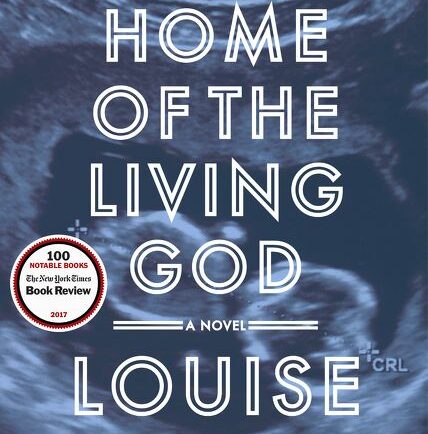
 Louise Erdrich
HarperCollins, 288 pages
Reviewed by Leslie A. Klingensmith
White liberalism. Roman Catholic theology. Native American displacement. Women’s rights. Cross-cultural adoption. Government intrusion. Reproductive choice. Evolution. Science vs. faith. Global warming. Creation spirituality. Motherhood. These are some of the issues that Louise Erdrich addresses – either explicitly or implicitly – in her latest novel, “Future Home of the Living God.” I loved the book. Erdrich’s ability to touch on so many important topics without being self-righteous or pedantic should be the envy of all who aspire to write. She has written a story that somehow manages to be both terrifying and hopeful — and all too possible.
Cedar Hawk Songmaker is a woman in her mid-20s, Native American by birth but adopted and raised by white parents. As her story begins, she is in the early stages of pregnancy. She has had the name and address of her birth mother for a while and ignored the information, but the probability of becoming a mother herself prompts her to seek out her biological family. Her sudden interest is ostensibly to inquire about any genetic traits she should be aware of — but it is also clear that she needs to understand herself, her origin and her relationship with her adoptive parents better. From the beginning, Erdrich drops hints that all is not well in the Upper Midwest of the United States (or maybe even the whole country). Initially the chaos is peripheral. People are carrying on with their daily lives, even though strange things are happening and the reader is told that “evolution is reversing.” When Cedar tells her parents that she plans to make a daytrip to the reservation to meet her biological family, they are worried for her. Instability has begun to creep into society, although we are left to guess specifically what is happening.
It is not long after Cedar’s visit to the reservation that whatever fragile equilibrium has been holding society together disappears. Cedar’s own pregnancy is not visible yet, but she finds out that all pregnant women are now required to report to hospitals, where they are imprisoned, supposedly for their own health and that of their babies. Women who fail to turn themselves in are arrested. Cedar and her baby’s father go into hiding. They are unwilling to surrender their own freedom, and there are frightening rumors circulating about what happens to the women (and their babies) once they are under the care of a totalitarian government.
This novel does not have a “happy” ending, but it is the ending we deserve. Erdrich leaves Cedar in a terrible state — but there are seeds of hope and glimmers of possibility that life can prevail. Whether you read the story as folklore, a parable, an allegory, science fiction or some combination, there is an underlying sense that things can be made right (at least on a small scale) when people seek truth and resist evil. The reader senses the presence of a loving Creator even when Cedar’s plight is bleak. As long as there is a handful of people who follow the lead of that Creator, the possibility for something better exists.
Leslie A. Klingensmith is pastor of St. Matthew’s Presbyterian Church in Silver Spring, Maryland.