Having sent its recommendations to the 2018 General Assembly, the Way Forward Commission is continuing its ongoing work – including preparing for an April 8-9 meeting convened by the Governance Task Force of the Presbyterian Mission Agency Board to discuss competing proposals regarding the Presbyterian Church (U.S.A.), A Corporation.
The Way Forward Commission and All Agency Review Committee have made a joint proposal to the General Assembly regarding the A Corporation. The Presbyterian Mission Agency Board has sent its own recommendation, asking the General Assembly for permission for the Presbyterian Mission Agency to create its own corporation.
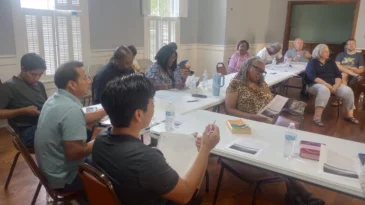
The Governance Task Force has called a meeting in Louisville to discuss the issue – saying it hopes to find some “common ground.”
Way Forward and All Agency Review are recommending that the A Corporation – which currently is the corporate entity for the Presbyterian Mission Agency and the Office of the General Assembly – be governed by an 11-person board with representation from each of the six PC(USA) agencies plus the advocacy and advisory committees, and three at-large members. The A Corporation board currently is composed of voting members of the Presbyterian Mission Agency Board.

The Presbyterian Mission Agency Board is asking the General Assembly for permission to divide the A Corporation into two corporations – one for the Presbyterian Mission Agency and one for the Office of the General Assembly. The Committee on the Office of the General Assembly does not support that proposal for division.
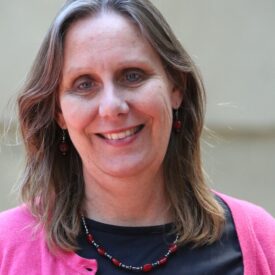
During a Way Forward Commission conference call April 5, Mark Hostetter, a minister from New York who serves as the commission’s moderator, said the commission will send representatives to the April 8-9 meeting. Others attending will include representatives from All Agency Review, the Governance Task Force, Presbyterian Women, the Committee on the Office of the General Assembly, and the PC(USA)’s advocacy and advisory committees.
Hostetter said there has been “intense collaboration” in recent weeks between Way Forward and All Agency Review, and “we are walking this walk as much as we possibly can together.”
With any restructuring proposal, “it’s impossible to think of every possible ramification” Hostetter said. But he said the commission hopes to address as many concerns as possible before the assembly, making “appropriate changes” as needed to improve the proposal. Hostetter said “there is a lot of optimism on all sides” regarding the Louisville meeting.
He said he expects “frank and open conversation” about details of the A Corporation proposals, including matters of funding, personnel and board composition.
During the conference call, commission members voted approval for one modification regarding its General Assembly recommendation – involving the process for the six agencies nominating their representatives to serve on the A Corporation board. At the suggestion of the General Assembly Nominating Committee and the Committee on Representation, the commission is asking each agency to send three names of people who are not employees of those agencies and who could serve – thus providing a bigger pool of possible candidates and more flexibility to achieve diversity on the board.
It’s too late for the commission to formally amend its recommendation to the assembly, but the commission would suggest that the assembly’s The Way Forward committee make that change, Hostetter said.
He also said the moderator of that committee has been named: Cynthia Jarvis, minister of The Presbyterian Church of Chestnut Hill in Philadelphia, who served as vice-moderator of the Way Forward Committee at the 2016 General Assembly.
The commission has the power to act on its own on some matters and plans to keep meeting until the assembly begins in St. Louis on June 16 – it currently has four more meetings scheduled between now and then. During the conference call, commission members provided updates on its ongoing work. Here’s some of what they discussed.

Shared services. Conversations continue regarding how shared services might best be provided in particular areas, including payroll processing and information technology.
The commission also wants to put together a work group, with representation from Way Forward, All Agency Review and others with expertise in particular areas, possibly from other PC(USA) agencies, to review policies and procedures at the Presbyterian Mission Agency, particularly with regard to legal services and finance and accounting.
The work group is not “coming in with an investigative arm,” Hostetter said, but wants to work collaboratively with the Presbyterian Mission Agency staff to consider if there are policies and procedures “that stand in the way of responsiveness and nimbleness,” and might be adjusted.
Communications. Senior communications officials from the six agencies are working together looking at issues including how data is collected and shared and how the agencies’ websites can be improved.
The communications directors are demonstrating an “amazing collaborative willingness” to consider what’s working and what’s not, Hostetter said. And they are trying to consider things from the viewpoint of “Jane and Joe Presbyterian” in local congregations, said Eileen Lindner, a pastor from New Jersey who serves as one of the commissioner’s vice-moderators.
Translation services. In conversation with those who already serve as translators for PC(USA) agencies, commission members are developing a deeper understanding of “what real equity and inclusion mean when you’re talking about language,” said Eliana Maxim, a mid council leader from Seattle and the commission’s other vice-moderator. There’s been discussion, for example, about the need for simultaneous translation during meetings and about the results of a survey on languages Presbyterians use and for which translation has been requested – showing that “there are some real other needs” beyond translation into Korean and Spanish, Maxim said.
Inclusion and equity. Julie Cox, a mid council executive from South Carolina, reported that conversations continue about how a Diverse Voices Table, with representatives from the staffs from each of the six agencies, would function to help shepherd the denomination’s efforts at inclusion and equity. That work groups continues to refine their “hopes and dreams, and also practical realities for what that might encompass,” Cox said.

Financial analysis. The commission is working on two main issues regarding the PC(USA)’s financial future.
One, commission members are starting to gather information on financial projections – about what sources of funding are available to the PC(USA), and what the funding projections are from each stream. That work includes gathering information on per capita funding and checking with eight other mainline denominations to find out how they assess and collect what’s the rough equivalent of per capita in the PC(USA), Lindner said.
Two, the commission is looking at practices and procedures for funds development in the denomination.
The commission is asking the assembly to appoint a 12-person committee to provide a comprehensive resource projection analysis and a summary assessment projection of national church assets and income for a financial sustainability review, with a deadline of Dec. 31, 2019.
And All Agency Review has asked the assembly to instruct the six PC(USA) agencies to engage in a collaborative self-study of the per capita model and its ability to adequately fund the Office of the General Assembly and the Presbyterian Mission Agency in the immediate and longer-term future and to explore alternative and creative funding resources for both.
The Presbyterian Mission Agency Board and the Committee on the Office of the General Assembly both voted in February to recommend to the assembly a significant increase in General Assembly per capita – from $7.73 per member in 2018 to $10.71 in 2019 and to $11.45 in 2020.