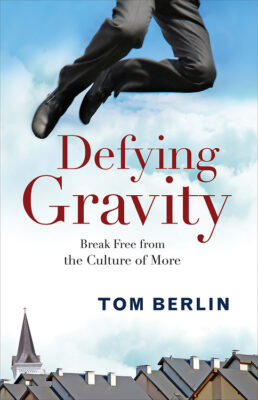
 Tom Berlin
Abingdon Press, 112 pages
Reviewed by Henry G. Brinton
Christians have often disagreed about money — some see it as a sign of God’s approval and others consider it to be a temptation that pulls people away from God. The Bible can be used to support either approach — Proverbs 10:22 tells us that “the blessing of the Lord makes rich” while Jesus insists that “you cannot serve God and wealth” (Luke 16:13). Now Tom Berlin, senior pastor of Floris United Methodist Church in Herndon, Virginia, provides a new image for money: gravity. In “Defying Gravity,” he makes the case that our money and possessions have a pull on us that is similar to the gravity that holds our bodies to the earth. “Financial gravity enables us to function in our daily lives,” he writes, causing us to pursue basic necessities such as food, clothing and shelter. But at the same time, it can be an oppressive force that pulls us away from faith in God. Faithful Christian living does not require us to reject money, but instead to defy its pull and make Jesus the new gravitational center of our lives.
Full of stories of Berlin’s personal struggle with financial gravity, the book is gracefully written and would work well in an adult class or all-church stewardship study. While thoroughly biblical, it also includes fascinating insights from history and science. For instance, Berlin describes a black hole as a location in space where the gravity is so great that nothing can escape its pull, and in a similar manner “money and the things it buys can produce a field of gravity so strong that many people simply cannot escape.” Many of us look for happiness in higher salaries, bigger houses, new appliances and the latest electronics, but as we pursue these items we find ourselves moving farther from satisfaction and deeper in a financial black hole. Berlin says that the way to escape the pull of consumerism is to live a life of generosity, one in which the focus is on what we can give instead of on what we can get. In Christian terms, this is a life in which we do not see ourselves as sole owners of our possessions, but instead as stewards of the time, talents and resources that truly belong to God. Christians who practice stewardship and give one-tenth of their income are “serious about their desire to participate in what God is doing in the world,” according to Berlin.
“Defying Gravity” reveals the power that financial gravity has on Americans today, reporting that 44.8 percent of Americans give none of their income to any charitable purpose. That’s right: zero. Even within the church, one in five American Christians make no financial contribution to any charity at all, religious or otherwise. Fortunately, Berlin offers some practical advice for those who want to escape this black hole. He recommends creating a budget, setting goals for generosity, decluttering and living simply. Berlin writes, “Simplicity is the most effective tool people can employ if they want to escape the financial gravity of our culture.” Although many people think that giving leads to feelings of deprivation, Berlin claims that it leads to joy and significance. “All of us can defy gravity,” concludes Berlin. “It doesn’t take lots of money. It does take time. It takes sacrifice. It takes a shift in our view of the world.” And in the end, it enables us to enjoy the pull of God’s kingdom, which has Jesus as its gravitational center.
 Henry G. Brinton is pastor of Fairfax Presbyterian Church in Fairfax, Virginia, and author of “The Welcoming Congregation: Roots and Fruits of Christian Hospitality.”