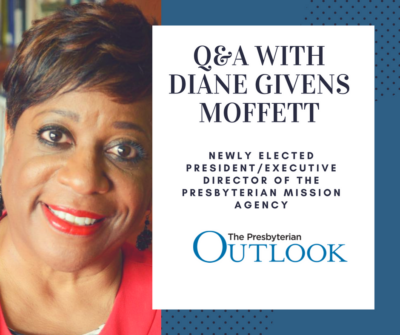
 On May 8, the Presbyterian Mission Agency Board elected Diane Givens Moffett, pastor of St. James Presbyterian Church in Greensboro, North Carolina, to serve as president and executive director of the Presbyterian Mission Agency, subject to confirmation by the 2018 General Assembly of the Presbyterian Church (U.S.A.). Moffett has been called to a four-year term, and starts the new job June 11.
The Outlook’s Leslie Scanlon interviewed Moffett shortly after her election. This conversation has been edited slightly for length.
Sense of call to the position
“I am the granddaughter of Willie Mae Jessica Pope. She’s my resident theologian, and she taught me a love for God and a love for God’s people. Let me say that. I love to see people transformed. I love to see things improve. I work to hopefully mine out gifts that are deposited within people that are there, that sometimes lie latent. What inspires me are the possibilities here in the midst of all the challenges of 21stcentury ministry, that God will do a new thing. …
“I heard there was an opening before. I was asked to consider it, and I thought no, no. But as I began to think about it more and to think about what was happening, I thought my gifts, my experience, seem to line up and match what is needed for the church. I feel this is a call. … It was a lot of prayer. I serve a beautiful congregation right now in a wonderful city. And was thinking I would be there, really. You probably know, I had a mayoral race. But as I began to open up and say ‘God, whatever you want for me,’ and this opportunity came again [as the search committee resumed the search in February, after putting it on hold in late 2017], I just felt the Spirit calling me. I said ‘I’ll do it, if this is what you’re calling me to do.’ ”
What excites you about leading the Presbyterian Mission Agency (PMA)?
“We have an excellent staff. I think there is some excellent work being done. I have seen and witnessed and been blessed by the work of PMA,” through a new worshipping community for college students that her church started and support from Presbyterian Disaster Assistance after a tornado strafed Greensboro this spring.
 “I see the work that we are doing. There are some stories that just need to be told. As a preacher and as a pastor, I know how powerful stories are. Jesus taught in parables. We do a lot of great things, but we don’t always lift those up as they should be. I’m really excited about learning about what God is already doing. How God is already at work in the world, in the PC(USA), and in the places that we are bearing witness.”
What is the importance of having a pastor in this leadership role?
“What makes the church distinct from a corporation like a bank is that we have at the root an understanding of how important people’s lives are. That people are important, and what they do. I think a sensitivity to that and an openness to what is happening as we move out into the world. And a pastor’s heart. A passion to move through times of challenge, times when everything is going really, really well and times when it’s not. Being a pastor and having gone through transitions and changing the culture of congregations — I think that hopefully will be an asset. I certainly will offer it as something that I bring.”
The dispute involving the Presbyterian Mission Agency Board, the Way Forward Commission and the All Agency Review Committee regarding the structure of the Presbyterian Church (U.S.A.), A Corporation — have you been following that?
“Quite frankly, not until I began to look at this role. What I’m concerned about at the end of the day is I want to be released for ministry. I want to be released to be able to lead this agency and our church, to make sure that people who need to hear the good news of the gospel hear it. I want to be released for ministry. … I will be open. I will listen. I just believe that it will work out some way. I think it’s important thought that all those who are making suggestions for any ministry, not just the PMA, that there is some real good understanding of the nature of the work. It’s important so you can make more informed decisions. That’s what I’m hoping and trusting — that we’ll be able to come to some agreement, somehow.”
Also: “I just learned to trust. … I started in a church where there was really mad conflict. It was going to be closed. People were literally — it wasn’t just polite arguing or passionate arguing. I remember getting in the middle of two elders who were just so enraged. … When we’re seeing the kind of challenges we are witnessing. I am saying, ‘God, what are you showing us? What needs to be addressed? How can we take the challenges, the conflicts, the disagreements as a way to say, ‘Who are we going to be? Are we going to be a church that will trust one another? Are we going to be a church that will support one another and stand with another as we go through changes?’ Because I don’t think any agency is perfect, because people are not perfect. But we’ve got to build the kind of trust and openness to new beginnings. It’s a matter of saying, ‘Who do we envision ourselves being going forward?’ And making the kinds of structural changes and the kinds of policy that again ultimately equip us and I’m saying release us to make sure we have the freedom to do the ministry that God has called us to do.”
What is Greensboro like politically — red, blue or purple? And what have you learned from your political and community experiences there?
 “Greensboro is a good mix. I would say it’s purple. … We have a mix but it would probably lean more towards blue if there were a leaning. That being said, we’ve got to learn how to talk with one another. We’ve got to learn how to deal with one another in a way that is respectful and honorable. One of the things I would not do in my political run is some of the things — I wouldn’t go certain places with information or attacking. I was standing for something, and not against anyone.”
Moffett said she’s now seeing more pastors running for office. “The church cannot hide in the sand. We have got to be in the community. I tell my congregation, ‘Wherever you spend most of your time, that’s your ministry. That’s where your light shines.’ … The voices of people who are believers, they need to be heard. …. The church is in service to serving the world. We don’t want to get so inwardly focused that we forget how important it is to be a witness, and to embody what we talk about.”
Challenges for mid councils
Moffett is a former moderator of Salem Presbytery in North Carolina, and currently moderator of its executive committee. “One of the things that Salem is dealing with, as a lot of churches are, is a declining budget. How is that we can begin to help people see the importance of the work we do? How can we partner more? Those are the questions our presbytery is wrestling with. Right now we have — I guess they’re calling themselves a Dream Team. We have put together a task force, and we are re-envisioning the presbytery in terms of its leadership and how we might format even the presbytery meetings. We want presbytery meetings that people leave feeling inspired, feeling that we took care of the business and in doing that we left feeling like ‘I want to do this again.’
“Engaging congregations. Being relevant in terms of how we partner. All of those are questions we are wrestling with, and I see other people are doing it too.”
A focus on mission — and small church challenges
Moffett’s congregation – St. James Presbyterian in Greensboro, North Carolina – averages 200 to 225 in worship, over two services, but she’s had experience pastoring much smaller churches as well.
St. James talks about “turning the church inside out, being a missional church,” and partners with Cone Health Network to serve people who might not have access to medical care. North Carolina is one of the states that did not expand Medicaid, “so some of the poorest people dropped through the cracks.”
Every Sunday at 3 p.m., St. James offers “A Message and a Meal,” providing people who need it a healthy meal and information from health care professionals on taking care of themselves. The church is located in a district with a concentration of poverty. “Greensboro’s been a tale of two cities,” Moffett said — and her campaign for mayor tried to focus on inequities in resources, the impacts of poverty and economic development.
Small churches can be a force in ministry, Moffett said. “There are a lot of small congregations and groups of people doing important work. You can have a large congregation that is doing precious little, and a small congregation that is doing a whole bunch.” She encourages small congregations to consider creative ways of funding and sustaining ministry.
 “And quite frankly, maybe we’re going back to the idea of the early church, where people are all over, in pockets. They met in their houses. It’s not a one-size-fits-all. Wherever we are, we’ve got to find our unique quality. What’s in our hand, and build upon that. For some people that may mean a whole different kind of structure. Maybe you won’t be able to have a pastor. Certainly I hope that people will, because I think leadership is important. … I also think it’s important for the church to be visible, in terms of the actual building erected. I think the presence of the church in the community is important. But at the end of the day the people are the church.”
Moffett started in a congregation of fewer than 35 in Oakland, California. “Most of those were my family. So I know what it means to be in a small congregation and doing a lot of ministry. We led through the Rodney King riots. We did the African-American Korean reconciliation project, went to Korea twice with a delegation of African-Americans and Koreans. We did a lot of work, and we were a small congregation. And that congregation, by the way, is still open today — the one that had been set for closing. But it took a lot of patience, a lot of prayer and a lot of discernment as to what we saw God doing that we could join in doing to make the community better.”
Moffett, an African-American woman, will now lead the Presbyterian Mission Agency. The PC(USA)’s stated clerk, J. Herbert Nelson, is an African-American male. Yet the denomination remains roughly 91 percent white. How well or poorly do you see the PC(USA) doing on racial issues and diversity – and what needs to happen?
Moffett said of Nelson: “He’s qualified. He has a history [of leadership]. I want to make that statement.”
The denomination, in the mid councils and through its advocacy committees and the General Assembly Committee on Representation, is “doing some good work. However, it is not funneling down into the local churches. … We are still primarily a majority white church. And because we live in a world that is filled with people of color, it says something. It says something. … In many ways, the denomination is setting an example, but it needs to permeate down into the local congregations.”
St. James started in 1867, when formerly enslaved African-Americans left First Presbyterian Church of Greensboro – whose pastor owned slaves – to form their own congregation after emancipation. St. James has “a rich history … very active in the civil rights movement,” Moffett said.
But the two congregations “had never dealt with that,” their entwined history. “We had never dealt with that reality.” Led by their pastors – Moffett and Sid Batts of First Presbyterian – they began to build connections. “We started talking, and reading some books and watching some films. We had this service [of reconciliation].And now we have dinner groups. Because fundamentally, for me, I’m not going to tell you everything that’s on my heart and mind if I don’t know you. It comes back to relationships. … All of that comes when you have trusting relationships.”
St. James and First Presbyterian have stared “Dinner and Dialogue” groups, “to get to know one another and see what organically arises out of that, as we begin to deal with some of the issues in our city. And other churches have picked this up. … It’s knowing people. It’s trusting people. If I don’t know you, then I’m going to talk at you instead of with you. It’s quite simple and yet it’s difficult, because we build so many walls. Those walls need to come down. I think that’s the work of the church.”
Dog person or cat person?
Moffett and her husband, Mondre – a jazz musician and music professor – have three adult daughters, four grandchildren, and two Shih Tzus who are getting up in years. She said of her dogs: “They give me lots of material for storytelling.”