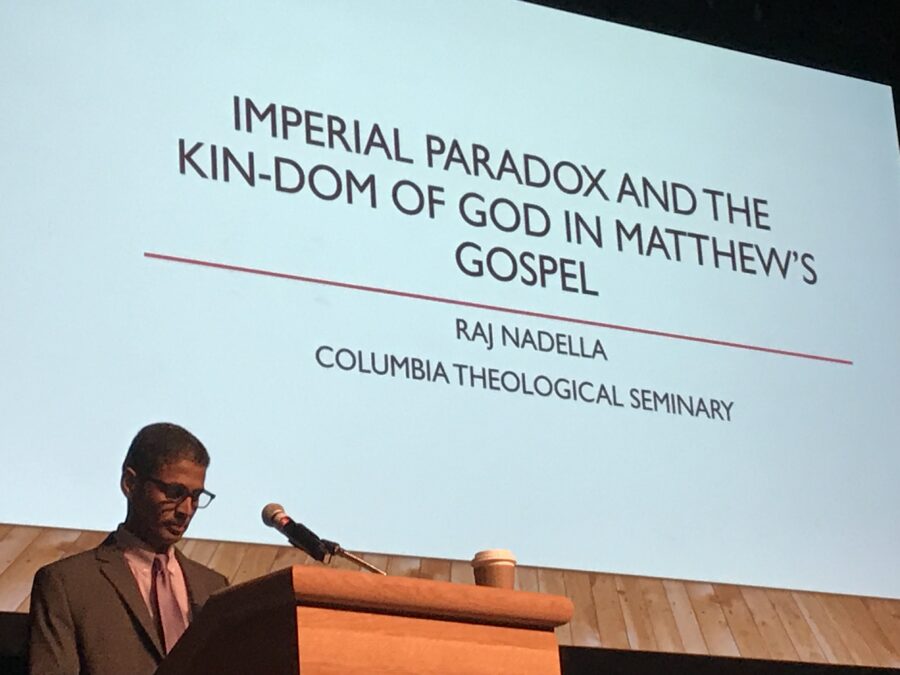
ST. LOUIS – Even after a late night of committee meetings, commissioners filed into the auditorium early on the morning of Tuesday, June 19, coffee in hand, ready for a second day of Bible study focused on building the kin-dom of God.
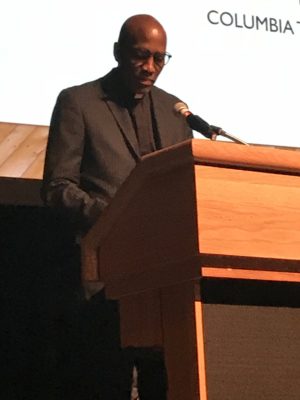 The first Bible study lesson was taught by Deborah Krause, academic dean and New Testament professor at Eden Theological Seminary. On the second day, J. Herbert Nelson, stated clerk of the Presbyterian Church (U.S.A.) underscored the importance of grounding the assembly’s work in theology and the Bible. Nelson introduced Raj Nadella, assistant professor of New Testament at Columbia Theological Seminary as the teacher for the day.
Nadella lead participants in an exploration of the “imperial paradox and the kin-dom of God in Matthew’s Gospel.” Nadella spent the hour delving into texts from Matthew that demonstrated the “imperial paradox” that espouses a worldview where in order for some to live lavishly, others must live in poverty.
The texts for the session included:
- Matthew 14:1-12 – Herod’s opulent birthday party that ends with John the Baptist’s head on a platter;
- Matthew 14:13-21 – an entirely different kind of banquet where Jesus feeds 5,000; and
- Matthew 15:21-28 – the story of the persistent “nasty woman” who will not take no as an answer from Jesus when it comes to the healing of her daughter.
Nadella deftly wove the biblical texts with both the history of the Roman Empire and present day, American culture and politics. Then, as now, the message of empire says that in order for some to prosper, others must suffer. Nadella said that the message of Matthew is “kings are greedy, oppressive and really bad.” And yet, like in 1 Samuel 8, God’s people want a king, because they want to be great but being great comes at a painful cost for most.
Rome, Nadella explained, created paradoxical structures that they presented as complimentary. They even used religion to justify this paradox, these structures. The gods sanctioned this oppressive system so then, “Who are you then to question them?” Nadella said this is religion in bed with the empire and “not a whole lot has changed in 2000 years.”
Jesus, in contrast, presents an entirely different kind of community and economy as evident in Matthew 14:13-21 – the feeding of the 5,000. Jesus’ distribution of the bread is “centrifugal,” and not like Herod’s “centripetal” system. Herod and Rome operate an economy of hoarding, whereas Jesus participates and promotes an economy of sharing.
Finally, Nadella unpacked the challenging text of Jesus and the Canaanite woman (Matthew 15:21-28). The woman, he said, would not give up, despite the disciples telling her to go away. Even Jesus tried to rebuff her but, Nadella said, “Nevertheless, she persisted.”
Nadella reminded those gathered that Jesus was entering enemy territory. He was in the area of his archenemies, but now even they are asking him for miracles. The economy of empire says: You cannot share your food with your enemies. Empire says: Even if I wanted to share with you, there isn’t enough for everyone. If I give the food to the dogs the children won’t have access to food. It is a zero-sum worldview.
But Jesus, Nadella argued, went into enemy territory to expand his ministry and to call people to focus on Rome and its oppressive practices not on fighting each other.
Nadella said of the woman’s refusal to be turned away, “She is a ‘tough cookie’… I might even call her a nasty woman.”
She is saying to Jesus, Nadella posits: “Didn’t you say you are going to introduce an economy of plenty? Didn’t you cross borders imposed by Rome? Didn’t you say you were redefining family?”
Nadella continued, “Jesus pauses, and he says, ‘Yes ma’am.’”
The lesson closed with a call to “act like the nasty Canaanite woman” because we have a stark choice, Nadella said, “We can be complicit in the American empire or the church can challenge the empire.”
His call was met with a standing ovation.