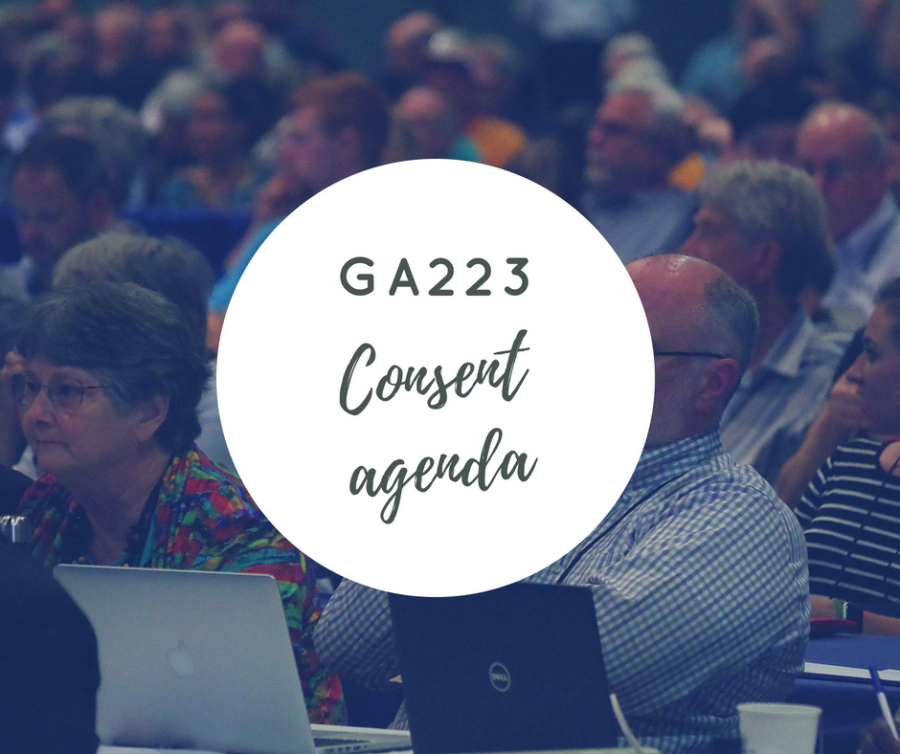
ST. LOUIS – In a stroke of efficient decision-making, the 2018 General Assembly voted June 20 to approve a combined consent agenda, made up of items that had received overwhelming support when considered by the assembly’s 14 committees.
The combined consent agenda is the result of a change in the standing rules the assembly approved in 2012 – with the intent that commissioners spend less time on matters on which there’s substantial agreement, leaving more time to discuss issues on which the assembly is divided or finds particularly significant.
It works like this. Items that an assembly committee approved by at least a 75 percent “supermajority” vote generally are eligible to be placed on the consent agenda — although committee moderators can lift from the consent agenda items with constitutional implications and those they perceive may merit more discussion.
On June 20, the assembly approved a consent agenda with 87 items. Any commissioner could ask that an item be pulled for more discussion, and seven items were removed from the consent agenda for that reason. The assembly then approved the consent agenda, with 80 items remaining, by a voice vote.
Here some of what the assembly passed via the consent agenda.
Middle East
The Middle East Issues Committee ended up with a bumper crop of measures eligible for the consent agenda. The committee designated nine of the 13 proposals that came before it as eligible for consent.
They include what could stand out as one of the most impactful proposals that will come to the floor of the General Assembly by through that route: a call for the church to combat federal or state efforts to delegitimize conscience-driven boycotts, divestments or sanctions that support Palestinian rights by targeting Israel. That overture passed the committee June 19 by a 50-2 vote.
Environmental issues
The committee unanimously (with 55 in favor) had approved an overture from New Covenant Presbytery, recommended that congregations and agencies of the Presbyterian Church (U.S.A.) make a significant effort to reduce the use of polystyrene foam (Styrofoam) products. The committee amended the language for clarity, specifying that it applies only to Styrofoam products, not all polystyrene products. This overture is similar to previous resolutions from 1988 and 2008. Where it differs is in its breadth: This recommendation applies to all the PC(USA)’s agencies, and also urges individual congregations to limit their use of Styrofoam as well. Here’s moreon that discussion in committee.
Social justice issues
The assembly an overture from the Presbytery of New Castle affirming and celebrating the full dignity and humanity of people of all gender identities – encouraging congregations “to welcome transgender and gender non-binary people into the life of the church,” and acknowledging that the church has “participated in systemic and targeted discrimination against transgender people, and we have been complicit in violence against them.”
By approving a second overture from the same presbytery, the assembly celebrated the service of LGBTQIA+ people, and lamented the way “that the policies and actions of the PC(USA) have caused gifted, faithful, LGBTQIA+ Christians to leave the Presbyterian church so that they could find a more welcoming place to serve.”
And the assembly approved a name change for the Advocacy Committee for Racial Ethnic Concerns. At the committee’s request, it will now be known as the Racial Equity Advocacy Committee, using the acronym REAC. The assembly also instructed the six PC(USA) agencies to begin using the term “people of color” instead of “racial ethnic people” – with the former a term that’s much more widely in use.
The Way Forward
This committee only put one item on the consent calendar: an overture from the Presbytery of Newton asking the assembly to appoint a team to review the denomination’s per capita funding system and to consider financial sustainability over the next 10 years. That overture asks that the team make a report of its work, along with “suggestions of potential experiments for changes “ to the funding system to the 2020 General Assembly.”
Overture advocates argued that leadership for the study team should come from the local church – from congregations and mid councils. “This national conversation has to come from the grass roots and be led by the stakeholders,” said Jeanne Radak, the Newton Presbytery leader. The committee unanimously approved the overture.
Peacemaking, immigration and international issues
Through its approval of an overture from the Presbytery of New Hope, the assembly spoke publicly on nuclear disarmament – voting to call on the U.S. government to “immediately begin the process of complete, irreversible, and verifiable nuclear disarmament” and join international efforts to achieve nuclear disarmament.
The assembly also approved two commissioners’ resolutions regarding peace in Nicaragua – calling for prayer, and denouncing violence and injustice.
And it passed a resolution from the Advocacy Committee for Racial Ethnic Concerns committing the PC(USA) to advocate for an end to the hostilities in Yemen, and to advocate for an end to United States military and financial support of Saudi Arabia’s Yemeni war.
The committee amended the resolution to encourage Presbyterian to support relief efforts in Yemen through Presbyterian Disaster Assistance.
General Assembly procedures
As is usual, the General Assembly Procedures Committee brought many items on the consent agenda —15 to be exact. Most addressed approval of reports, tweaking standing rules and the approval of certifying bodies. None may sound exciting on the surface, yet these actions impact how the General Assembly does its work. Two items on the consent agenda demonstrate this truth.
Item 03-12 seeks to ensure balance in the experts who speak to committees when committees are deliberating business. It adds the following sentence: “When such experts advocating a particular point of view have spoken to the committee, the committee moderator shall offer to the committee the opportunity to hear from experts advocating a different point of view.”
Item 03-13 addresses who can speak at the mandated committee open hearings. It clarifies that those who have other opportunities to speak to the committee may not speak at open hearings. It adds to standing rule E5a: “Public hearings are the opportunity for the committee to hear from those who do not have other avenues for addressing the committee—including those who are not Presbyterian. For this reason, those who are given privilege to speak to the committee in E2f(1–7) are not entitled to address the committee during public hearings.”
The assembly also approved Salt Lake City as the site for the 2026 General Assembly.
Ecumenical and interfaith relations
The committee considered reports on dialogue between Reformed churches and the United States Conference of Catholic Bishops, between the Episcopal church and the Presbyterian church. And it named the churches it will nominate to send ecumenical delegates to the 2020 General Assembly in Baltimore.
PC(USA) agencies
A committee considering business related to the work of four PC(USA) agencies took action on several measures involving the Jarvie Commonweal Service, which provides services to elderly people in the New York City area. There has been ongoing disagreement regarding changes made in the administration of the program, The assembly asked its co-moderators to form a reconciliation team “to identify and engage those concerned in a peacemaking and reconciliation process,” and to report back to the assembly in 2020.
Mid councils
The assembly approved some mid council boundary changes. And it approved name changes for two presbyteries of Korean Americans – from Eastern Korean Presbytery to Eastern Korean American Presbytery, and from Midwest Hanmi Presbytery to Midwest Korean American Presbytery.
Mission coordination
The assembly approved a new mutual mission agreement between the PC(USA) and the Presbyterian-Reformed Church in Cuba.
Theological and church growth issues
The assembly’s committee on Theological and Church Growth Issues and Institutions referred to the Presbyterian Mission Agency’s Office of Theology and Worship a series of proposed changes in the new Directory for Worship, with the instruction that the recommendation be brought back to the 2020 General Assembly.
Nominations
The assembly approved a series of uncontested nominations from the General Assembly Nominating Committee to various national committees and boards of the church, and nominations from the co-moderators of the 2016 General Assembly of people to serve on the General Assembly Nominating Committee.