ST. LOUIS – What the General Assembly’s The Way Forward Committee might do became less clear on the evening of June 18, as the leadership of the committee unexpectedly hit the pause button on discussion of the Way Forward Commission report.
Paul Hooker, the committee’s parliamentarian, told the committee before it adjourned around 9:30 p.m. that “there were matters related to the bylaw proposal in the Way Forward Commission report that required further clarification,” and said that clarification was still in process.
The committee had planned to spend the evening discussing matters related to the Way Forward Commission and All Agency Review Committee reports, and a counter-recommendation from the Governance Task Force of the Presbyterian Mission Agency Board.
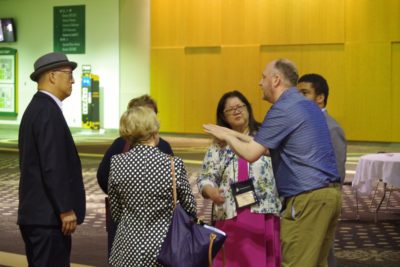 But a serious question clearly had emerged– with members of the Advisory Committee on the Constitution and lawyers and top leaders of the Office of the General Assembly (including stated clerk J. Herbert Nelson) and the Presbyterian Mission Agency Board huddling for hours in the hallways and nearby meeting rooms.
The flurry of conversation followed a presentation that afternoon, in which representatives of the Presbyterian Mission Agency Board told The Way Forward Committee that the board has a new idea regarding restructuring at the top levels of the Presbyterian Church (U.S.A.) – but one that won’t be ready for action until 2020.
The board’s Governance Task Force suggested that the committee take off the table the task force’s earlier recommendation to divide the PC(USA), A Corporation, into two new corporations: one for the Office of the General Assembly (OGA) and one for the Presbyterian Mission Agency (PMA).
It also suggested taking out of consideration the Way Forward Commission’s proposal for reconfiguring the A Corporation board. Currently, all the members of the A Corporation board are voting members of the Presbyterian Mission Agency Board, and Way Forward wants to restructure and broaden that board membership.
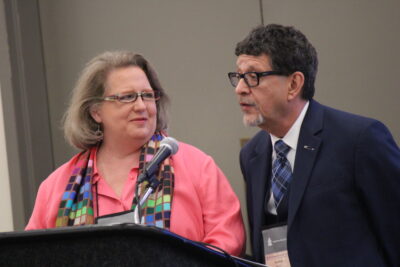
The new idea, as outlined by Conrad Rocha and Melinda Sanders of the Governance Task Force, is this: that the 2018 assembly would refer the whole matter to the Presbyterian Mission Agency Board (PMAB) and the Committee on the Office of the General Assembly (COGA) to work out “an equitable governance model,” as Rocha described it, and to report back recommendations to the next assembly in 2020.
Regarding the proposals already submitted, “not enough due diligence was done,” Sanders said. “We believe they both have unintended consequences. We believe that change is necessary and good for the church,” but only when done properly.
And Rocha contended the Way Forward proposal is unconstitutional – that it would violate Section G-4.0101 of the PC(USA) constitution, which states that each congregation shall form a corporation with trustees, and “the powers and duties of the trustees shall not infringe upon the powers and duties of the session or the board of deacons.”
Rocha argued that a secular corporation is required, and “such corporate existence shall not cause the mission arm of those councils and congregations to be subordinate,” which he contended the Way Forward proposal would do.
Rocha argued that any changes to the A Corporation’s internal structure and governance “must be done through deliverance” – an act of the General Assembly. Rocha said that “if we don’t see this fundamental canon law as relevant or necessary” – if the PC(USA) doesn’t follow its constitution – why should secular authorities? “This might cause a slippery slope that secular courts could use in setting aside the trust clause in property suits.”
This is complicated stuff.
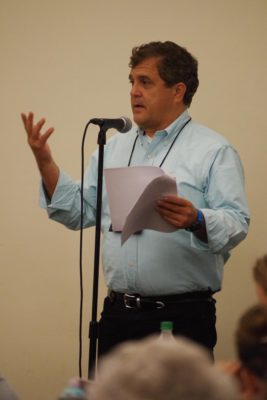
Earlier, Mark Hostetter, moderator of the Way Forward Commission formed by the previous General Assembly, told the committee that a dysfunctional institutional culture at the Presbyterian Mission Agency makes change in the national structure imperative — and he suggested the possibility that the assembly might consider setting up anadministrative commissionto take charge of the Presbyterian Mission Agency Board.
In response to a question from a committee member, Rocha said the new proposal for PMAB and COGA to work together on an “equitable governance structure” for the A Corporation had not been discussed in advance with COGA.
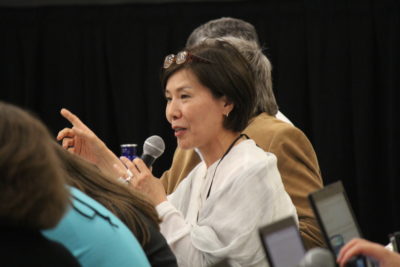
Barbara Gaddis, moderator of COGA, said one of the questions involved is: “Who has the power?” And she said, “We really think we need a power shift, and we really think the Way Forward Commission has given us a power shift as a gift, to ready us for the next generation.”
Whether some clarification of the bylaw proposal for the A Corporation can be brokered to the satisfaction of all the parties to remains to be seen.
Before that question arose, however, The Way Forward Committee had started to find its own voice.
Committee members asked a lot of questions. They wanted clarity too.
What is the A Corporation?
What is a deliverance?
What are shared services?
And when they didn’t understand the answers, they asked again. “I would appreciate you talking to me as if I was 10,” said one committee member, following an answer that didn’t shed enough light.
Cynthia Jarvis, the committee’s moderator, said at one point: “This is insider lingo. People don’t talk this way” in regular life. “You’re just talking Martian to us.”
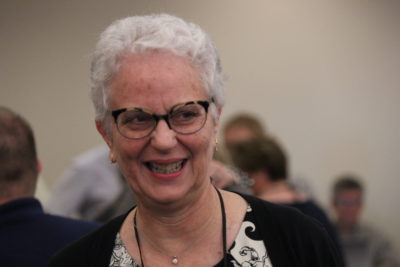
During an open hearing, Sue Krummel, who is the executive presbyter of the Presbytery of Chicago and formerly served as the denomination’s associate for mid council ministries, used an analogy to describe the complicated relationship of the six PC(USA) agencies that seemed to resonate with people – folks returned to it over and over during the discussions.
Part of that analogy: PMA controls the A Corporation, which is responsible for the denomination’s national office building in downtown Louisville. Other PC(USA) agencies and entities that use space in the building pay rent to do so, and pay for shared administrative services that PMA provides.
“It’s like there are six siblings in our church with a very interested cousin on the side” – the cousin being Presbyterian Women, an independent but related corporation to the PC(USA). “Four live in the same building,” Krummel said. “One owns the building, the three others pay rent. The other two siblings have their own buildings,” but “are very interested in what happens in this house over here, as is the cousin who uses some of the services.”
Jim Wilson of All Agency Review took the analogy further, explaining why All Agency Review and Way Forward want to change the composition of the A Corporation board and how shared administrative services such as accounting and payroll are provided.
Within the family, “someone has to take out the trash, someone has to do the dishes, someone has to mow the lawn,” and as things stand now “it’s not being done well,” he said.
All Agency Review and Way Forward want to free PMA to do mission, “because we vitally need that,” Wilson said. “Our highest priority is to empower this church to be a more missional church.” These joint proposals from Way Forward and All Agency Review give PMA tools “to focus on mission instead of cutting the grass.”
Committee members also asked why, if all these groups are committed to unity in the PC(USA), they couldn’t work out their differences in the months before the assembly convened. “My question is why that didn’t happen,” said young adult advisory delegate Melissa Courtney of the Presbytery of Baltimore.
The response: We tried. We met. We tried to work things out. We have different views on fundamental questions. So all of these proposals have ended up in St. Louis, with the hopes the assembly can figure something out.
“Get aboard the discernment train,” committee vice moderator Veronica Goines said at the beginning of the evening session. “”We’re about to go into high gear. And the Lord is with us.”