ST. LOUIS – The Way Forward Committee of the 2018 General Assembly started off its work with a history lesson, and a bedtime story of the six Presbyterian Church (U.S.A.) agencies.
Because this committee is considering such complex business – including competing recommendations for reorganizing the PC(USA), A Corporation, from the Way Forward Commission and the All Agency Review Committee on the one side, and the Presbyterian Mission Agency Board on the other – it began meeting June 15, one day before the assembly itself convenes.
The room wasn’t crowded, as it likely will be next week. But those in the crowd included high-level observers: members of the Presbyterian Mission Agency Board; of the Way Forward Commission and All Agency Review Committee; lawyers; and senior leadership from the Presbyterian Mission Agency.

Beth Hessel, executive director of the Presbyterian Historical Society, provided some historical context for the complexities the committee will consider – describing the denomination’s roughly 300-year history of schism, reunion and reorganization, and key values and tensions at work in that movement.
Among the values:
- Mission is a central Presbyterian commitment.
- Governance is shared, and polity is important. “We are not guided by bishops,” but have a system in which both ministers and ruling elders share governance, she said.
Despite those common values, “we have tensions when we try to live this out,” Hessel said. She cited these tensions:
- Corporate vs. missional views.
- Centralized vs. decentralized. Who makes decisions?
- National vs. local. “In your everyday life, what is the church? Your local congregation,” Hessel said. Yet for those involved with mid councils or the work of the national church, “it’s often the church as a whole.”
She described the trajectory of Presbyterian history – splits, reunions, periodic reconfigurations. It’s “as convoluted as our family tree,” Hessel said.
Some snapshots in history: a time when the denomination had 13 boards (each focusing on particular regions or programs), plus seven boards of women’s ministry. They were later consolidated into four, and the women’s mission boards were merged into the national mission boards “without the voice of women” being consulted, she said. That’s a sign, she said, of ongoing concerns of how the denomination represents the diversity of all in the church.
Over time, the denomination became increasingly corporate in structure, “increasingly less bottom up and more top down,” Hessel said. Mission was measured by effectiveness and efficiencies, with the idea that “if we can manage properly our mission will be successful. Here we see the growth of the large bureaucratic national church.”
She also described the growth of church agencies – and how those associated with a particular agency “tend to become uncritical advocates of their cause,” leading at times to jurisdictional struggles and infighting among agencies.
Even since the reunion of the northern and southern branches of the denomination in 1983, the denomination has restructured several times.
The challenges, Hessel said, include how “we make change from a sense of strength and trust,” and “how to show the world that we Presbyterians are about our Great Commission.”
One committee member pointed to the chart of Presbyterian splits and reunions – the complicated family tree – and said: “The reflection of the kingdom of God to the world – I don’t think it looks like that chart.”
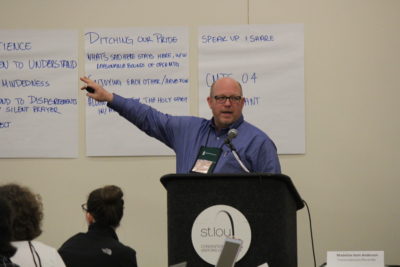
The bedtime story. Charles Wiley is a former longtime Presbyterian Mission Agency staff member (most recently as associate director of theology, worship and evangelism), and now the director of major gifts at Columbia Theological Seminary, and serves as a resource coordinator for the committee. He provided an overview of the six PC(USA) agencies in the current structure – “the what, not the why” as he put it.
Wiley described what each agency does, how many staff members it has and the size of its budget. “The agencies – sometimes they’re called Louisville,” because the PC(USA)’s national offices are in Louisville. But each agency has distinct responsibilities and serves the church in particular ways, Wiley said – focusing his presentation in part on “why might you need that agency.”
Office of the General Assembly: Think: governance. OGA has a staff of 62 and a budget of about $9.2 million. Why might you need it? Some examples:
- A congregation is calling a pastor.
- A mid council has a polity question.
- You’re serving as General Assembly commissioner, and OGA pays for your hotel room and travel – plus makes all the arrangements for the assembly.
Presbyterian Mission Agency: Think: mission. PMA has a staff of 425 and a budget of $71 million. Why might you need it?
- PMA sends mission co-workers, many of whom have connections to local congregations.
- PMA works in ministry with people of color, providing support to Korean-American ministry and for Hispanic new worshipping communities.
- PMA provides daily lectionary and worship resources – those are the most-visited parts of the PMA website, Wiley said.
Presbyterian Investment and Loan Program. Think: church growth. PILP has a staff of 14, made $26 million in loans last year and has a portfolio of $151 million. Why might you need it?
- Your congregation needs a loan for a capital project.
- You want to invest to support church growth.
Presbyterian Publishing Corporation. Think: thinking. PPC has a staff of 40 and did $8 million in sales in 2017. Why might you need it?
- PPC publishes scholarly books and Bible commentaries, along with popular books on faith and prayer.
- Congregational Ministries Publishing has moved to PPC, so it’s now in charge of producing Christian education resources.
- You want to buy a Presbyterian hymnal.
Presbyterian Foundation. Think: financial stewards. The Foundation has a staff of 65 and distributed $65 million for mission in 2017. Why might you need it?
- You want to endow a ministry.
- You’re engaged in or benefit from an endowed ministry.
- You want to support the Theological Education Fund.
Board of Pensions. Think: benefits. The board has a staff of 185 and in 2017 paid out $630 million in benefits. Why might you need it?
- You’re a minister and you want to retire.
- You’re employed by the PC(USA), and you need to see a doctor
Not technically a PC(USA) agency, but often perceived as one, is Presbyterian Women. Presbyterian Women is an integrated auxiliary, a corporation related to the General Assembly but not subordinate to the assembly, Wiley said. It’s involved “in ways that are very parallel to the six agencies.” Presbyterian Women has a staff of 13 and a $3 million budget. Why might you need it?
- You use the Horizons Bible study.
- Presbyterian Women supports mission domestically and overseas.
- Presbyterian Women works for justice.
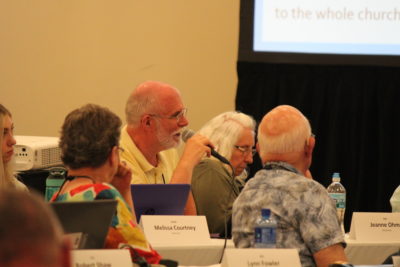
Following his presentation, committee members asked questions – most of which Wiley deferred, saying they could be answered by others who will speak to the committee on June 18.
Among those questions:
- How well do the six agencies play together?
- “What the heck did the Presbyterian Mission Agency do to tick people off?”
Worship. At the start of the meeting, the committee’s vice moderator, Veronica Goines, a minister from the Presbytery of the Redwoods, led worship – including asking members of the committee to remember their baptismal vows and for a dozen of them to form a living baptismal font, since she didn’t have an actual bowl to work with.

Twelve committee members formed a circle at the center inside the commissioners’ work tables – creating a baptismal body surrounded by laptops. The group started with the circle stretched wide, then stepped closer and closer together. Those in the circle said they felt energy, warmth, connection.
The committee’s responsibilities “felt overwhelming to me” at first, Goines said. She asked the committee members to remember their unity in baptism, to stay centered in recognition of God’s presence. “We fill find that the joy of the Lord, as the Scripture says to us, will be our strength.”