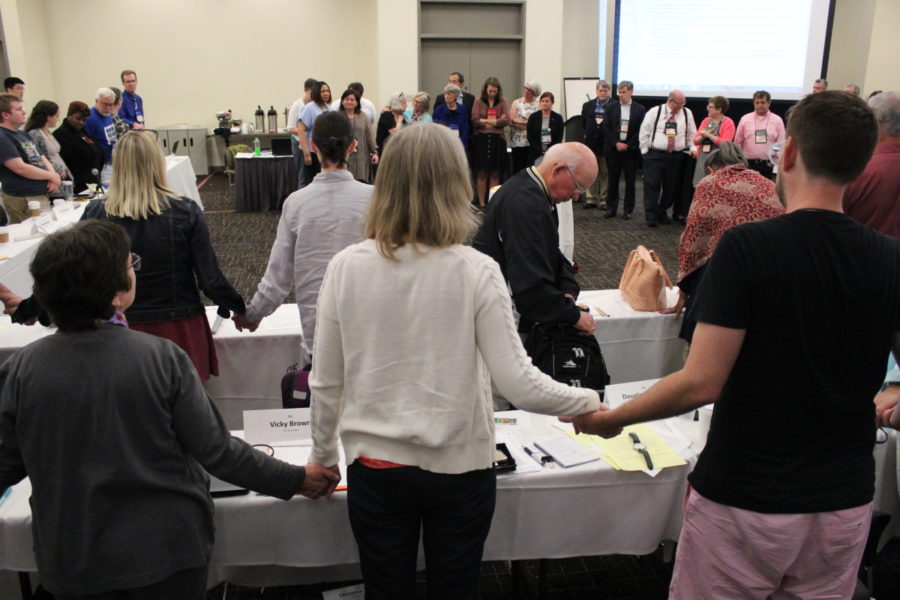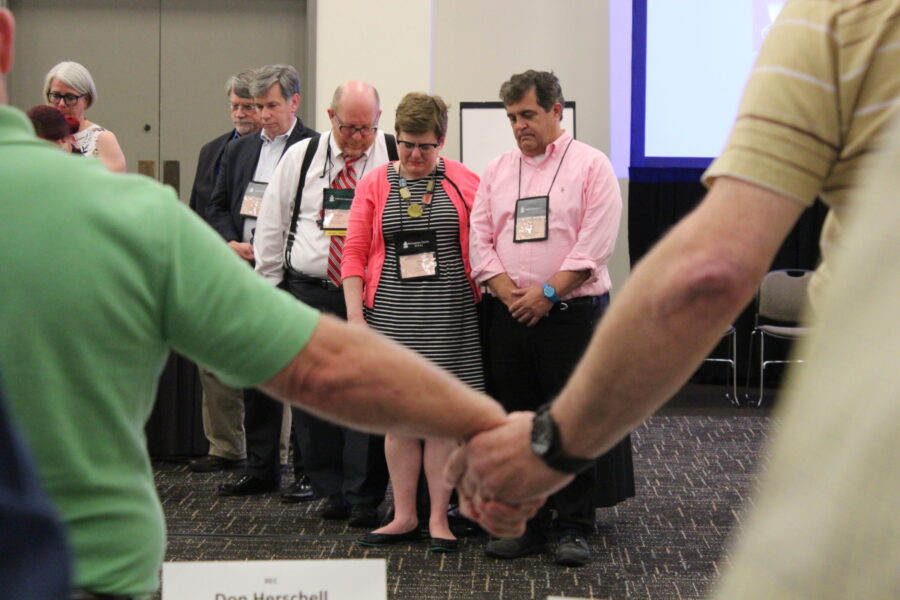
ST. LOUIS – The Way Forward Committee of the 2018 General Assembly voted 51-5 on June 19 to approve the recommendations from the Way Forward Commission.
There were some amendments to those recommendations along the way, but the committee essentially voted to ask the assembly to approve all of the report, including a joint recommendation from the Way Forward Commission and the All Agency Review Committee to reconfigure the board of the Presbyterian Church (U.S.A.), A Corporation.
The committee also voted 58-0 to approve the recommendations of the All Agency Review Committee.
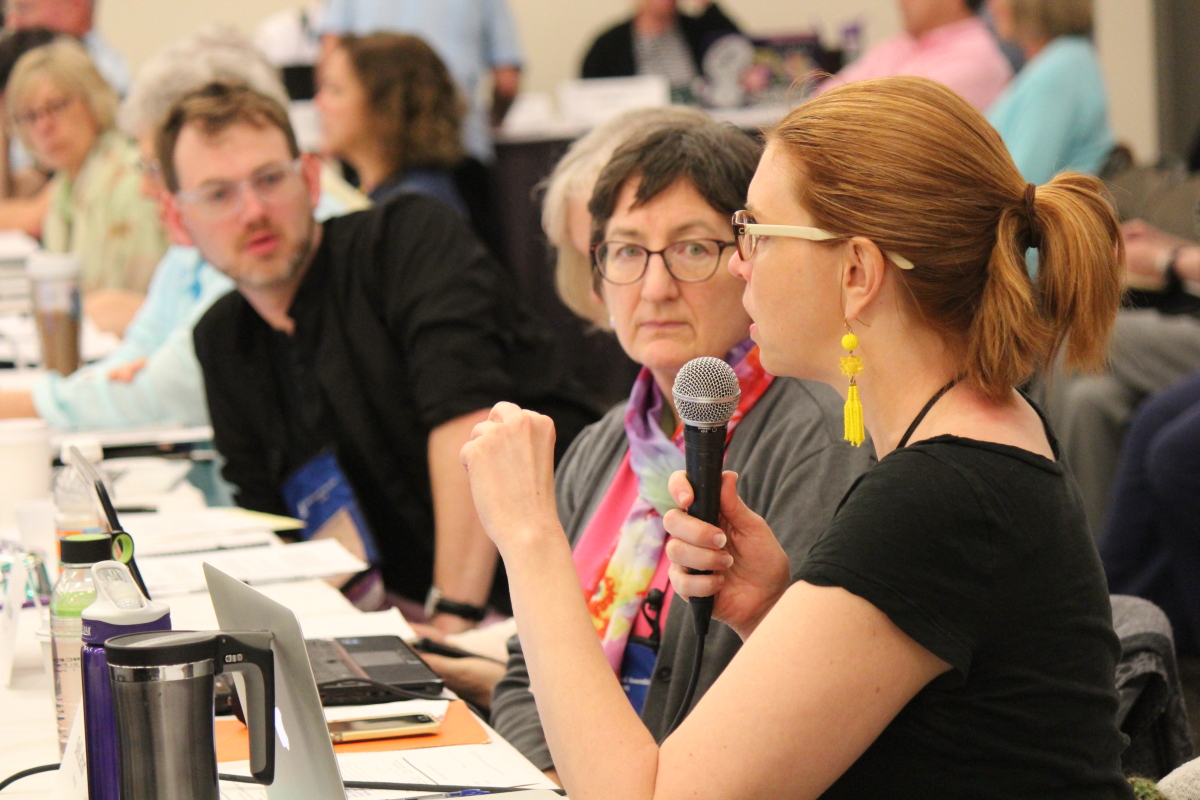
The dispute over control of the A Corporation – a secular corporation serving the PC(USA) – has been hugely controversial for months now at the top levels of the denomination. The assembly committee ultimately voted in favor of the commission’s recommendation and did not support the approach recommended by the Governance Task Force of the Presbyterian Mission Agency Board.
Conrad Rocha, representing the Governance Task Force, asked the committee on June 18 to refer the A Corporation question to the Presbyterian Mission Agency Board (PMAB) and the Committee on the Office of the General Assembly (COGA) to work out “an equitable governance model,” as Rocha described it, and to report back recommendations to the next assembly, in 2020. The governance task force has contended that the commission’s proposal separates “money from mission,” and could leave the Presbyterian Mission Agency without control it needs over staff and finances to do its work.
The assembly committee apparently saw it differently, responding to concerns raised by the Way Forward Commission about a dysfunctional institutional culture and the importance of the users of shared administrative services having a voice on the A Corporation board in how those services are provided.
If the assembly supports the committee’s recommendation that would mean control of the A Corporation would be broadened. Instead of having a board composed solely of voting members of the Presbyterian Mission Agency Board, the A Corporation would be governed by an 11-person board with appointees from five of the six PC(USA) agencies; representatives of the Advocacy Committee on Women’s Concerns, the Advocacy Committee for Racial Ethnic Concerns and Presbyterian Women; and three at-large members.
The committee also voted to ask the assembly to approve a Moving Forward Implementation Commission that would oversee the denomination’s attempts to live into whatever the assembly might recommend from the work of the Way Forward Commission and All Agency Review – including ongoing collaborative work involving communication, inclusion and equity, and more.
The measure the committee approved would authorize that commission to “take any and all administrative actions as necessary to accomplish the Way Forward Implementation Commission Vision,” with respect to the Way Forward Commission initiatives and the administrative supplement the commission approved June 5.
Mark Hostetter, moderator of the Way Forward Commission, urged the committee to be explicit in granting powers to the implementation commission – stating that the timing of when the new commission starts its work and the definition of its authority are critical, “that’s where the rubber meets the road.”
“Think about what you want this commission to do and how much power it could have. It needs to be explicit,” Hostetter said.
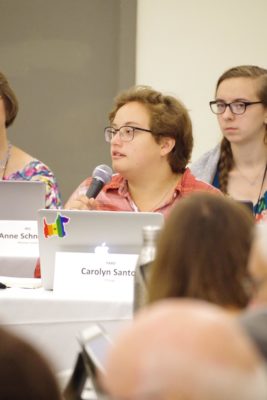
Julie Emery, a minister from the Presbytery of Southern New England, asked whether The Way Forward Commission got everything it needed to do its work.
Hostetter responded that “we entered this process with the idea of collaboration,” establishing many working groups. Some in the PC(USA)’s agencies were wary or reluctant at first, but much good work was done, he said. “There was some resistance,” Hostetter said, and having an implementation commission to monitor next steps makes sure everyone understands “they can take action if there’s not cooperation – full and complete cooperation.”
Committee members also voiced a desire for healing and reconciliation where it’s needed, after J. Herbert Nelson, the PC(USA)’s stated clerk, described “a significant lack of trust,” stemming from a series of structural changes and decisions made over the years after the northern and southern branches of the Presbyterian church reunited in the 1980s. In part, “it’s about power sharing,” Nelson said.
The action states that the implementation commission, working with Nelson and Diane Moffett, the new executive director and president of the Presbyterian Mission Agency, may contract with an outside consultant to address issues raised in the commission’s report and its action regarding trust and transparency.
And, acting on a motion presented by Shelli Latham of the Presbytery of Greater Atlanta, it states that the implementation commission should direct an evaluation of shared services, reporting the result of that to the General Assembly in 2020. That evaluation would look at the services provided, fees charged, recommendations of additional services that be provided, and ways in which mid councils, congregations or other Presbyterian organizations might potentially use shared services as well.
 “We believe that by engaging all agencies in determining the constitution of Shared Services and how services are administered, in a transparent and holistic process, that greater buy-in will be accomplished across the 6 Agencies and Presbyterian Women, giving the General Assembly as a whole greater bargaining power, opportunities for cross-agency collaboration, and shared accountability,” a comment attached to that action states.
It’s estimated the outside consultant would cost $50,000 to $70,000.
A consultant could help the Office of the General Assembly and the Presbyterian Mission Agency “address the wounds and the healings that need to occur,” said Victoria Sherman, a ruling elder from the Presbytery of Giddings-Lovejoy. There needs to be “healing, so we can come back to a sense of trust.”
Some suggested the two agencies could work out their difference on their own, with leadership from Moffett and Nelson. Others said the consultant could help those leaders work through difficult issues.
“I know how difficult it is to make significant change in an organization, particularly with the people most involved in it,” said Alex Thornburg, a minister from the Presbytery of Des Moines.
“We have a commission that was unable to get these agencies to work together,” another committee member said. “It ain’t worked so far. We need to bring in some outside help. If it costs $50,000, that’s money well spent. Because if we don’t, we’re going to lose hundreds of thousands of dollars” as tensions in the agencies bubble to the top.
“We need to support our leaders,” said Contina Lundy, a ruling elder from Philadelphia Presbytery. “This is giving them that kind of support.”
 After hours of waiting for advice from the Advisory Committee on the Constitution (ACC) to arrive, the committee worked its way quickly through responding to that advice once it got there – with the Way Forward Commission providing a series of revisions to its bylaw proposal to respond to the concerns the ACC had raised. Then, the committee seemed to know fairly quickly what it wanted to do.
With the Way Forward Commission recommendations, the Presbyterian Mission Agency Board “would still control their budgets, but they would not hold all of the cards,” one committee member said. “Currently, PMA holds all of the cards.”
The committee talked for a while about whether to add more at-large representatives to the A Corporation board, but decided to stick with the Way Forward-All Agency Review recommendation. “If a board gets too big, it’s cumbersome,” one board member said.
Another said: “Jesus worked with 12, Madame Moderator, and he worked great.”
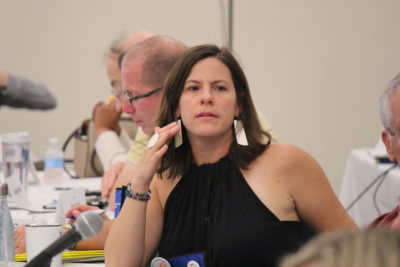
Emery said, “I really feel strongly that creating a separate board (for the A Corporation) does not separate mission from money” for PMA. “I believe the people who work for the wonderful agencies” who will serve on the reconfigured board “care deeply about the church and the work we are trying to do, and that the change will allow the Presbyterian Mission Agency Board to focus on mission.”
Emery said she has served a church that had a board of trustees, “and that board of trustees was deeply faithful. They cared about the work they were doing.”
The action taken also asks the assembly to create a 12-person committee to study issues of financial sustainability in the PC(USA).
The board did make some changes in the Way Forward Commission recommendations.
It voted to invite Presbyterian Women to join a Diverse Voices Table considering issues of equity and inclusion.
It approved language stating that the current A Corporation board members would continue to serve until the new board is constituted – hoping to achieve a smooth transition.
And it approved a proposal for “a systematic approach to language accessibility” for the denomination, requiring that “translation services be staffed appropriately in order to provide translation services to all six agencies and be centralized in Shared Services. We recommend that our existing translation staff spread across several agencies be coordinated within Global Communications. Global Communications would translate all materials going forward and historical/existing records upon request.”
At the conclusion of business, the committee invited members of the Way Forward Commission, All Agency Review and the Governance Task Force of the Presbyterian Mission Agency Board forward to thank them for their work.
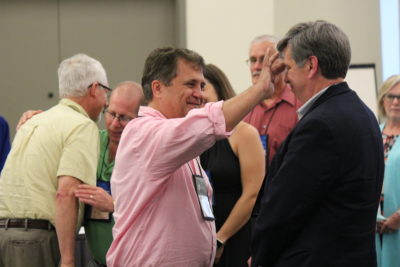
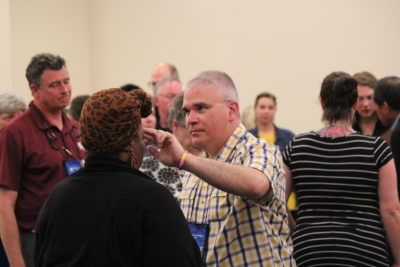 They prayed together and marked one another’s forehead with salt water, a sign that each was a beloved child of God. The container they used: a metal pan that had been used in the kitchen of a concentration camp in Arkansas where the mother of Steve Yamaguchi, the committees assistant, was interned during World War II.