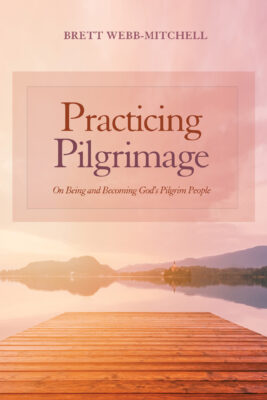
 Brett Webb-Mitchell
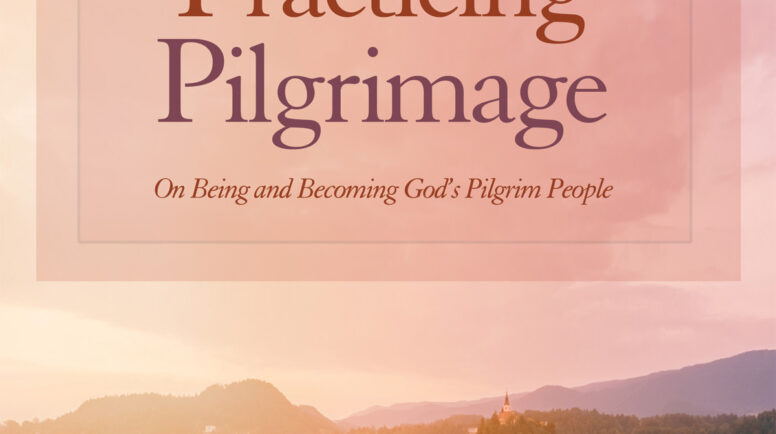
Cascade Books, 220 pages.
Reviewed by Kenneth E. Kovacs
Like Brett Webb-Mitchell, I have long viewed the Christian life as pilgrimage. A Christian is a pilgrim – a wayfarer – on a journey. We are people of the Way. We follow, as Webb-Mitchell says, “Jesus, the Pilgrim God,” walking with him and being transformed in the walking. We are people on the way, leaning into God’s future, moving toward the horizon of God’s advent.
It’s said that pilgrimage is belief in action. My beliefs about pilgrimage were put to the test several years ago when I became a peregrino (pilgrim) and walked over 500 miles across Spain on the Camino de Santiago de Compostela. Since then, the pilgrim life has become even more precious to me, continually informing my life and service as a pastor.
Webb-Mitchell’s “Practicing Pilgrimage” is an excellent guide for those wanting to explore the importance of pilgrimage in the Christian tradition. This book won’t tell you what to pack or what kind of hiking boots to buy before venturing out on the road, but it is a guidebook of sorts. Part pilgrim adventure memoir, part theological exposition, Webb-Mitchell wants us to step out and venture along the pilgrim path. Whether we follow the steps of Columba across Scotland or walk around the block, the goal is contemplation and transformation — seeing the world, our neighbor, ourselves, our relationship with God with fresh eyes. “What a pilgrim lives out during an actual pilgrimage,” he says, “is an intensification of what we pilgrims of God live out every day on the pilgrimage of faith.”
I really appreciate Webb-Mitchell’s description of the church, the body of Christ, as a body in motion, full of bodies in motion, not at rest. And there’s nothing like walking a pilgrimage to discover the joy and struggle of being a body in motion. The church as pilgrim, he says, is more than an analogy or metaphor, but a beautiful description of the body of Christ at prayer and at work. Perhaps never more so than today, the church must see itself as moving, being on the way.
“Practicing Pilgrimage” is full of practical resources for cultivating the pilgrim life in congregations. There are helpful chapters connecting pilgrimage with hospitality and justice, framing the order of worship as journey, moving liturgies of remembrance, suggestions for using labyrinths and creative retreat ideas.
“There is no road,” Antonio Machado said, “the road is made by walking.” A pilgrim knows that we are always following in the steps of those who went before us. A pilgrim never walks alone. When I walked the Camino, I felt I was walking with those who walked before me. One of those saints was Jeff Krehbiel, former pastor at Church of the Pilgrims in Washington, D.C., who died last spring; he was one of my pilgrim guides on the way to Santiago. Knowing that we never walk alone, we venture forth in love, step by step into the future. As one often hears on the Camino, “Ultreïa!” Onward!
Kenneth E. Kovacs, pastor at Catonsville Presbyterian Church in Maryland, is the author of “The Relational Theology of James E. Loder” and “Out of the Depths.”