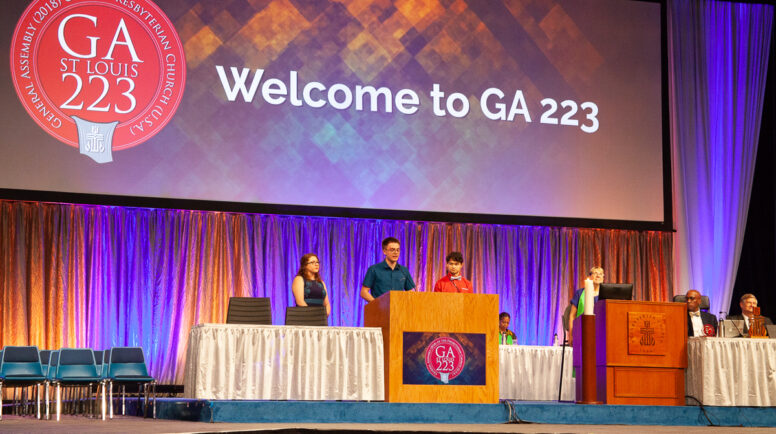
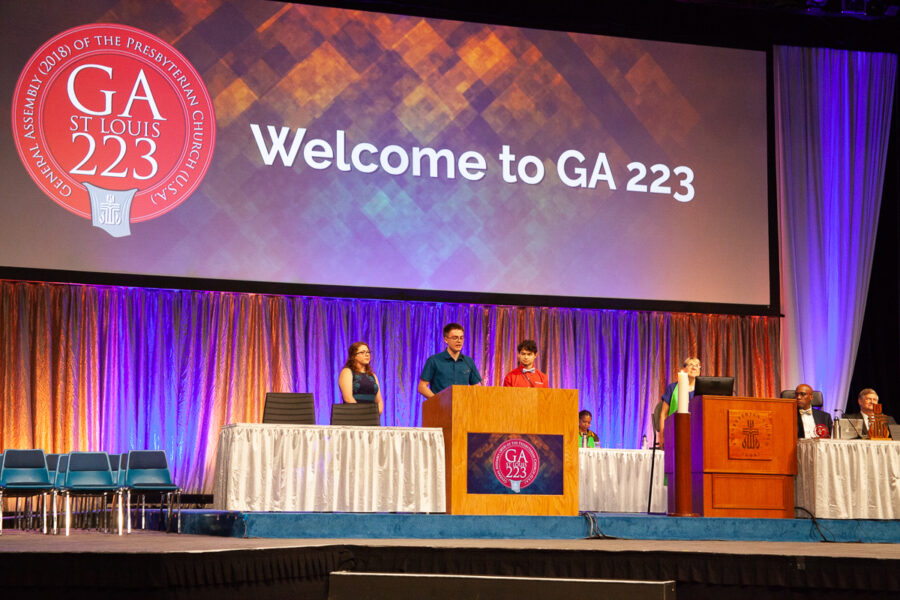
ST. LOUIS – Fourteen committees addressed a multitude of issues over the course of the 223rd General Assembly of the Presbyterian Church (U.S.A.) meeting in St. Louis June 16-23, 2018. The consent agenda alone brought and quickly passed 80 items of business on the floor of the assembly. Hours of discussion and debate ensued as the GA created task forces, made statements, passed budgets and much more. Below is a sampling of some of what they accomplished. For more coverage, analysis and commentary, visit pres-outlook.org/tag/ga223. For all of the business conducted, go to pc-biz.org.
Small churches. An item of business concerning small churches in the PC(USA) called for establishing a new department within the Presbyterian Mission Agency with a multi-million dollar financial implication. The committee amended the resolution to instead require a report to the next General Assembly that would report on the existing and new programs designed to help smaller churches. The alternative resolution from the committee was passed by the assembly with 93 percent approval with no discussion.
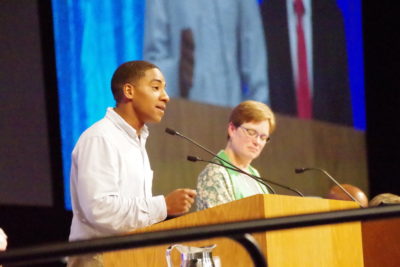
Being black in the PC(USA). David Benraty, a young adult advisory delegate (YAAD) from Eastern Virginia, spoke to the commissioners’ resolution “On the challenge of being black in the PC(USA).” Benraty passionately talked about the challenges faced in African-American Presbyterian churches due in large part to historic racism and oppression. Sharing a story of being reprimanded for drawing on the walls of his childhood church, Benraty asked his grandfather why he couldn’t draw on the walls. His grandfather replied, “Son, this is our church and we have to take care of it.” Benraty said, “Our black churches need our care.”
Leslie Ferrell, a ruling elder commissioner from Seattle Presbytery who served on the mid council committee, spoke in favor of the resolution and noted that 70 percent of African-American churches in the denominations have vacant pulpits.
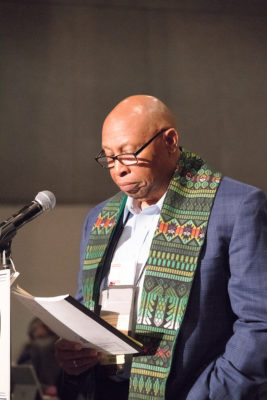
Thomas Priest, member of the Racial Equity Advocacy Committee, also spoke in support so that, “we may stop the bleeding” and Presbyterian African-American congregations “can thrive and grow.”
The assembly approved by voice vote to direct mid councils to pay “careful attention to issues of inclusiveness and fair practices by the pastor nominating committees and committees on preparation for ministry” and to “raise awareness of the declining nature of black congregations throughout the Presbyterian Church (U.S.A.) and the lack of pastoral leadership, both current and future, for those congregations.”
Native churches. An overture called for the preparation of a comprehensive on-site inventory of all historic Native American and Alaskan Native properties in the PC(USA) and to verify what needs to be done for their repair and continued use. Terry Palmer, a minister commissioner from Grand Canyon Presbytery, stated that the overture strengthens mission partnerships with Native American congregations. Edward Spence, a minister commissioner from Grand Canyon Presbytery, also spoke in favor of the overture, but pointed out that the budget was unnecessarily high. In his presbytery, volunteer retired civil engineers were able to do this in his presbytery at no significant cost. The overture passed with 86 percent approval.
Confession of Belhar. The assembly voted 439-73 to create a task force to develop a letter to accompany the Confession of Belhar from South Africa — a letter that would explore the confession’s themes of racism, reconciliation and repentance in the U.S. context.
Writing that letter won’t happen immediately — it takes a task force. The assembly instructed the task force to develop an accompanying letter that “addresses the participation of the Presbyterian Church (U.S.A.) and other Reformed bodies in racism in our historical context, building on prior statements of repentance and apology.” That letter would include topics such as “unjust land acquisition; genocide of native peoples; the enslavement of African men, women and children; and a system of white privilege that unfairly discriminates against people of color,” the action states.
Mid councils. The assembly approved some mid council boundary changes. And it approved name changes for two presbyteries of Korean Americans — from Eastern Korean Presbytery to Eastern Korean American Presbytery, and from Midwest Hanmi Presbytery to Midwest Korean American Presbytery.
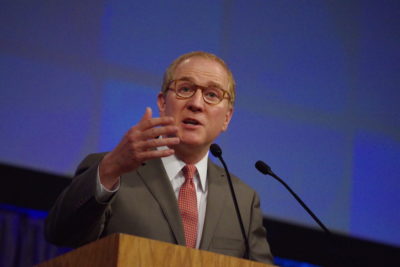
Presbyterian Foundation. The assembly approved Tom Taylor for another term as president of the Presbyterian Foundation. Taylor addressed the body, giving thanks for the honor of serving, saying, “It is the most meaningful work I have ever done in my life.” Taylor summed up the work of the Presbyterian Foundation as “transformational generosity.”
REAC. The assembly approved a name change for the Advocacy Committee for Racial Ethnic Concerns. At the committee’s request, it will now be known as the Racial Equity Advocacy Committee, using the acronym REAC. The assembly also instructed the six PC(USA) agencies to begin using the term “people of color” instead of “racial ethnic people” — with the former a term that’s much more widely in use.
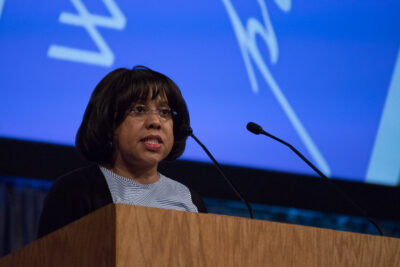
LGBTQIA+ advocacy committee. An overture called for a task force to investigate and study the need for an advocacy committee to address the concerns of LGBTQ+ people in the church. A question was brought to the floor asking: “Do we need to keep studying this issue? We know we need it, so why study it?” Rhashell Hunter, director of Racial, Ethnic and Women’s ministries, responded that this was the process recommended by the Advisory Committee on Women’s Concerns. An amendment was proposed to change all references in the overture to include LGBTQIA+. The amendment passed to include the two additional initials in the acronym. The overture passed with 80 percent voting in favor.
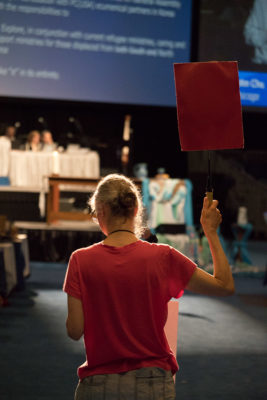 Full dignity and humanity of all. The assembly approved an overture affirming and celebrating the full dignity and humanity of people of all gender identities — encouraging congregations “to welcome transgender and gender non-binary people into the life of the church,” and acknowledging that the church has “participated in systemic and targeted discrimination against transgender people, and we have been complicit in violence against them.” A second approved overture celebrated the service of LGBTQIA+ people, and lamented the way “that the policies and actions of the PC(USA) have caused gifted, faithful, LGBTQIA+ Christians to leave the Presbyterian Church so that they could find a more welcoming place to serve.”
Mental health. An overture on “Establishing a Grant to Develop Resources to Educate Entities Regarding Serious Mental Illness Issues” called for recognition of the 10th anniversary of “Comfort my people,” a report published at the 2008 General Assembly. It also included the establishment of a $250,000 grant to be used to implement the provisions of this overture. An amendment to bring back changes to the overture — that were proposed during the committee meeting and that the committee had rejected – passed. The assembly then approved the overture with an 82 percent majority.
Doctrine of Discovery. Rick Ufford-Chase, former General Assembly moderator, spoke in favor of an overture to expand the response to the Doctrine of Discovery. Ufford-Chase told a story about a trip he took to Standing Rock where Native American elders talked about the importance of churches that have repudiated the Doctrine of Discovery and shared how harmful it had been for them. The overture passed with 87 percent voting in favor.
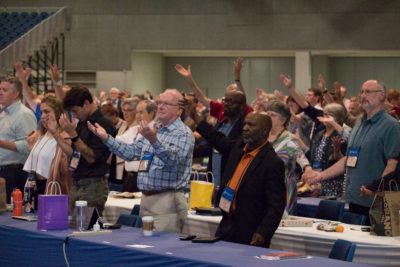 Environmental racism. The assembly approved an official stance 452-34 “on responding to environmental racism and to promote environmental justice.” In committee, commissioners heard testimonies from across the Presbyterian diaspora. Oluwatosin Kolawole from Lagos, Nigeria, spoke about the encroaching coastline in West Africa, saying that many of the beaches where he played as a child are gone. Desiree Lawson, a pastor from the Presbytery of Lake Huron, highlighted her experience serving a congregation in Flint, Michigan. And Sue Smith, an advocate from Monmouth Presbytery (the sponsor of the measure), said: “In 2015, 155,000 people died prematurely of pollution. For those of us with privilege it is our responsibility to listen and respond to these voices.”
Recognizing that environmental injustice and racism affect the “least of these,” the 223rd General Assembly resolved to: “Renew our denominations call to promote environmental justice … . Take action to respond to environmental racism … [and to] provide educational resources to churches and mid councils about environmental racism and injustice.”
Carbon pricing. Allying the PC(USA) with legislation to combat climate change, the assembly passed a measure instructing the Presbyterian Mission Agency to lobby elected officials to approve carbon pricing initiatives.
Already adopted by several cities and states, carbon pricing imposes a tax on carbon emissions: a corporation is charged a fixed price for every cubic ton it emits. Government agencies tax carbon emissions, and then reinvest this carbon tax revenue into clean energy initiatives. The tax can be increased incrementally over time, encouraging corporations to become carbon neutral, and offsetting the negative effects of carbon emissions through investment.
Peace on the Korean peninsula. The assembly also passed a committee substitute for a commissioners’ resolution aimed at promoting peace on the Korean peninsula. The adopted measure directs the stated clerk and the Office of Public Witness to communicate with domestic and international governments and agencies to encourage peaceful resolution of divisions between the two Koreas, and it authorizes church agencies to monitor progress toward reconciliation and denuclearization. The resolution also encourages the U.S. and other governments to lift sanctions on North Korea, as appropriate.
 Boycotts. The Middle East Issues Committee had little trouble reaching consensus on an issue that could set the PC(USA) at odds with pending legislation in Congress. By a 50-2 vote, the committee endorsed an overture that calls on the church to resist federal and state efforts to penalize individuals, organizations or companies for taking part in boycotts, divestments or sanctions (BDS) aimed at advancing Palestinians’ rights. The margin of support the measure for approval by the assembly by simple consent.
Senate bill 720 and House resolution 1697 would make it illegal to support a boycott against a country friendly to the United States, unless that country is already subject to a boycott under U.S. law. Under the Senate bill, violators could face fines up to $1 million and prison terms of up to 20 years. The Senate and House measures have drawn substantial support by members of both parties.
Four years ago, the 221st General Assembly took a guarded step in the BDS direction when it narrowly voted to divest from three American companies — Caterpillar, Hewlett-Packard and Motorola Solutions — that were accused of abetting violations of Palestinians’ rights by the Israeli military. However, the divestment resolution also declared that the church was not divesting from Israel and was not aligned with the BDS movement. This measure passed on the consent agenda.
Partnership in El Salvador. The assembly voted to act as a partner in working for region-wide and country-specific changes in policy sought by the Reformed Calvinist Church of El Salvador — to help reduce levels of gang-related violence in Honduras, Guatemala and El Salvador. The PC(USA) will assign a mission partner to help develop a refugee and immigration advocacy network and will invest in peacemaking in the three countries to reduce migration and reintegrate people who are returned from the United States.
Covenant agreement. Mienda Uriarte, PC(USA) area coordinator of Asia and the Pacific, spoke in support of the overture “On Covenant Agreement Between Gereja Masehi Injill di Minahasa (GMIM) and the Presbyterian Church (U.S.A.).” She described the ways this covenant relationship between GMIM and the PC(USA) can enrich the Christian love between the two Reformed denominations. In 2016, the GMIM General Assembly “made a commitment and took formal action to nurture and care for diaspora members throughout the world.” The 223rd General Assembly voted to approve this overture, directing the General Assembly Committee on Ecumenical and Interreligious Relations, in relationship with the Office of the General Assembly and the Presbyterian Mission Agency, to “explore the possibility of developing a covenant relationship with GMIM, in consultation with presbyteries having significant Indonesian and Minahasan-speaking members.” A report will be presented at the 224th General Assembly in 2020.