ST. LOUIS – “How big a voice do we necessarily have?”
A young adult advisory delegate asked that question about Presbyterian influence during a debate at the 2018 General Assembly over a proposal that the Presbyterian Church (U.S.A.) divest from fossil fuel companies (something the assembly chose not to do, favoring continued corporate engagement instead).
And it’s a fundamental question — in some ways, both a practical and a theological one for a mainline denomination with a declining and aging membership, whose stated clerk, J. Herbert Nelson, often proclaims: “We are not dying, we are reforming.”
The PC(USA) today is not the same denomination it was five or 10 years ago. It has tilted markedly towards the progressive side as more than 350 congregations have left the PC(USA) since 2012 for more conservative denominations — many of them in response to the denomination’s decision, after years of discord, to allow the ordination of gay and lesbian pastors in partnerships and to permit its ministers to perform same-sex marriages.
 So this 2018 assembly felt empowered to speak — no longer quite as worried about making internal peace, and compelled by the urgency of a national political scene roiled by racism, school shootings, immigration policy and a president whose tweets set off controversy almost hour by hour.
The 2018 assembly voiced its views in vote after vote — on policies in Central America and the Middle East and the United States; proclaiming the full humanity and dignity of people of all gender identities; celebrating the gifts of ministry of LGBTQIA+ people; marching through downtown St. Louis to deliver more than $47,000 in worship offerings and donations that will be used to bail out people who were incarcerated for minor offenses, but couldn’t afford to pay their fines or make bail.
Those votes were a way of saying publicly, “Here’s what Presbyterians stand for.” The related question of “How big a voice do we have?” was also asked at this assembly, in multiple permutations. Among them:
What is the value of the PC(USA) speaking to it members a message of hope, justice and acceptance? What does it mean to Presbyterians in the pews and to the pastors who lead those congregations to take a public stand — to offer a message of liberation to the captives, as the assembly literally did by raising money to bail people charged with misdemeanors out of jail? And what about Presbyterians who aren’t on board with all that the assembly did — who may come from divided or “purple” congregations where some parishioners will disagree, in small or big ways, with positions this General Assembly took? “This is our church too,” one commissioner said, in the heat of a debate.
 What’s the impact when the PC(USA) speaks to the secular world – condemning gun violence, for example, or insisting that the Trump administration end the practice of separating children from their parents as migrants try to cross the U.S.-Mexico border? The assembly debated whether to say “president’s policy” or just say “policy” when decrying the policy of separating families — with one commissioner saying that referring to the president amounted to “name-calling,” and others saying the church needs to specifically challenge Donald Trump’s policies. The commissioners chose the words carefully, which raises the question: How strong or dominant is the Presbyterian voice in the public square? When Presbyterians speak, do elected officials or people outside the church listen?
The PC(USA) is one of many denominations speaking now. As the assembly debated what to say about family separations, a Religion News Service correspondent was compiling a running list of faith-based groups speaking out about the issue. The PC(USA) made the list twice – the assembly’s action (#48) and a statement that Nelson issued several days earlier (#33) – along with statements from Sikhs, Baptists, Catholics, Mormons, Buddhists, Methodists, Quakers, evangelical leaders and more.
What’s the value of faith groups working with others to produce change – through coalitions working on climate change, for example, or Black Lives Matter or the Poor People’s Campaign: A National Call for Moral Revival? How is the Presbyterian voice amplified when the PC(USA) joins with others in coalitions? And what are the dynamics for Presbyterians learning to sometimes be supporting players, not always the ones in charge?
The march is an example of how the PC(USA) is striving to engage in public witness — collaborating with coalitions of St. Louis activists who’ve been marching in the streets for months, taking on issues of racism, poverty and systemic injustice. Some of those community leaders are young and not from the church. And using the money to bail people out, working through the St. Louis-based nonprofit civil rights Arch City Defenders, is a tangible way to measure impact.
Within the PC(USA), whose voices are loudest — who’s being heard, and who’s left out? Some identified an emerging theme at this assembly of push-back to the institutional church, reflected, for example, by the call for young adult advisory delegates to be given vote in the moderator election, or in a commitment to provide more resources for translation services, so those for whom English is not their first language can have access to information and make their voices heard and influence felt.
The role of PC(USA) agencies and advisory and advocacy committees also came into play. The assembly reconfigured the PC(USA), A Corporation, to provide more equitable sharing of power on that board. During the debates on fossil fuel divestment and on providing guaranteed family leave for workers, commissioners asked pointed questions – particularly of the Board of Pensions president, Frank Spencer.
 The debate over fossil fuel divestment demonstrates that what some see as a responsible way of moving forward, others may view as exactly the wrong thing. After much discussion, the assembly voted 332-178 at a pivotal procedural moment to support the PC(USA)’s Mission Responsibility Through Investment (MRTI) committee in its process of using corporate engagement to try to nudge oil and gas companies towards change — choosing that over divestment in fossil fuel companies.
Sam McGregor, a minister commissioner from Providence Presbytery, urged the PC(USA) to “remain a prophetic voice at the table” of corporate engagement.
Rob Fohr, the PC(USA) director of Faith-Based Investing and Corporate Engagement, said the denomination is part of a new Climate Action 100+ coalition that collectively represents $30 trillion in assets, giving it significant leverage in climate change negotiations.
But supporters of fossil fuel divestment questioned how influential the denomination’s voice really has been in corporate engagement — and whether by waiting to divest at a time when climate change is progressing quickly, “we have basically sunk the environment,” as Scott Wipperman, a minister from Glacier Presbytery, put it.
“The argument is to stay a prophetic voice at the table,” said Sophia Alecci, a young adult advisory delegate from San Gabriel Presbytery. Jesus didn’t stay at the table, she said, “he flipped the table over.”
On Twitter, people pointed out that 40 presbyteries had supported the fossil fuel divestiture overture. “Could be read as grassroots vs. institution,” one observer tweeted — and that kind of commentary echoed on social media on the debates over family leave (sent to a task force to study and report back in 2020) and whether to give the young adult advisory delegates vote in the moderators’ election (also referred for more study).
This assembly created at least 16 task forces, study committees and commissions — so the assembly spoke out, but also followed the deliberative Presbyterian way.
There was also tension between asking for more (in mental health ministry, translation services and work with small congregations, for example) and finding a way to pay for it. In the end, despite concerns raised about the potential impact on mid councils and congregations, the assembly voted to approve a General Assembly per capita rate of $8.95 in both 2019 and 2020 – more than the $8.50 an assembly committee had recommended earlier in the week.
 To some Presbyterians, the tone of this assembly was just right – hopeful, challenging, inclusive, living into the kind of church they have longed for the PC(USA) to be, saying what needs to be said, regardless of the impact.
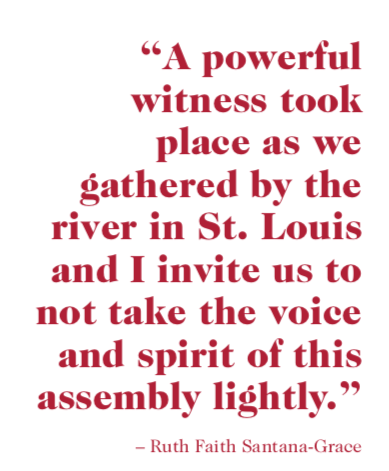
Ruth Faith Santana-Grace, executive presbyter of the Presbytery of Philadelphia, wrote after the assembly that she perceived “a powerful witness took place as we gathered by the river in St. Louis and I invite us to not take the voice and spirit of this assembly lightly. This assembly is challenging us to not be silent. It is compelling us to step outside of our comfort zones. And they are reminding us that this is our moment in time to embody the kingdom of God.”