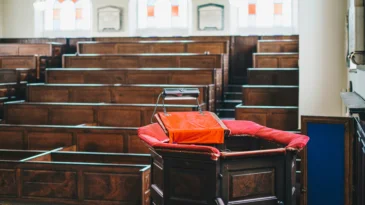
On the day of the May 9 immigration raid in a small Iowa town, families whose husbands and fathers had been detained came to the Presbyterian church to wait – waiting for the start of a new and precarious future.
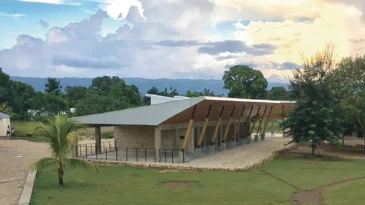
First Presbyterian Church sits adjacent to the National Guard Armory in Mount Pleasant, Iowa. Years ago – after immigration agents rounded up nearly 400 people at a meatpacking plant in Postville, Iowa, during one of the largest workplace raids in U.S. history – an arrangement had been struck that if a raid ever happened in Mount Pleasant, families could gather at the church. It was a day that Trey Hegar, First Presbyterian’s pastor for the past four years, hoped would never come, but knew well that it might.
And on this ordinary-seeming Wednesday, it did. Immigration and Customs Enforcement agents detained 32 men during the raid at Midwest Precast Concrete on the west edge of town – 22 from Guatemala, seven from Mexico, two from El Salvador and one from Honduras. This is one of a series of raids immigration officials have coordinated across the country in recent months – picking up 22 in a series of towns in northern Kentucky last December; detaining 97 in a meat-packing plant in Morristown, Tennessee, in April; and, in June, 146 at a meat-processing plant in northern Ohio and 114 at a nursery in Norwalk, Ohio. Those are just a few.
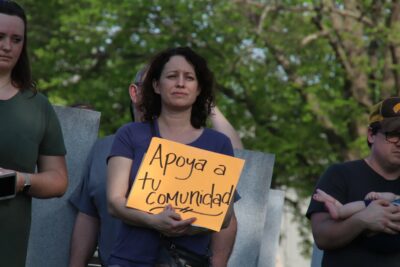
What the numbers alone don’t show is the rippling impact of an immigration raid – the fracturing of families, business disrupted, the fissures caused when differences of opinions emerge in the community about whether the raid was the right or wrong thing to do. Churches are divided as well, with many of the mainline congregations organizing to assist the immigrant families and some evangelical Christians either staying silent or speaking out in favor of the raid.
Some are angry with immigrants who break the law. Some are themselves struggling economically. One man told Hegar: “I work three jobs and I can’t make ends meet, but we’re going to bend over backwards to help an immigrant? I don’t get it.”
Hegar said that “there is an underlying hostility” from some towards undocumented immigrants, despite the difficulties that caused many of those people to head north. And with Donald Trump’s election, “some pretty overt racism came out,” he said – with students at his son’s elementary school telling Hispanic students: “You can’t live here anymore because Trump is our president. You have to leave.”
Immigrants from Central America have been part of the life of Mount Pleasant – a town of about 8,500 people in southeast Iowa – for at least three decades now. Many of the immigrants are from the same region of Guatemala, who left after violence from gangs and drug cartels disrupted their lives. The immigrants have become part of the community, their children attending local schools and playing sports, with one man starting a Hispanic newspaper and others opening restaurants.
This is in some ways a classic small town.
“Friday nights and Saturday nights are all about kids and sports and band,” Hegar said.
This also is Trump country – the president carried Iowa’s Henry County by 62 percent in the 2016 election.
And it’s a community where new immigrants coach soccer and where an organization called Iowa Welcomes Immigrant Neighbors (Iowa WINS) has hosted global potluck dinners, to which people bring home-cooked dishes representing their heritage to share with their neighbors– food from Laos, Guatemala, Cambodia, Czechoslovakia. There also have been educational efforts: helping people in Iowa to better understand the political and economic forces driving immigrants to the United States.
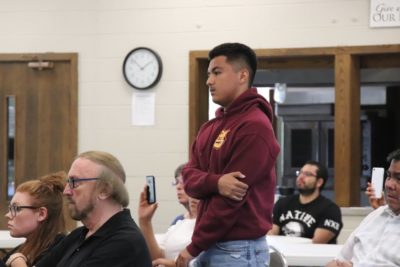
Since the raid in May, Iowa WINS has been doing more urgent work – partnering with churches in the area to provide for basic needs of families in which the husband has been detained or deported, and to use donations to bail detainees who were awaiting hearings out of jail.
One teenager was left alone after the raid – “his dad was deported last week. His mom is still in Guatemala,” Hegar said. The 15-year-old boy, Walfred Uriza, is facing deportation himself, Hegar said, even though he had already begun the process of seeking asylum after receiving death threats from drug traffickers who wanted to use him as a mule to carry drugs. Those threats caused Walfred and his father to flee Guatemala for the United States; his father has now been sent back, although some fear he may be killed.
For now, families from the community are providing the boy shelter and Iowa WINS is giving money for food. “He wants to work everyday and send money back to his family,” Hegar said – although he and others are encouraging the boy to stay in school, telling him, “Your job is to study.”
Some of the men caught up in the raid were the primary or sole sources of income for their families, Hegar said. Although ICE reported that some had criminal records, others were in the process of trying to obtain legal status, Hegar said. As of mid-August, five had already been deported, one leaving behind four children and a wife who does not have a job. A few families are thinking of leaving the country voluntarily, Hegar said. During a rally shortly after the raid, one woman said six of her cousins had been detained.
After the raid, it took significant time and energy for immigration advocates to track down where the men had been taken and what their status was, particularly for single men who weren’t married and didn’t have families here. ICE would not provide a list of the men detained, but the company eventually did, Hegar said.
“It took us two weeks to get in contact – they move them from facility to facility,” he said. When the advocates found one of the detainees, they got as much information as they could from the man – name, phone number, family members “and anyone else they knew of who was detained.”
The daughter of one of the men detained, Juana Barrios, toldIowa Public Radio in May that she had come to the United States when she was three and that her father had been in the country for 17 years. “He’s been working very hard to feed our family,” Barrios said, and “we know he is a good man,” with no criminal record. When she found out he had been detained, “it was the most horrible feeling I could ever experience in my life,” Barrios said.
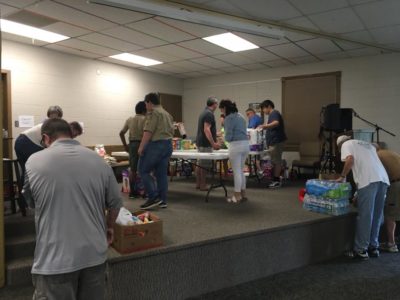
People who heard of the raid began donating money and also supplies for the church’s food pantry – laundry soap, diapers, rice, tortillas, beans and now school supplies. The money received in donations – more than $120,000 as of early August – was divided evenly among the families and used pay rent, utilities, groceries and legal bills, but is about to run out. “We’re just trying to be a Band-Aid for a little bit,” while families of those being detained figure out to do next, Hegar said.
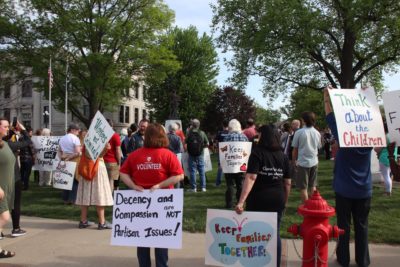
Iowa WINS also has held prayer vigils and public gatherings in support of the immigrants — speaking out on the impact of family separation and deportations and working with the Eastern Iowa Community Bond Project. And people have shown up in Mount Pleasant to help – driving for hours in cars packed with donated supplies, with Spanish-speaking graduate students offering counseling and other assistance for immigrant families.
The raid has united the mainline denominations and the Roman Catholics, but divided evangelical churches from mainline ones with differing theological views of what loving one’s neighbor means in this situation, Hegar said. “The argument is ‘they’re illegal.’ To which I said, ‘Thank God Jesus didn’t take that stance for us. … We’ve learned to say they’re undocumented immigrants. Nobody is illegal.”

The religious divide in Mount Pleasant over immigration mirrors what national polls show: According to the Pew Research Center, 81 percent of white evangelicals who voted in the 2016 presidential election voted for Trump, as did 58 percent of Protestants overall and 60 percent of white Catholics (although only 26 percent of Hispanic Catholics did).
A Public Religion Research Institute (PRRI) poll from April 2018 found white evangelical support for Trump at an all-time high, with 75 percent at that time holding a favorable view of the president.
This summer, First Presbyterian has begun holding regular “Getting to Know You” sessions at the church – giving Spanish speakers a chance to learn words in English and English speakers Spanish. Hegar has told families of those detained – some of who had attended evangelical churches in town – that they are welcome in his congregation.
Since the raid, a few of the immigrants have started coming to worship at First Presbyterian. One woman told Hegar: “I see Jesus in your church.”