Andrew slid up to the table to speak to the chaplain at the Travel Center of America (TA) in Columbia, New Jersey. He had been eavesdropping on a conversation the chaplain was having with a group of elders and pastors who were visiting from Kenya to learn about the truck stop ministry that had been active there since 1985.
 “I overheard you talking about the needs of drivers. There are things you should know,” he told the group. “Drivers need chaplains. This is a secret society. We’re all looking for a cave — no real attachments; we avoid relationships. We don’t want to be hurt.” He further explained: “Drivers are prodigal children. They have no faith community. It makes keeping the spiritual life together difficult. It hurts without it. You have no one, only yourself.”
“What do drivers need the most?” one of the Kenyans asked.
“Genuine care — what they lack is someone who cares,” said 29-year-old Andrew, who hailed from the Arizona desert. He had taken to the open road after a drunk driver killed his fiancée and daughter five years earlier.
Economic lifeblood

The NorthWest Jersey Truck Stop Outreach (NWJTSO) is a ministry that serves drivers and travelers at the TA that is located 70 miles west of New York City on Route 80. Here, big rigs can park, refuel and undergo repairs, and long-haul drivers can shower, wash clothes, grab a hot meal and purchase essentials before or after they deliver their load to the major metropolis or other destinations.
The trucking industry is the lifeblood of the U.S. economy, says the American Trucking Associations, the largest national trade association for the trucking industry. Nearly 71 percent of all the freight tonnage, about 10.5 billion tons annually, is moved in the U.S. via trucks (about 80 percent of all cargo). In 2016, there were 3.5 million truck drivers.
Over-the-road drivers spend over half of their lives behind the wheel traversing deserts, mountains, lone stretches, main arteries and blue highways to deliver the abundant life. Without this industry, the U.S. economy would be at a standstill. Drivers bring to our shelves the fruit of the harvest: corn from the Midwest, raspberries from Canada, cherries from Washington, peaches from Georgia, watermelons from Mexico as well as products from around the globe, including such faraway places as China, Thailand and India. They load up at ports that are rife with organized crime, human trafficking and suffocating pollution. Without these men and women, we would starve or experience consumer withdrawal for which no rehab yet exists.
Ministry of presence and attention
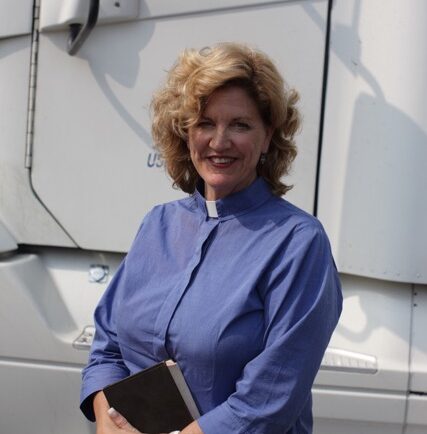
Serving as the chaplain at this truck stop since 2006, I have learned one thing: Drivers need someone who will actively listen, who will care about what’s going on in their lives, who will travel with them down the highways of their story. They need human fellowship, no matter what their faith tradition, or lack of one. This is a ministry that is about one thing: presence. It’s about simply being attentive, without an agenda or spiritual quota to fill. It’s a ministry that reaches around the world as drivers come from every nation under God — Bulgaria, Turkey, Syria, Iran, South America and Russia, to name a few.

Although no one can claim ministry in any setting is safe, the truck stop in particular strikes many as thrusting a minister into the “darkness,” which may be the best reason for being there at all. As a woman I am careful about how I present myself, how I dress and where I go within the premises. I don’t, as some joke, knock on the doors of 18-wheelers in the back parking lot and ask drivers, “Do you know Jesus?” Parking lots at many truck stops around the country are known to be the territories of pimps and prostitutes, although there have been efforts to clean up the more notorious stops across the country. A driver once shared how a young woman, with an infant in hand, went from truck to truck seeking five dollars to feed her child.
Shortly after I came to be a chaplain here, there was a serial killer on the loose. It turned out that Adam LeRoy Lane was an over-the-road long-haul truck driver, who would lock up his truck in the parking lot of a truck stop and walk into the nearest neighborhood to prowl for his next victim. When he found the first unlocked door, he’d enter and kill. One of his last victims was murdered a block away from a truck stop, which was 21 miles away from the one I serve and he had likely frequented my truck stop as well.
According to the FBI, if you’re a serial killer, then being a long-haul trucker is an excellent career choice. The FBI noticed a pattern to highway serial killings and began The Highway Serial Killings initiative in 2004. It’s reported that more than 750 murder victims have been found around U.S. highways, with about 450 potential suspects, many of them truck drivers.
A glimpse into truck stop ministry
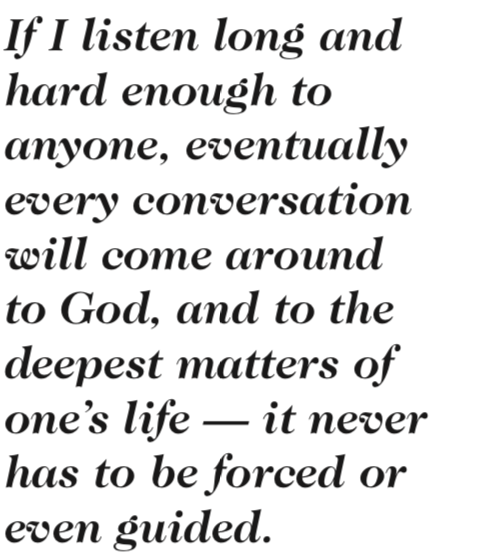
I am here one evening a week and on call 24/7 for drivers, the staff and for those who find themselves stranded here. As the chaplain I have learned a profound lesson: If I listen long and hard enough to anyone, eventually every conversation will come around to God, and to the deepest matters of one’s life — it never has to be forced or even guided. When I began my ministry I offered a Sunday afternoon worship, but I found that few attended as most drivers tried to make it home on the weekends — and there was some resistance to a female pastor. I decided that a mid-week Bible study would be less threatening and hopefully better attended. I invited members of the two churches I was pastoring at the time to join me. Now, 12 years later, many of the original attendees still come, but it has expanded, and now several from various churches join in to become a faith community away from home for those passing through. Individuals from the Presbyterian, Lutheran Brethren, Catholic and Evangelical Free churches come to share the gospel, to study the Word and to help.
 HAZMET driver, Mike, joined the study four years ago; a year later he asked to be baptized at the truck stop. “I consider this my church,” Mike said, before confessing his faith to the group and to the friends he had invited to witness the event.
Another young man, David, in his late 20s had walked away from a long-term drug rehab program two towns away, and accidentally attended the Bible study one Wednesday evening, believing it was an Alcohol Anonymous meeting. Tory, a local man who regularly attends the study, invited David to stay with him that night since David had nowhere to go. The next day, David came to faith in Christ. Tory, who is in his 80s, reported that it was one of the most blessed days of his life.
On another occasion, I had the privilege of officiating a wedding at the truck stop.
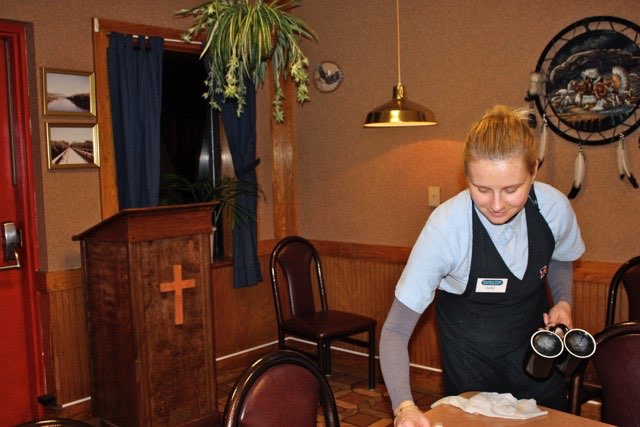
I listen to a lot of stories. Colleen, a waitress, shared her story with me one evening, in between waiting tables. Her mother had been a drug addict when she was young, which left Colleen vulnerable to the men who came and went from her home. When she was four, her stepfather raped her. I’ve learned that when we tell our tragic stories, sometimes it loosens the hold that our personal traumas have on us.
Travelers sometimes end up stranded here for one reason or another, like a 60-something-year-old woman who met a driver in a bar in Wisconsin. Being intoxicated, she passed out drunk in the back of his big rig. She woke up in New Jersey the next day, only to have the driver leave her there cold. Wearing only shorts and a T-shirt, and since it was zero degrees out, the TA management gave her some warmer clothes. She had no identification on her, nor any cash. The NWJTSO brought her a bus ticket home.
Since 1985, when the first minister served the Columbia TA, the ministry has been supported mostly by area Presbyterian and Methodist churches and various humanitarian groups, like Rotary and Kiwanis, Women’s Clubs and individuals. It costs about $6,000 to $10,000 a year to provide the ministry. The funds go toward the purchase of Bibles that are free for the taking, for emergencies to help stranded travelers or to members of the TA staff who find themselves in need. It also provides a small stipend for the chaplain. Other types of donations come in, too. The women of the Blairstown Evangelical Free Church, one town over, bake 400 dozen cookies every Christmas and package a dozen per bag for every driver that passes through. On Valentine’s Day, the local Woman’s Club also bakes cookies for the drivers.
And drivers give back. When they are unable to deliver a load for whatever reason, they have given fresh produce, hundreds of pounds of butter and other items for area food pantries.
Drivers’ tales
Ed. One night a man settled in at the counter. He had glistening olive skin, a pock-marked face, black-rimmed thick glasses and dark, wavy hair. He opened a black leather book in a language that looked like Arabic. I asked if he was reading the Quran.
“I do not talk of this,” he said. “Religion, politics, I do not speak of this. Everyone has their own ideas. People get upset.” He was reading the Bible in Farsi, his mother tongue, I later learned.
“I am a Christian,” he said.
When I asked him where he was from, he refused to say.
“I keep my faith private. Quiet. The world is dangerous, even here in America.”
I invited him to come to the Bible study that evening. He came, told us his name was Ed and that he was from Iran. He taught us about the historical relationship between Jews and Persians and how so much changed with militant Islam. I asked about Christians being persecuted for their faith in Iran.
“Men came to my brother’s house in Tehran in the middle of the night. They pulled him from his bed, took him outside to the drinking pool and cut off his head in front of his family. They beheaded him because he was a Christian.”
“Ed” had moved to America to escape his brother’s fate.
Dan. Another driver, who was 87 years old, had been hauling Christmas trees from British Columbia. Dan said he didn’t have a choice but to keep driving, as he had spent his life savings on medical care. Six years ago, he had been laid up in his truck for days as he writhed in pain. A good Samaritan discovered him slouched over the wheel. After being hospitalized, he underwent surgery for colon cancer. Even during chemotherapy treatment he couldn’t afford not to drive.
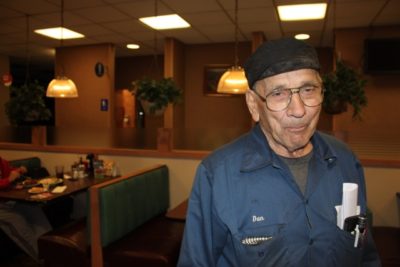
As his story unfolded, he told me how he was drafted into the army as WWII raged in Europe before finishing his engineering degree.
“My infantry had orders to clean up Dachau, a concentration camp in Germany. When my division entered the camp there was evidence that the Nazis had vacated the camp only hours earlier. Fires were smoking. The tire tracks were fresh. We saw that the ground had been moved. It was darker than the ground around it. Our commander told us to rake back the dirt.” He and his comrades uncovered body after breathless body. “Their mouths were opened as if they were still screaming. We found a man who was still breathing. Then we dug with our hands, trying to find others who were still alive.”
“The man, he was as thin as this blade,” he said, flipping his knife sideways. “A skeleton.”
“I think of that man everyday of my life,” he said.
As I watch him walk slowly out of the restaurant, I think that all ministry is about resurrecting the living.
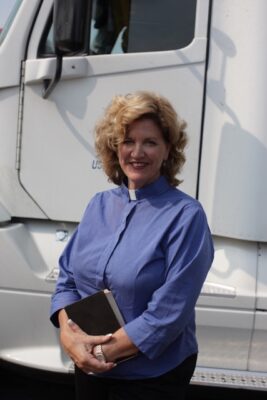 Sherry Blackman, a journalist, poet and author, serves as the pastor of The Presbyterian Church of the Mountain in Delaware Water Gap, Pennsylvania, as well as a truck stop chaplain at the Travel Center of America in Columbia, New Jersey, a validated ministry of Newton Presbytery. She is the author of “Call to Witness: A True Story of One Woman’s Battle with Disability: Discrimination and a Pharmaceutical Powerhouse” and the forthcoming “Rev-It-Up: Tales of a Truck Stop Chaplain.”