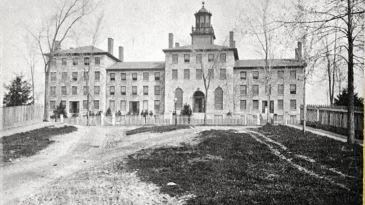

Author’s note: This is a work of fiction. However, “Connecting Grace” is a real initiative of Johnson C. Smith Theological Seminary, in partnership with the Philadelphia Leadership Foundation, that equips faith communities to be agents of healing for families affected by crime, incarceration, criminalization and stigmatization.
Between 2013-2018, I had the honor and privilege of working with James H. Costen Jr. at Johnson C. Smith. During the workday, we shared dreams for this developing initiative. Mr. Costen passed in April 2018. The story that follows is in honor of the profound work of Mr. Costen, his father, the Rev. Dr. James H. Costen Sr. and his phenomenal mother, Dr. Melva Costen.
I never wanted to be a newspaper reporter, but after three decades, I have fallen in love with it. I love the people I meet. This week, I met Frank Jackson. At the end of the month, Mr. Jackson will be released after serving 24 years, 18 days and six hours in a maximum-security prison for possession of an illegal substance. While imprisoned, Mr. Jackson completed the number one best-seller, “Connecting Grace.”
Even after so many years in that room that barely exceeded his height in length, he told me he could still close his eyes and hear his sister laughing. He could still hear his neighbor’s multiple attempts to start his lawnmower. Louder still and without squinting, he could hear the voices in the choir, could still hear his momma playing the piano, could still hear his daddy preaching.
I am not sure if he was attempting to hold on to something that could not be bound, or setting something free that was once bound within him. But each day, he took time to read a tattered Bible, holding it just outside the cold steel bars of what he called “his cage.” As he touched and turned the slender pages, it seemed he was spending time with a friend who loved him mutually. Yet today, he stared at it with angry tears, as if looking up to a trusted relative who had tortured and abused him. The Bible was supposed to remind him of a God that promised not to leave him. Today, he said, it reminded him of a church that abandoned him.
“Patiently, I’ve waited,” he said. “Each week, each month.”
He told me of how he knew of weekly Sunday services going forth with might; he could still hear them in his memories. He knew there was Sunday school at 9:35 a.m. every Sunday. Wednesday was still synonymous with Bible Study. He knew that at his grandmother’s church, the Wednesday before the first Sunday of each month was set aside for an “all night” prayer meeting. They were often there until 9:15 p.m. Yet, as hard as he squinted, he could not hear them praying for him.
Closing his Bible, he pondered, “How does a man become pariah to a parish that once parented him?” Perplexed and pushing back his tears, he slid the book back through the bars and beside his bed he bowed. Quietly, I listened as he prayed aloud:
Mother, Father God, I feel you here. Through the coldest nights I feel your warmth and through the thickest heat I feel the gentle cooling breeze of your Spirit. Just as my enslaved ancestors who endured the ruthless Middle Passage somehow managed to feel you amidst the worst imaginable conditions, through the greatest horrors endured by any group of human beings to date, right now, I feel you. With no sign of your grace before them, they held on to the only thing they had left. They held on to hope. They held on to you alone. Right now, I’m alone and I’m holding on to you.
They called you by names that their captors despised. They called you Olorun, the owner of heaven. They called you Olodumare, The One who no person and no thing is greater than. They called you Chukwoo, Unkulunkulu and Masou Karoni. Mawu draw me near to you. Closer. Closer. Close enough for me to hear your whispers of comfort and care.
Whisper to me like you did to my ancestors who labored in the dusty fields of Georgia from can’t see to can’t see. Even though some weren’t able to escape their plantations, they sang and prayed to you until they escaped at the level of the spirit. Just as they imagined riding the chariot to see King Jesus as a counter-narrative to their captors’ god, King Cotton, let my soul ride to freedom.
Hear the deepest desire of my heart. I want safety and provisions for my son and my wife. I want her to know that I love her. I want him to have guidance to become the best man you would have him to be. Thank you for any way you make that happen. Thank you. Thank you.
And my mother, my father, my sister, my brother — I need them to know that physically, mentally and spiritually, I’m OK. I’m OK. I. Am. OK.
Thank you for being my doctor in my sickroom and my lawyer in the courtroom. Thank you for not letting my bed be my cooling board and my sheets my winding cloth.
And if you do come before I wake, give me a home somewhere over there. Somewhere where I can walk the streets of gold. Somewhere where every day is like a day in May and every month is like the month of June. Somewhere where it’s always “howdy howdy” and never “goodbye.” I pray all these prayers in the name of your precious, sweet, darling son Jesus’ name. Amen
He rolled onto the bed and pressed down the tape that held a miniature picture to the wall close to his bed. “This picture was taken one afternoon when Rev. Dr. Martin Luther King Jr. came to my parents’ house. A lot of folks lie and say that they marched with King. My parents did in fact march with King. They marched with him, worshipped with him and joined him at table.” There in the picture were his parents with the pastor King and his wife Coretta, all having dessert in their dining room.
He rolled to stare at the ceiling. “This ceiling is something like a movie screen. There is more space up there than in my head.” He said today’s feature presentation was “Memories from My Southern Racist Grade School.” He told me in his mind’s eye he could see a boy coming his way. He was on the playground at his school in Rocky Mount, North Carolina. Just as he put his foot on the ladder leading up to the top of the big steel sliding board, he turned again to see the boy standing next to him. The boy’s face was filled with rage. A little girl standing next to him seemed to be crying. Soon, there were two more boys, all three seething and screaming. Screaming something, but there was no sound. He wondered what made the boys so mad. He wondered why the little girl cried.
He placed his foot on the next step of the ladder and suddenly he felt a jerk. With a second jerk, he felt himself flying to the ground and the sound of the three boys exploded as if the sound of three hundred men. “You can’t put your nigger butts on our sliding board before her. If you go up there, she can’t go. You just have to wait until she’s all done.”
He had been denied time to play on the playground before and he even knew the “rules.” He also knew that the teacher told him he could play on the slide now and that the boys had no reason to touch him. Without another thought, he stood up and knocked one of boys to the ground with one punch. Just as he felt the pulse in the veins of the next boys neck start to pound in his clutches, the teacher screamed his name and he was back in the present.
He sighed and said, “That had to be the worst time of my life, 1957. Dad moved the family from Ohio to North Carolina to begin his first pastorate. It was a modest-sized congregation. Initially, we had black and white members. Our family wasn’t supposed to be suspicious or afraid. Like hell we weren’t. It was the 1950s.”
Yet, at least once a week, mostly on Sundays, they were invited to visit someone’s home. Members wanted to talk to their pastor and his pretty little wife about his messages about racism and injustice and about her freedom songs. The atmosphere thickened by the end of each evening. His parents were much quieter on the way home than on the way in. There were rarely two visits to the same home.
Mr. Jackson continued: “The black folk were interested in sermon discussions too. Every dinner meeting included some kind of heavy question. Dr. Bryant, the first and only black doctor in the city invited us over once. He asked, ‘Can’t we just wait a couple of years until they get used to you?’ Ms. Jeremiah, the oldest and wealthiest living member, asked him one time, ‘Why must you stir these people up, Reverend?’”
He wished they could just move. Pointing up as if to be projecting on the big cement screen above his bed, he talked about five years of report cards. “Nothing but A and A+ lined the coursework column. But over here in this conduct column, there was a whole ‘nother story. Not an A could be found on any of the cards. I remember in 2nd grade, there was one B+ in conduct; that was because there were no white students in my class. After that it was all D’s and F’s in conduct. But that class work grade column stayed full of A’s!”
By the time he left 8th grade, he’d had multiple fights. He never aspired to be a fighter. He didn’t even want to be an athlete. He enjoyed history, politics and poetry. Yet, every day was a fight. A physical fight. A mental fight. A spiritual fight. For respect for himself. For respect for his siblings. For space to listen and learn, uninterrupted. For basic survival.
What he shared with me about those fights resonated. He said: “The biggest fights happened at night. Brawls. Epic battles for quiet inside my head. Many sleepless nights in that little tiny bedroom I shared with my brother. That was when I first started using the ceiling like a screen. Every face I saw was red with spite.”
He told of the rag-tag symphony of slurs and curses that seemed so loud. Inside stores, bared teeth and snarls accompanied the response to the simplest requests. Small groups formed everywhere his family went. Most were flash mobs of three or four people, but menacing all the same. Occasionally there were signs. Picket signs. Segregation signs. “Whites Only.” “No Blacks, Jews, Spics or Chinks allowed.” There was no real comfort in knowing they weren’t the only targets.
“At home, we felt more cornered than free from the bigotry. Children and adults yelled when they drove by. Police knocked at least once a week with noise complaints; even when no one was home. A phone call could be expected every Sunday.” The ceiling-screen never showed a peaceful picture, never a place where he was wanted.
“That’s why I was so excited when I heard we had been invited to dinner at the home of another local pastor. Martin Luther King Jr. was coming! I had heard him on television. He sounded older on television. Maybe it was the age of the struggle. I admit, I was starstruck. My parents and THE Rev. Dr. Martin Luther King Jr.!” He realized that somewhere inside of him, there was an expectation that this visit from THE Rev. Dr. Martin Luther King Jr. would be salvific. During dinner, they did talk about the church and civil rights for a few minutes early on. And he could tell by his father’s nods and his mother’s gentle smile that they were receiving affirmation of their efforts but, how much longer were they to have to fight!?
By high school, Jackson’s family moved to Atlanta, his father called to build a new church in the heart of the black community. It was finally over. No more jeers and name calling. No more fighting. Just building and learning.
Jackson said, however, “My first year of high school was also my first year of dating and trying drugs. By the time I graduated, I was on a consistent diet of frosted flakes, potato chips and cocaine. I never tried to quit, but I did try to hide my habit from my folks.”
 His dad knew; he wanted to help him get clean before his mother found out. His mother knew; she wanted to help him get clean before his father found out. When they both knew that the other knew, they wanted to help before the church and the community knew. The church and the community knew but they didn’t want to know. So, they didn’t know.
I know the pattern Jackson was describing all too well. Somewhere between false notions of Christian piety and black respectability politics, families and churches often hide the problems of their members rather than bring them forth for assistance and support. Drugs and their associated crimes tear families apart at the root. But to share that someone in your family is suffering an addiction or a crisis is an indictment against your faith; if your prayer life is airtight, the devil shouldn’t be able to get in. Moreover, some believe that to be fully Christian is to be “washed white as snow.” That is to say, to be saved is to be elevated above blackness. To have drug problems or to have some in one’s family incarcerated takes one away from their proximity to whiteness and catapults them irretrievably into the black abyss. Shame is powerful. So is internalized oppression.
For Jackson, at that time in his life, the drugs dulled the pain. Things were better in Atlanta, but he still saw sneers and heard jeers. “But my medicine worked, Brotherman,” he said as he sat up on the side of his bed, sitting knee to knee with me. “If I could hit that pipe two or three times, the noise just went away. The visions went away. I could have peace all day. After a while it went from two or three times a day, to five or six times a day. Next thing I knew, I was hitting it every hour or two.”
He recalled knowing that it wouldn’t be long before he hit bottom. “The fact is newspaper man, I had already hit bottom, I was just so high I couldn’t feel the impact of the fall. But after that first night in here, after a few hours unable to get to my high that allowed me to sail above the noise and the visions and the pain, I heard and felt it all! And this time it was worse than ever!”
Many had told me of the pain of crashing from years of self-medication. Mr. Jackson was probably the most famous incarcerated person I had ever interviewed, but he was not the first by far. I interviewed the first in 1995, the year after the passing of the Violent Crime Control and Law Enforcement Act. This bill’s tough-on-crime rhetoric highlighted an all-out obsession with America’s correctional control. It assumed black boys as young as third grade would be imprisoned by young adulthood, and rather than supporting circumstances to avoid this, adequate prison facilities to house them were built instead. Author James Logan summarizes the outcome of this bill in “Good Punishment”:
Since 1980, the United States has engaged in the largest and most frantic correctional buildup of any country in the world. In 1923, the United States had just 61 federal and state prisons. By 1974, there were 592. Today, more than 2.4 million people are locked away in 1,719 state prisons, 102 federal prisons, 2,259 juvenile correctional facilities, 3,283 local jails and 79 Native American country jails. If military prisons, immigration detention facilities and civil commitment centers are added to the equation, these numbers expand geometrically.
As a reporter that has read the statistics over and over again, one would think that I would be dull to the numbers by now. To know that the build-up of prisons and mass incarceration in America is the black-lash of the abolition of slavery makes my blood boil. In a country and an economy that was never intended to work without access to free labor, the prison industrial complex is the only answer. The end result is arrest, imprisoning and ultimately the farming out of people that disproportionately looked like me and Mr. Jackson to companies that use cheap prison labor like Microsoft, Procter and Gamble and AT&T.
As he and I rattled over the numbers, he told me of one of the sermons his father preached that stuck with him. Though a lament of a prophet from centuries ago, the topic text echoes the cry of millions of African-Americans today.
For help that never came, we looked until we could look no longer. We kept waiting for help from a nation that had none to give. – Lamentations 4:17
 He loved to hear his dad preach. The church was once his favorite place to be. That’s why, though he had become accustomed to America’s betrayal, there was a constant nagging about the absence of the church during his time in prison. Sure, he got a couple of visits, but where were his letters and care packages? Where was the care for his wife and his child?
“The way Dad preached about Peter’s imprisonment had my expectations all out of whack. Peter’s church prayed for agency. They solicited God for direction on what to do for their imprisoned friend. Where was the agency of my church?” He stood and began to pace the floor and smack his hand with his fist. “I thought, well, maybe they’re hampered by finance. Then I remembered that our congregation included some of Atlanta’s elite; the median income of these upper-middle-class folk exceeded $200,000. So maybe they were too busy, I thought. Then I said: No, over 30 percent of the members are entrepreneurs; they can be off when they want to be. At least another 30 percent are retired. Then I just settled on that fact that they must be ashamed of me. It’s like ‘How could the pastor’s kid end up in prison?’ It’s like you said earlier, most church folk I know have a certain view of themselves, like, ‘We’re not those kind of black people.’ Black children raised in the church don’t go to jail; we go to college. We make God proud. We go to Spelman, Morehouse, Harvard, Princeton and Yale. We are the physicians, engineers, lawyers and business owners!”
He might not have wanted the church to visit as a group as much as he thought he did. The model for prison ministry in the Christian church is too simple and, unfortunately, ineffective. Scheduled visiting groups include a minister and a band of singers. The goal is always to pack as much Jesus in the allotted 30 minutes given by the facility to get the gathered inmates “saved.” It can be very impersonal and more about putting a checkmark on the churches’ mission ministry books for the month. The imprisoned are somewhat dehumanized by the whole enterprise. I recall reading some of acclaimed ethicist, Riggins R. Earl Jr.’s work on this topic. In his book “Dark Symbols, Obscure Signs,” Earl wrote:
“This is the body-soul dilemma. It is a constant dance between ministry to one or the other, never both. Traditional prison ministry seeks to save the soul without care to the body and those attached to the body. It is only a half-step away from the way ‘Christian’ slave masters focused on the body of the enslaved Africans. (Their souls were seen as corrupted and unsalvageable from having spent time inside their dark bodies.)”
So, patiently, he waited. Month after month. Year after year. He was one of the fortunate ones that had a supportive family. They were there every month. It was easy to mistake them for the church since they were members as well.
His mother and father did ministry to the families of the incarcerated well before the church would ever consider it. Jackson said: “At the end of my fifth year, mom told me that Gena, this sister that was a cheerleader at my high school got locked up for four months for failing to pay some parking violations. The cash bail was too much for her family, so she was stuck serving time while they worked to try to bail her free. I have the first letter she wrote me while she was in there.” He pulled out a wore piece of paper and read:
Hey Frank –
I’m in county for three tickets. I couldn’t pay them. I can barely feed my family. Originally, they were between $100-200. By the time the late fees and penalties kicked in, it was over $500. I kept hoping for a miracle.
This is hard, Frank. My children miss me and I miss them. I’m all they’ve got. I mean their dad is alive but … I just can’t be locked away in here. Nia just turned 9. Fatman’s birthday was last week; he’s 8 now. Can you believe it!? He’s so tall! He’s still a baby to me and I miss his little pumpkin face more and more every day.
Trice has some kind of little skin rash, but it’s getting better. If I cry another tear from not being able to hold my babies, I think I’ll dry up and die. But more than missing them, I don’t know what they’re eating or how they’re eating. Then Momma had to cancel Nia’s doctor’s appointment; because she didn’t have money to pay. She had to cancel one of her own appointments; I normally drive her. They’re staying with granddaddy right now; we lost our apartment. I’ll be able to find another place when I’m out, but all of our furniture and much of our clothing got ruined in the eviction.
Please ask your church to pray for us, OK? Love you, Fathead! xoxoxo
Putting down the letter, he said: “I couldn’t even force myself to say that I would. What the hell was a prayer going to do for a jobless, homeless mother with two sick babies? She needed the church to do something more than pray.”
That’s when he started to unpack his idea; it was simple. The church didn’t have to house all the resources she needed. The church could build relationships with entities that could help her family both while she was incarcerated and after her release. They could be the hub of needed connections. Connecting people to the grace they needed. “Connecting Grace.” Basic survival needs. In a case like Gena’s, before her release, the church could begin building a relationship with her and her family. Following her release, they could become family.
But there was one small problem. What about perceptions? He said: “Momma had already solved this problem. Though the church wasn’t ready to put my program to work, she had reached out to Gena of her own volition. She invited Gena to come to one of her choir rehearsals. They were preparing for Women’s Day. Gena and two more ladies that Momma met while visiting the jail all came to help. Originally, they were only needed to help assemble some new song books. But, once a rain storm rolled in, so did the calls of ladies saying that would not be able to make rehearsal. This was a disaster. There were no more rehearsals and attendance had been scanty at best at the previous two. There were no altos. Actually, mother knew there were three.
“She knew Gena could sing and Jackie had posted a picture of herself impersonating a blues singer. It was time to make good on that impersonation. Tracey was mortified, but she wasn’t about to show it in front of these snooty church women. As they moved up to the right side of the choir loft, the stares turned into glares. The whispers started, ‘Where did you get these girls from?’
“Momma told them she met the women in Greendale and when the church women asked if she meant the prison, I was told Momma’s voice thundered and she said, ‘And they will assist me in any way I choose!’
“Gena told me that rehearsal was the first time she had sang publicly since we were in high school. Tracey had never sung before, at least not in public. Soon they were all singing as one choir. When Jackie soloed on ‘Oh Lord How Excellent,’ the glares turned into looks of adoration and the choir became one voice of collective praise.”
When he asked his mother how she knew her little experiment would work, she replied, “Christians want to love the Lord, but they don’t want to love the Lord’s people. Your father built his church by becoming one with the people of the community, not just the people of the church in the community. His favorite hangout was the pool hall. The guys in there trusted him. Even when he couldn’t get enough people from the church to go, he would take whole vans filled with people from the community to the prison. Many times, we were the only way some of the parents got to see their children. The choir was people from the community not just the church. You see, it was never about voices. Singers are a dime a dozen. It was about using this common language to build relationships.”
She’d used the same relationship-building tool to build a coalition between the sisters of her sorority, a far more aristocratic bunch than the church. She testified: “When the people gathered, they didn’t see professional singers, recording artists, social elites, ecclesiastical dignitaries, prisoners or formally incarcerated persons. They didn’t care what denomination or faith tradition was represented. When the melodies blended, they heard the voice of God.”
Jackson noted: “That was the source of my book. It can work. Some of the churches that have started the work have sent me letters to let me know that it does. You don’t have to be a mega-ministry, just have an abundance of love and care for those imprisoned who Jesus counted among the least of these.”
As I finally exited through the clanging door of bars, I looked back at him and he reached out through the bars for my hand. “This is how you connect,” he said. “From out there to in here. By starting conversations and extending the grace you know you would want if the shoe was on the other foot, for you, for your family. Next week this time, I’ll be at my first book signing. Don’t miss it!”
Until then, patiently, he waited.

CARLTON JOHNSON is the operations officer for Johnson C. Smith Theological Seminary in Atlanta and associate minister at the First Afrikan Presbyterian Church in Lithonia, Georgia. He also serves as president of the Atlanta chapter of the Association for the Study of African American Life and History.