 I learned to run by chasing my father. To wait on a front stoop with laced shoes was to demand entrance into a space I had not been invited. Never mind the family business and loads of stress, or the need for a quiet hour to himself, I was determined. The trick was to slip out the front door undetected, to avoid a mother’s suggestion of letting him run alone. To sneak into the cacophony of summer cicadas after the garage door closed and before his bedroom door opened was to steal time with an intriguing, yet stoic, father who was far more action than words. Headphones in, here he comes and… off he goes. Quick toes, knobby knees and gangly legs, turned over themselves like the machinery of a grasshopper caught on her back. Right beside him. Just behind him. Way back. He never slowed down, and he never looked back. Sure, I stomped home mad and defeated. I might have even cried as a 10-year-old, but eventually, this game of chase turned into years of running with my father. I was as stubborn as he was.
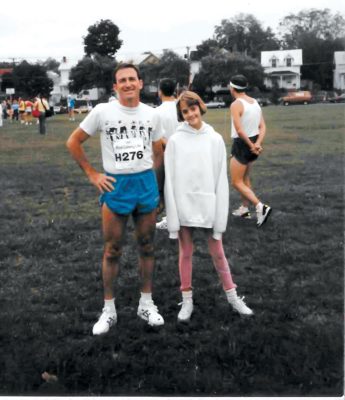
What I discovered was that running granted entrance into a holy space, where I could align the rhythm of my feet with God’s breath. Through disciplined practice, a sense of peace and purpose emerged as if it was the clean and pure air I needed to survive. To intuitively predict my next three steps on the dew-laden edges of a Blue Ridge trail, to overcome the burn of a mountain climb, to lock step with the old man on a silent morning, was to experience God’s grace and even God’s love. This was my shameless pursuit: that space, that moment, that feeling. And winning was, well, all the better. Sure, I’d wait if I had to, but in the end I demanded entrance, pursued access and demonstrated my worthiness through sheer determination. Most of all, running provided a framework for life and in time, an identity.
So nine years later, it was devastation that took my breath away when I could barely finish a collegiate cross-country meet. Running, lifting, running, swimming, running, eating, running, even sleeping and dreaming were infused with the chase. But the endgame was no longer a space or feeling, the goal was to win. I still loved to run, but somewhere between the rolling hills of southwest Virginia and toeing the starting line in college, I had come to hate the race. Dreams were nightmares, freedom was a trap and if running was a significant part of who I was, I no longer recognized myself.
Graduation replaced the warm and fuzzy Blue Ridge Mountains with a huge sky that held peaks so threatening I felt small and naïve to what a mountain really was. I ran out west, away from “all that running.” A girl could get lost out there, and I did. My friend Joe calls these “my testimony building years.” I call them lonely. I worked. I traveled. I occasionally shirked into random narrow-minded churches. I dated musicians. None of this helped my growing sense of invisibility and looming unworthiness. Come to find out, the mountains were right; I was indeed both small and naïve. After two years, I finally did the only two things I knew how to do. I went for a run around a nearby lake. Then, I prayed.
To be honest, praying had never been my thing. The way I saw it, whatever I had to say, God already knew. Plus, I couldn’t think clearly, much less come to terms with what I needed to say out loud. No, this drama was of my own making, and mine to deal with alone. As my dad always said before vacation, “You pack it, you carry it!” God had more legit matters to attend to: cancer, war, starving children in Africa and people who still believed in God, to name a few. Besides, all that “God language” seemed self-righteous. As a teenager, I would occasionally time the church prayers with my running watch. “For the Love. Of. God. If God isn’t dead, I’m sure this prayer is killing ‘him.’ ”
Oh Holiest Heavenly Highest God,
Why hast thou abandoned thy stubborn servant?
That Thou hast not even noticed thy
frustrated and impatient
daughter as she hast stomped away
from thine glory, sort of mad,
yet again,
I beseech thee
to assist her and
fixeth this messeth, once and for all,
and I ask thy Holy Ghost that this plea may ascend
unto thee and have access to thou golden throne, whatever that means.
Thouest Shallest Hurryeth Upith. Amen.
To be clear, I did not set out on my run with a prayer in mind. No, that day the plan was to run as fast as I could until I was forced to choose between inhaling or perhaps dying. Running has always been the place where God and I work stuff out. No words needed. So, you can imagine my surprise as I exhaled from the pit of my stomach and out came this one huge ask, “God, get me the #$*#@ out of here!”
 How demanding. How impolite. How desperate. After looking around to ensure no one other than the enormous bird floating near the shore heard me, I just kept running. On my way back, I stopped by my mailbox to discover a letter nestled deep inside. A friend was inviting me to explore the idea of leading a Habitat for Humanity team to Malawi. Two weeks later, I received a job offer that would transfer me back to the East coast. I guess Thine Holiest showest me.
I did go to Malawi several months later. Exercise in a place that requires relentless work to stay alive seems ridiculous, perhaps even offensive. Women and girls balance full buckets of water on their heads as they travel for miles each day. Over 10 percent of all adults are HIV positive and 50 percent of the country lives in poverty. On average, Malawi loses more than 2.7 percent of its natural forest every year. These issues are devastating and urgent, and yet there typically seems to be no need to run. Keeping time is a good idea in theory, but I learned quickly that there is really no difference between, “now,” “now now” and “just now.” Each suggests the near future with no guarantee. It could be an hour, or perhaps a few hours, or maybe even in a few days, so don’t hold your breath. My running watch was entirely useless, and for the first time in my life I wasn’t sure what I was supposed to achieve or pursue.
If Virginia is for lovers, then it is true that Malawi is the “warm heart of Africa.” To spend time in Malawi is to spend time with humans who possess a deep joy and loving kindness that can neither be manufactured nor attained. Every morning at 5 a.m., a zip of my tent would interrupt the balance of a hushed, awakening earth, monkey hoots, the smell of smoking fires and, if you were lucky (or had resources), tree-ripened mangos and instant coffee beckoned. Just down the path from our campsite, the mamas dutifully and proudly swept their earthen yards as bright-eyed babies peeked from behind their vibrantly wrapped legs. To run without an emergency as motivation confused my fellow women, but they greeted me anyway. Their eyes said, “Good morning you, silly girl.” They had a point. The Lord doesn’t require us to run humbly, but rather walk humbly.
Maybe they were shouting to me: “AZOONGOO! AZOOOONGOOO! Wait! I’m coming with you.” Or perhaps they were warning each other: “Azoongoo, Azoongoo! Look out, here comes the crazy one!” But with each step, children multiplied before my eyes: five then 20 then 50 or more. And every morning we would run. The littlest ones following me with their swollen bellies and bigger smiles fought to carry the scarf from my head. Always running two steps ahead, the older boys, maybe 7 or 8 years old, whirled old metal wheels, click-clicking along with sticks. Their skill of dexterity and showmanship stopped me in my tracks. Their eyes said, “Hey lady, check this out, you must see me now!” I knew that language far too well. With heavy breath I had to stop and admit, “You are amazing boys!” We all laughed. The sun rose.
Just last week, far from Malawi, I was pumping gas into my SUV and exchanged an early morning greeting with a woman wearing medical scrubs. “Good morning,” I said in a perfunctory way.
“It’s going to be an amazing day!”
“I hope so,” I answered with doubt.
“Oh, it is. You wait and see.”
“You are almost convincing me,” I replied, now appreciating her optimism.
“Honey, you know what they say?”
As if they were detached from my Christian soul, my eyes literally rolled themselves behind her back, “No, what do they say?”
She leaned in low and whispered, “They say we gotta talk it into existence.” My heart stopped a beat with gratitude and shame. She was right. I had become cynical and blinded by the breakneck pace of my life.

So shall my word be that goes out from my mouth;
it shall not return to me empty,
but it shall accomplish that which I purpose. – Isaiah 55:11
For the entire run, children shouted, “Azungu! Azungu!” — which, directly translated, is “White woman! White woman!” in the Chichewa language. Well, I am what I am. Still pursuing, still naïve and confused, but those children and I ran every morning together, and I was glad for the gift of their reminder. I was not invisible after all.
After two weeks building in our tiny village, we retreated for two days to a camp across Lake Malawi. On the final golden afternoon, I stepped away from our camp for one last run. What began as a magical ending to the day quickly turned dangerous. As the sun set, I realized the red paths of bare earth seemed to enfold upon themselves. I became lost. With a quickened pace, I came upon an unfamiliar village. While one could expect them to carry the same Malawian generosity of heart, their faith and culture did not allow for my display of bare grasshopper legs. No one was smiling. Not only had I caught an entire village off guard, but I managed to offend them too. The cacophony of jeering, laughing and mocking had me wishing I was invisible after all. Toes and legs and knees, the machine kept churning, but tears fell along with the night until a young girl appeared from behind the growing crowd. Our eyes connected, she grabbed my hand and off we went!
A dress of tatters batted against her thin legs as the sound of her bare feet patted the dirt below. Her breath was easy and shallow as mine silenced in her companionship. Our tempo was quick but paced for over a mile, hand in hand, breath in breath. Finally, she delivered me safely to camp. I placed my hands on her shoulders and said, “I have nothing to give you.” The navy blue scarf on my head was one I had worn every day for two weeks. It was woven with beautiful tan elephants, their trunks braided into a pattern of flowers. I pressed it into her hand. In that moment, as she disappeared into the night, I finally knew why I was running.
“Before you know kindness as the deepest thing inside,
you must know sorrow as the other deepest thing.” — Shihab Nye
All my life, I had pursued God’s kingdom of grace and love, only to have it handed to me by a Malawian child who vanished into the night. I wish I knew her name. I wonder if she was teased or even punished for her kindness on my behalf. Where is she now? Sometimes it seems as if she was a dream, so long ago, so far away. Years go by, and I don’t think of her. Azungu, Azungu.
Now, my own daughter is 10 years old. She does not like to run, but she has always enjoyed a good day of coloring. The blank page is white, a clean slate. Colorless nothing. The assumed beginning. The opposite of black. The reflection of what I cannot see. She has a stack of a hundred white sheets. Anything is possible. “Sweet pea, color your heart out, as long as you stay off my mahogany table!” White is the safe zone. “Try to stay in the lines, honey.” Don’t run over to South Street, or Bay Ridge, or Hawthorne, or Main Street, depending on the town.
My daughter’s soft little hands hold her favorite blue crayon. The puffy clouds and a bright yellow sun frame the unspoken dream we continue to pass down. It has very little to do with God’s kingdom, and yet somehow it’s already etched into the mind of my pink-lipped, plump-cheeked baby girl. It hangs on the refrigerator for admiration as it fades into the background of assumption, the dream inside the dream. Arms and legs and smiles of sticks, right beside the tall house complete with windows, flowers and chimney smoke. Evidently it is freezing cold on this hot summer day, because two birds soar right past the smoke and clouds, straight toward the sun. Wait a minute: the house, the dream. She is like those birds! She is Icarus in pursuit and this is a matter of life and death. The air is thin, toxic almost, and those clouds, reveal nothing more than a suffocating white haze. She is so young and seems completely unaware, yet this presumption of freedom and upward mobility will choke her long before she reaches the sun and burns. I can’t watch. It is so much easier for me to ignore this reality, or at least dismiss it. I worked hard on those wings! They’ll land her the right school. The right ZIP code. The right job. The “American dream.” But know this: These invented wings are precious, and I’ve been taught how to protect them.
To be faithful, white and American is to stop the pursuit and quit with the wings of wax and feathers. Jesus came to exhibit the kingdom of God to the world, not the sun. I think of her falling through the sky. I think of my dreams for her and my love. I think of the girl who found me in Malawi, feet planted securely on the ground. With all hope, she is in her 20s and she has a daughter of her own now, maybe a toddler. I wonder what dreams she holds for her baby.
“Hold fast to dreams
For if dreams die
Life is a broken-winged bird
That cannot fly.” – Langston Hughes
For Christian pastors everywhere, the day after Easter is a Sabbath unto itself. Consider sunrise services, the Easter bunny, candy, breakfast and all the other services. The morning after is typically a day of recovery. On the way to buy milk, we drove past our church. The lightness of springtime blew through the purple fabric draped across a heavy wooden cross on the lawn. Two miles toward town, we passed the big steeple churches, cross after cross. She pondered these from her car seat.
“Why do we have crosses?”
“To remind us Jesus is not dead, but alive in heaven and all around us.”
“How did he die?”
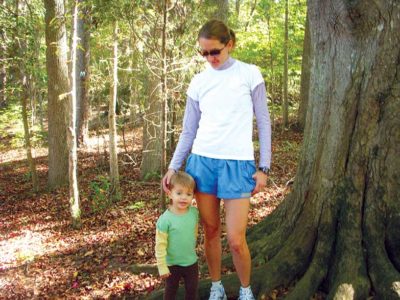
Oh, my heart sank. How do I tell this 3-year-old the truth? The hesitation drew shame into my heart. I didn’t want to tell her this Good News. In that moment, I wished she’d never have to know how we divide, blame and judge. Besides the occasional tête-à-tête involving her pension to forgo clothing in public places, there had been no real suffering and certainly no hatred. We were all feathers, wax and sunshine. Driving in silence, I mustered up the courage to pull over and deliver the blow. “Baby, some people were afraid of Jesus, and they hurt him.”
“What do you mean?”
“They hung him on a cross, and it hurt him so badly, he died.”
“Why did it hurt him?”
“They hammered nails into his hands onto the cross.”
No response.
There was a long pause as she stared out the window.
“Can we get a puppy?”
Shame filled my heart again, as I made a choice that people of privilege make all the time. I let her off the hook. But, later that night I reminded her how the story ends. “Baby, it’s a sad story. People like you and me were unkind to Jesus and didn’t help him and so He suffered and died. But remember, Jesus did not stay on the cross. Nobody can kill God’s goodness and love. That’s what Easter is. After three days, he was alive.”
 I’m not sure she understood, and I suspect she did not want to or could not, but ours is a narrative of hope and a promise of God’s grace. No matter how tangled and messy we get, there is an honest way out, even in the face of death. God will shine a light on the next step. What a story to tell. The problem for Americans is the integrity of this story is easily compromised by our history of slavery, oppression, racism, power and wealth. The temptation for those of us who are white is to tell only the parts we love, the shiny parts. Mother’s Day, Disney World, Santa Claus and slavery all rolled into one. I learned a version of American history from textbooks in southwestern Virginia. The way I remember it, even though some slaveholders were cruel, slaves and the plantation owners were typically friends. In fourth grade, our class visited Booker T. Washington’s tobacco farm in Franklin County, Virginia. “Slavery was bad, and now we are good. Let’s go to the gift shop.” What is a cross without the nails?
Without the nails, there is nothing to sustain a girl through the realities of life, is there? Without the nails, it’s nothing more than cheap wood, smooth and slick. Without the truth, we are untethered to the realities of human pride, disillusioned by the white cloud of exceptionalism and falsely protected by a fairy tale of sentimental spirituality. It’s a matter of life and death, not just for people of color, but for white folks too. We just refuse to see it.
Is the plan to wrap a 24-karat gold cross-shaped pendant around her neck and then shield her from the truth of what that cross means? She’s inherited an unspoken story of human unfaithfulness and failure. Left unspoken or hidden beneath the lie of innocence, this human reality promises to sentence her to a life separated from the true gift of God’s unbounded grace.
 There were at least 84 documented lynchings in southern Virginia during the years Booker T. Washington departed the tobacco plantation and established the Tuskegee Institute in the Jim Crow south. Yes, textbooks left that part out. Was the massacre at Mother Emmanuel AME Church in Charleston an “accident”? Were good people shouting “blood and soil” in Charlottesville, Virginia, a year ago? Does every member of our society have equal access to safety, opportunity and happiness regardless of their race, gender, sexual orientation and religion? Really? Dare I sit at the Lord’s table and sip his wine, lest I tell the gospel truth.
There is no balm for such a deep wound. I can never truly understand, which makes my job as a white parent and a pastor of a predominantly white congregation so much more difficult. It also predicates my reliance on those who are different from me that much greater. I cannot ask the people of color I love to carry the load of my repentance and reorientation. I packed it and I carry it, but I have come to seek their wisdom and guidance with the hope I am not too exasperating.
You see if I am honest, I fight against the Icarus within me, and a constant desire to claim what is not mine — the least of which is a tidy and false ending to a reality that is still harming, shackling and killing so many.
My wish dream of fragility is for this story to be fake news. A parable of truth, but not fact. If only there were no nails. If only his disciples spoke up. If only Pontius Pilate did the right thing. Maybe they wanted to, maybe they knew better, but they didn’t. If only I had spoken up, but I didn’t. If only I had known better, but I did. If only I could tell the story in a less condemning way, but I can’t.
Seek first His Kingdom and righteousness,
and these shall be yours as well. – Matthew 6:33
I am in the kingdom business, and so I have pursued an awakening and re-education regarding my own racial prejudice and bias with hopeless abandon: anti-racism retreats, group discussions, leadership training, book studies on racism, Bible studies on white privilege and personal prayers of repentance. I’d like to say I talk the talk, walk the walk, put my money where my mouth is, practice what I preach. I’ve been told that I need to lay off the racial justice stuff and watch myself. As a white woman in the south, I am not as polite as I once was, and someone recently mentioned that I gotten too big for my britches and too preachy for my own good. The people who said these things had been my dear friends, and I miss them. Notes have been delivered that say that I “should probably stick to the gospel and preach a little less about racism.” This one hurts, because it seems like sometimes the Good News of the gospel can be mistaken for a political statement of some sort.
 Even in the loving congregation I serve, which is committed to and united by Christ rather than our diverse political preferences, I have had to learn to parse my words wisely to avoid stepping onto the current field of polarized political landmines. I confess, I have misstepped a time or two (both ways), but Jesus was a brown-skinned, Middle Eastern Jewish man. He taught, healed and fought against the systemic oppression of the Roman Empire, and preached reform of a faith he loved that had become legalistic and hierarchical. That is the gospel truth, so I keep running. I have marched with and stood behind African-American leaders I admire and trust, and fought against systems of hierarchical power and privilege in institutions that ironically I love.
And yet, I have failed miserably.
The truth is, I am pretty good at running, but I’m not so great at being still. I have offended my friends who have brown and black skin with fast and fumbled words, and my voice has been paralyzed by fear when it was needed the most. I have shown up when I can get there, but not when it matters the most. I am bossy and impatient. I like to fix things. Nobody loves a tight agenda and measurable results more than I do. Meetings and worship over 59 minutes make me uncomfortable. Azungu. Azungu. Azungu.
So, for now I am slowing down. Don’t get me wrong, I’m still determined and stubborn, but the chase, the pursuit, the race toward the sun must stop. It may not be 24-karat gold, but I plan to hang a cross around my daughter’s neck, buy a bigger box of crayons and begin coloring a new dream with greater integrity and honesty. I will continue to create and hold sacred spaces with others in the kingdom for the purpose of racial justice and unity. This includes advocating for those whose voices are silenced by whiteness (and male dominance while I’m at it). If I’m not running, I should be able to look for my invisible neighbors in the shadows, and there will be time for more loving and honest conversations with white folks. The most important of which is with myself. Am I chasing an easy way out or running from a difficult truth? I am part of the cacophony perpetuating this mess, and it needs to crash and burn. “I do not run aimlessly.”
 Lori Archer Raible is co-pastor of Selwyn Avenue Presbyterian Church in Charlotte, North Carolina.