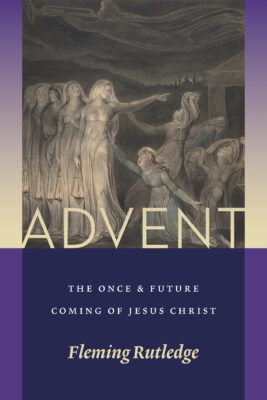
 Fleming Rutledge
Eerdmans, 426 pages
Fleming Rutledge has gathered from her repertoire of (mostly) unpublished materials a number of sermons and writings to help others who preach to understand and grapple with the rich themes of Advent, often passed over lightly. Rutledge is not fussing about the way Christmas seems to have seized Advent and misshapen it so that it matches the secular holiday that begins before Halloween. She is concerned that the Advent themes are too central to the gospel to be easily surrendered in an annual rising tide of sentimentalism.
Mainline Protestant churches, acutely uncomfortable with the apocalyptic, have tended to avert their eyes from it, leaving it to fundamentalists, who have seemed overly fond of literal interpretations that favor themes of punishment for a huge cast of characters that probably includes us. Only recently have some mainliners begun to appreciate that God’s project is not a matter of getting to heaven one at a time, but a far larger one, a new heaven and earth, the “renewal of all things” (Matthew 19:28). That is where the Advent lectionary leads us, and, indeed, begins to lead us as early as Christ the King Sunday, a few Sundays earlier.
Of course, if your theology is such that you believe everything is basically okay, perhaps in need of just a few moral reminders to make it all good, there is no need for a “renewal of all things.” However, if you take our predicament seriously, as Rutledge does, you know better. Our redemption, and that of the whole cosmos, requires recognizing that “the disappointment, brokenness, suffering, and pain that characterize life in this present world is held in dynamic tension with the promise of future glory that is yet to come.” Advent takes the need for redemption as seriously as it takes God’s commitment to it. The lectionary points us to biblical texts that are difficult, but clarify where our hope lies. Hope requires God’s judgment, from which we recoil, although it is a form of grace. No divine judgment, no ultimate justice.
Reading Rutledge, one is often struck by apt quotes from prayers in the “Book of Common Prayer.” She was exposed to these from earliest memory, and they have left their imprint on her mind and spirit. These prayers of the liturgy, easily repeated with aesthetic appreciation but not always with equal attention to their challenging themes, have, in Rutledge’s case, led the way in forming her faith. Or, perhaps as she was learning the Bible and theology, she recognized that what she was learning was already embedded in the prayers she had always been praying with the church. Similarly, the Presbyterian Great Thanksgivings have served to turn my attention to eschatological themes: “Christ has died. Christ is risen. Christ will come again.”
Rutledge notes in the introduction that this volume is not intended to be read from beginning to end. Rather, it provides resources for preachers to use as needed. Each of the Advent and relevant pre-Advent texts are engaged here, often more than once. Themes are, of course, repeated over the years. All to the good for preachers committed to helping congregations grapple with the scope of God’s “renewal of all things.”
 Ronald P. Byars is professor emeritus of preaching and worship at Union Presbyterian Seminary in Richmond, Virginia.