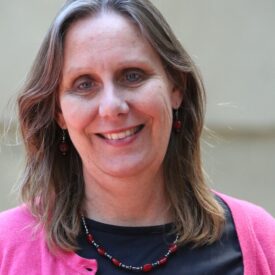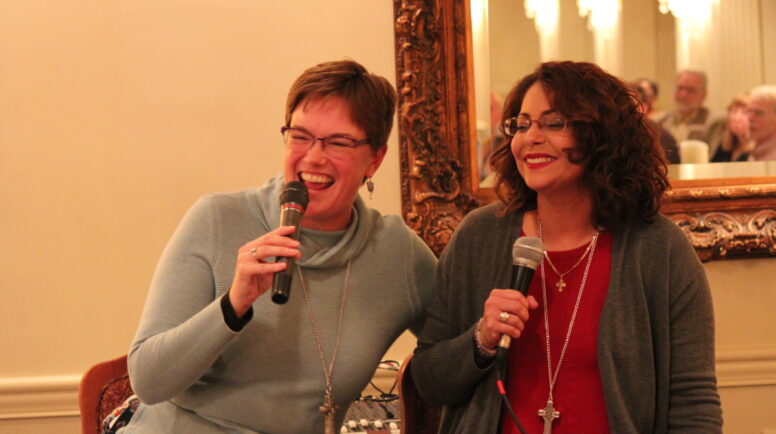
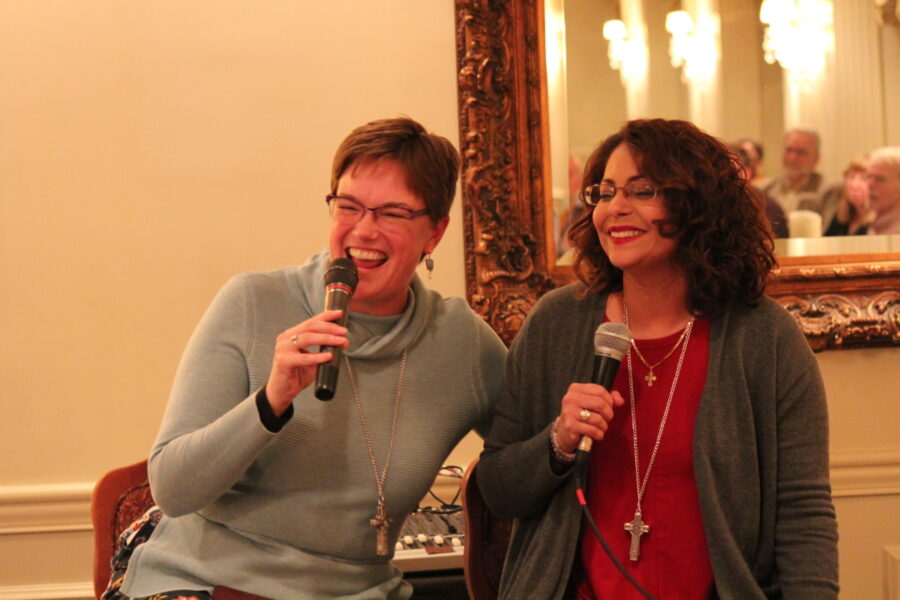
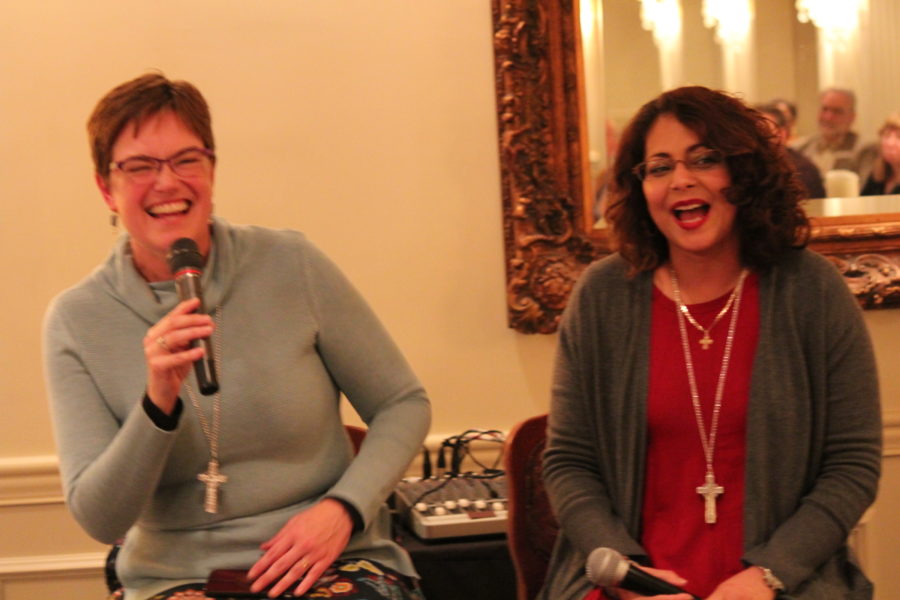
LOUISVILLE – Dinner was over, parliamentary training was done. And it was question-and-answer time for the co-moderators of the 2018 General Assembly, Vilmarie Cintrón-Olivieri and Cindy Kohlmann.
They gathered in Louisville Nov. 16 with the moderators of Presbyterian Church (U.S.A.) mid-councils at the annual Moderators’ Conference. Here’s some of what the elected church leaders from presbyteries and synods wanted to know of the General Assembly leaders.
How did you meet? The short version: a mutual friend, who knew that Kohlmann was considering standing for moderator, introduced them.
“I felt overwhelmingly that I wanted to stand with someone who was Spanish-speaking,” and from Puerto Rico, said Kohlmann, who’s a minister and mid-council executive. So the friend, who knew of Cintrón-Olivieri’s years of service as a ruling elder in the denomination, an English as a Second Language teacher and a conference administrator, asked if she would consider standing as well, and if he could arrange a conversation.
Kohlmann said that she prayed, God, “if you are calling me to this service, then you will provide the person,” but still felt anxious about the timing and who the person might be.
In their first conversation, they talked on the phone for two hours. “I don’t like talking on the phone,” said Kohlmann, who’s an introvert.
“I do,” Cintrón-Olivieri responded brightly.
After that conversation, “we were so sure,” Cintrón-Olivieri said. They felt the call “to stand before the church … and let the church decide.”
What issues are on your heart? After she visited Mission Presbytery in Texas several weeks ago and saw the work that the local churches and others are doing in the Rio Grande Valley, the stories of asylum-seekers will not leave her, Cintrón-Olivieri said.
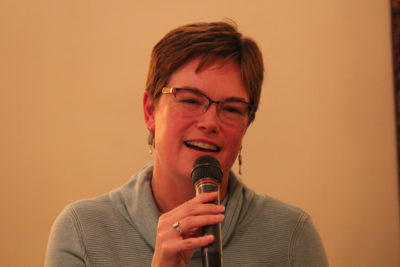 “Seeing people who have been walking for weeks, who are tired, who are starving,” she understands that what churches and humanitarian volunteers are doing to help “is beautiful, it’s wonderful, it’s daunting and it’s needed. … We have to give a voice to the voiceless.”
Kohlmann said her call to stand for moderator grew out of her work as resource presbyter for the Presbytery of Boston and the Presbytery of Northern New England – seeing how immigration issues were impacting congregations in the Northeast.
“How we treat, to use the biblical language, the widow, the orphan and the stranger in our midst is very central to my understanding of what it means to be a Christian,” she said. In the United States, the increased expression of intolerance and hate across perceived or real differences “is being expressed in damaging, fatal and destructive ways. And we are being called to follow a God who is love.”
With 1.4 million Presbyterians and with global partnerships around the world, “if we lived in that love, just imagine. We would change the world.”
What changes do you see? Both spoke of declining membership, churches leaving the PC(USA), grief and discernment. “We need to approach newness with an open mind and an open heart,” Cintrón-Olivieri said. “We are not sure what is behind that column. We do know that God is with us every step of the way. I think we need to move from a thought of fear” or uncertainty “to a vision of trust.”
Thoughts on patriarchy? Both have had some experiences of being female church leaders in ecumenical or interfaith settings where women are not allowed the same opportunities as men. Kohlmann described it as “holy dissonance,” saying “it can be a little awkward” when the women are all in the kitchen and the male pastors are in the dining room, and “you’re not in the kitchen.”
She spoke of being told by a male leader, as he left one meeting room, that “you girls did a good job tonight.”
And “if we can challenge that,” Kohlmann began.
“We will,” Cintrón-Olivieri finished.
How is this service changing you? After five months as co-moderator, “I’m not the same person who stood,” Cintrón-Olivieri acknowledged, having been changed by the encounters of those she has met.
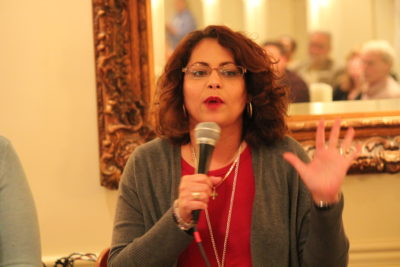 “It would be fair to say that I’m both bigger and smaller,” Kohlmann said — made bigger by the honor of being invited by so many to hear their stories, “simply because the General Assembly, led by the Spirit, on the fourth ballot, elected us.”
And smaller “because it is so incredibly humbling,” because she knows she needs to rely on the Spirit, the grace of God, and the prayers of the church.
Nov. 17 will be the 19thanniversary of her ordination, Kohlmann told the mid council moderators. “I never ever would have imagined that this was part of the journey. … I have no idea what God will do next. But my intention is to listen and to wait for God to make that clear.”