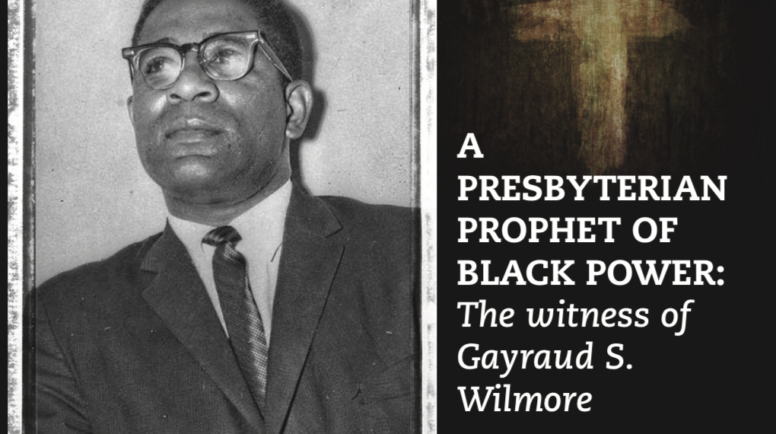
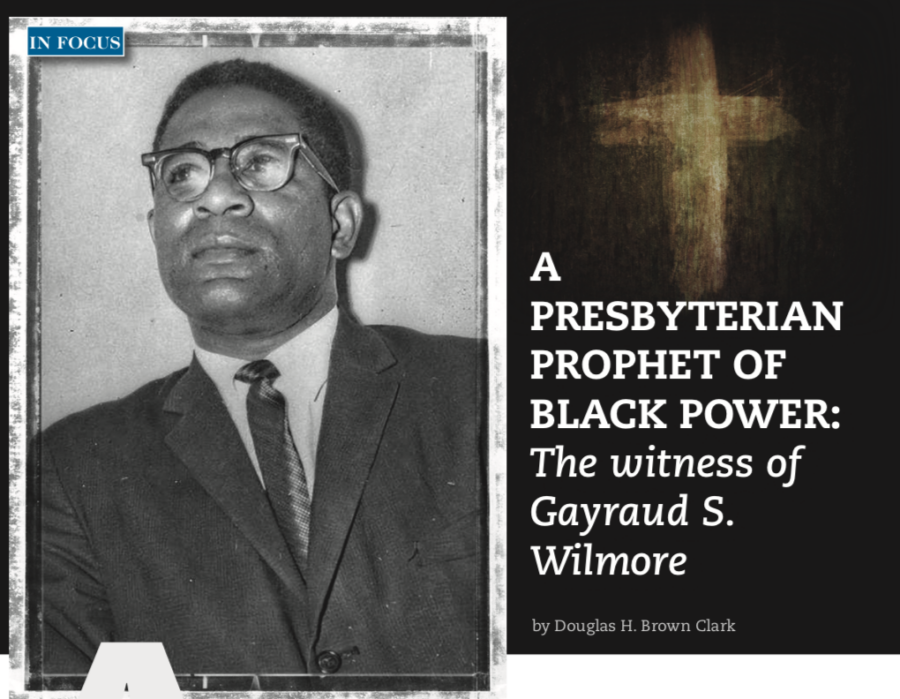
American Presbyterians have an imperfect history regarding racial justice, but in the 20th century they took some courageous stands. While white people like Eugene Carson Blake and J. Randolph Taylor deserve some credit, so does the steadfast prophetic witness of black Presbyterians. During the civil rights era, it was primarily the actions of black Presbyterians, wrestling like Jacob with their denomination to demand its blessing, which caused the “northern” – or United Presbyterian Church (UPCUSA) – to fully commit to the struggle for equality.
Gayraud S. Wilmore was a central figure in this struggle. Now retired and living in Washington, D.C., Wilmore is well known in seminary circles as a theological educator and a key ally of the late James H. Cone in the creation of the field of black theology. However, less well known is that prior to his academic career, Wilmore was the top racial justice official for the UPCUSA, and was arguably the most important Presbyterian civil rights activist during the 1960s. Wilmore has lived a life in fervent pursuit of racial justice, one with which contemporary Americans, especially Presbyterians, should be familiar.
A black Presbyterian minister
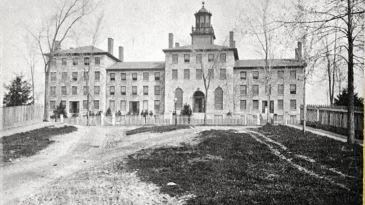
Raised in Depression-era Philadelphia, Wilmore became a Presbyterian through curious circumstances. When a dwindling white congregation could no longer pay the mortgage on its large church building in north Philadelphia, it offered the building to the leaders of a black civic organization led by Wilmore’s father on the condition that they start their own Presbyterian church there. Formerly Baptist, the Wilmores (one of whom would later write the book “Black and Presbyterian”) became Presbyterian overnight! After this serendipitous beginning, Wilmore would soon find himself immersed in the rich ethos, history and institutions of black Presbyterianism. At Lincoln University, a venerable black Presbyterian school in Pennsylvania, Wilmore was valedictorian in both his undergraduate and seminary classes. There Wilmore and other students also engaged in protests at nearby segregated, white-owned businesses through the campus NAACP, over a decade before student sit-ins in the South would capture national attention.
 Wilmore’s education had been interrupted by service as a buffalo soldier in Italy during World War II. Like many other black servicemen, he fought in a segregated regiment under racist white officers, wondering whether he should be back home fighting American racism instead. After returning from the war and completing his schooling, he was ordained in the Presbyterian Church. Despite his war experience under white leadership, Wilmore felt a divine call to serve in the denomination of his baptism and to take the fight for racial justice into the churches and councils of this predominantly white church. Wilmore’s first pastorate was a small black congregation in suburban Philadelphia, where he led an effort to desegregate local public schools, which included the 1950 enrollment of his son, Steve, as the first black student at the local elementary school. After a stint in campus ministry, he became his denomination’s only black social action staffer, and later the only black professor at Pittsburgh Theological Seminary. In 1959 he became the only black member of the committee which crafted the Confession of 1967.
Civil rights, black power and the commission on religion and race
In early 1963, the nation watched as police brutally attacked protestors in Birmingham, Alabama. In response, the UPCUSA decided it needed to “catch up with Dr. King” in its commitments to racial justice by creating a commission on religion and race. This commission was the result of tremendous pressure applied by black Presbyterians leaders like James H. Robinson and Edler G. Hawkins. Hawkins, who would later become the denomination’s first black moderator, asked Wilmore to become the commission’s executive director. Wilmore accepted, left his seminary post and led the commission until 1971. Backed by a $500,000 initial budget, the commission became a significant force in the civil rights movement, promoting voter registration in Mississippi, lobbying for passage of the Civil and Voting Rights Acts, supporting embattled black pastors and joining major demonstrations like those in Washington, D.C., and Selma, Alabama.
The signing of the Voting Rights Act on August 6, 1965, was a moment of triumph. Yet less than a week later, a rebellion erupted in response to police violence in the Watts neighborhood of Los Angeles. King and Wilmore both headed straight to the scene. Wilmore soon found himself huddled behind a barricade erected by armed black Presbyterians as they fended off marauding Hell’s Angels. A few days later, King and Wilmore spoke at a Christian Action Conference in Montreat, North Carolina, attempting to explain the anger behind the rebellion. In Wilmore’s explanation of the “riots,” he also criticized King and other Southern-based civil rights leaders, saying:
“They do not know what it is to face policeman every night … to fight rats all day, to have to sit up in the bed with a pair of shoes to throw at them … to be literally emasculated by your wife who works when you can’t work, who is able to earn something … in a white suburban kitchen. They do not know what it is to have their dignity taken away from them by the condition of the American Negro family in the deepest heart of the ghettos of the North and West.”
Wilmore, raised in the slums of north Philadelphia by a proud veteran father financially ruined by the Great Depression, and a mother who had to work in white people’s kitchens to keep the family afloat, was speaking from experience. He had supported early civil rights actions against segregation and disfranchisement in the South. However, as the movement shifted toward the economic concerns highlighted by the mid-1960s rebellions of the urban North and West, for the first time Wilmore fully saw the cause as his own. He was no longer fighting for the sometimes-detached theological ideals he had learned and taught in seminary classrooms; he was fighting for the survival of his people and of the kinds of people with whom he had grown up. Like the prophet Esther, Wilmore realized that he come into his position “for such a time as this.”
When the cry of “black power” went viral in June 1966, this new phase of the movement had a name. Within a month, Wilmore and Benjamin Payton of the National Council of Churches had founded the National Conference of Black Churchmen (NCBC), and released its first public statement as a ringing endorsement of black power. The NCBC would become the largest ecumenical organization of pro-black power clergy, and spurred African-Americans in many denominations to reinvigorate their black clergy caucuses. Wilmore, the face of the “white” church’s racial justice effort, had become a leader in the militant, revolutionary movement for black power, which advocated self-determination and black consciousness. An interviewer acknowledged at the time that Wilmore was a “hyphen” between black and white communities, but added, “the figure is apt if you assume a solid black hyphen, for there is no doubt about Wilmore’s blackness.”
The black manifesto
White United Presbyterians, based largely outside the South, had slowly become supportive of racial justice reforms, as long as those reforms took place in the South. Faced with new economic demands and what some called “riots” in these northern cities, white Presbyterians’ enthusiasm for racial reforms waned. Eventually, white northerners would encounter militant black demonstrations in their own churches. In May 1969, activist James Forman marched into The Riverside Church in New York City, over the protests of its Presbyterian pastor, to present the “Black Manifesto” with its demand that white religious institutions pay $500 million in reparations for their past complicity in slavery and discrimination. Forman and his associates subsequently made similar demands at the headquarters and annual meetings of many denominations, including the UPCUSA. Wilmore secured a speaking slot for Forman at the General Assembly that year in San Antonio. During the assembly, Wilmore was also visited in his hotel room by young gun-toting radicals sympathetic to, though not directed by, Forman, who wanted to enter the assembly and demand payment at gunpoint. Wilmore spent several hours talking them out of this scheme.
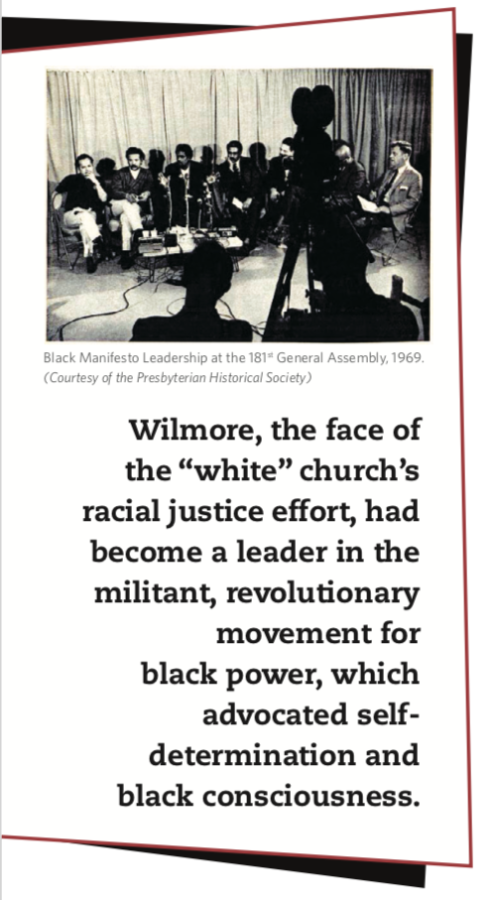 White Presbyterians, whose reactions to the manifesto ranged from grudging openness to anger and disbelief, were surprised to learn that most black Presbyterian pastors firmly backed Forman’s demands. Wilmore expressed his approval in a widely-disseminated essay, “The church’s response to the Black Manifesto.” Wilmore wrote that he understood that many Presbyterians could not accept Forman’s radical ideology or his disruptive tactics. Nevertheless, Wilmore argued vigorously and eloquently that reparations were fully in keeping with the words of the Bible and the tenets of Christian theology.
Wilmore described this atheist, Marx-inspired Black Panther as entering Riverside “bearded and brandishing his staff like an Old Testament prophet,” carrying out “a modern-day reenactment of Amos before the temple at Bethel.” Biblical prophets are often social misfits, so if Forman were a prophet, that would explain his apparent strangeness, without negating the truth of his message. Wilmore compared Forman’s disruptive tactics to Jesus’ triumphal entry and temple cleansing, the posting of Luther’s theses and the Boston Tea Party, and concluded that “disruptive confrontation is as Christian as street corner revivals and as American as the Fourth of July!” Wilmore, like other black clergy who had had long sought change through courteous, diplomatic appeals, recognized that Forman’s “hard-line” tactics were more effective at getting white people’s attention.
Forman did gain attention, but was unsuccessful at securing reparations from almost all of the dozens of denominations and institutions which were the targets of his protests, with the exceptions of the Episcopal and United Presbyterian Churches. Wilmore and others convinced the UPCUSA to respond by creating two initiatives, both of which, in the self-determination spirit of black power, enabled working class people, to improve their own economic circumstances. One, the Presbyterian Economic Development Corporation (PEDCO), provided millions in low-interest loans to minority-owned businesses from 1969 to 1988. The other, which is still active today, is the National (or “Presbyterian”) Committee on the Self-Development of People (SDOP), which provides community-development grants in impoverished communities, and allows members of those communities to manage the funds themselves. Partly funded through the annual One Great Hour of Sharing offering, SDOP has shared millions of dollars through grants since 1970. While the church has never called these funds “reparations” and they pale in comparison to the actual wealth created by centuries of enslaved labor, they are in fact among very few successful reparations efforts in U.S. history.
Defending Angela Davis
Another UPCUSA response to the manifesto was to increase its support for legal aid to civil rights activists, empowering the commission to disburse such funds without (white) oversight. Using this authority, the commission provided a $10,000 grant for the legal defense of scholar and activist Angela Davis who was on trial in California in connection to a murder, of which she was later acquitted. This grant, especially in light of Davis’ Communist affiliations, created a major controversy in the denomination. White backlash eventually resulted in the curtailing of the power of the commission and a denominational reduction in formal involvement in racial justice activism. While Wilmore was not involved in the details of the Davis grant, the event as a whole reflected the efforts of he and other black Presbyterians to push the denomination to the radical edge of social justice, and to gain the ability for leaders of color to act without white oversight. While Wilmore and other black Presbyterians were proud of their witness for justice, they were also dismayed by the harshly negative reaction by white Presbyterians.
A prophetic legacy
Wilmore left the commission later that year. He spent the remainder of his career as a theologian and educator, teaching at Boston University, Colgate Rochester Divinity School, New York Theological Seminary and the Interdenominational Theological Center, training a new generation of ministers and theologians. Wilmore and James Cone became close friends and co-workers, especially in their joint editorship of the two-volume “Black Theology: A Documentary History.” Wilmore wrote five books and countless articles in black religious studies.
 While not as well-known as Cone or Eugene Carson Blake, Wilmore has lived a life of critical importance to the Presbyterian witness for racial justice, the movement for black power and the development of black theology. He laid the groundwork for, and in many cases taught and mentored, future black seminary professors, moderators and other leaders in the Presbyterian Church like J. Herbert Nelson II, Denise Anderson, Alton Pollard, Brian Blount, Deborah Mullen, Ron Peters and the late Katie Cannon. A denomination that recently added the Belhar Confession to its Book of Confessions and is studying the possibility of adding King’s “Letter from Birmingham Jail” would not exist in the same fashion without Wilmore’s witness. In a time when, as in the late 1960s, the nation has turned from major breakthroughs in racial justice to a troubling racist backlash, the witness of Gayraud Wilmore and other black Presbyterians has prepared the way for new leaders who have been called, “for such a time as this.”
Douglas H. Brown Clark is a doctoral student in American religious history and a candidate for ordination in the PC(USA). His dissertation examines religion and black power through the activism of Gayraud S. Wilmore.
Further reading:
By Gilmore
“Dissent and Empowerment: Essays in Honor of Gayraud Wilmore”
Eugene G. Turner, editor
Westminster John Knox Press, 124 pages
“Black and Presbyterian: The Heritage and the Hope”
Gayraud S. Wilmore
Witherspoon Press, 136 pages
“Black Religion and Black Radicalism: An Interpretation of the Religious History of African Americans”
Gayraud S. Wilmore
Orbis Books, 328 pages
“Black Theology: A Documentary History, 1966-1979”
James H. Cone and Gayraud S. Wilmore, editors
Orbis Books, 462 pages
“Pragmatic Spirituality: The Christian Faith through an Africentric Lens”
Gayraud S. Wilmore
NYU Press, 323 pages
On civil rights, black power and religion
“Faith in Black Power: Religion, Race, and Resistance in Cairo, Illinois”
Kerry Pimblott
University Press of Kentucky, 334 pages
“Church People in the Struggle: The National Council of Churches and the Black Freedom Movement, 1950-1970”
James F. Findlay Jr.
Oxford University Press, 280 pages
“A Stone of Hope: Prophetic Religion and the Death of Jim Crow”
David L. Chappell
University of North Carolina Press, 360 pages
“From Reconciliation to Revolution: The Student Interracial Ministry, Liberal Christianity, and the Civil Rights Movement”
David P. Cline
University of North Carolina Press, 304 pages
“Authentically Black and Truly Catholic: The Rise of Black Catholicism in the Great Migration.”
Matthew J. Cressler
New York University Press, 278 pages
“Dear White Christians: For Those Still Longing for Racial Reconciliation”
Jennifer Harvey
Eerdmans, 272 pages