
I’ve heard many colleagues share how proud they are that they serve “purple” congregations where members from different sides of the political aisle worship together without arguing over politics. They lift this up as if it is the sign of a healthy church in the midst of the contentiousness in our current political context. But when I inquire as to how they’ve achieved this sort of utopian congregation, the truth comes out: They don’t argue over politics because they simply don’t talk about politics. They avoid conversations about issues affecting public policies and public life in their sermons, in their educational opportunities, in their Bible studies. These colleagues believe their job is simply to love their congregation while completely avoiding issues involving politics. But is this truly the sign of a healthy church?
The moral fabric of our nation is being torn as the demons of racism, xenophobia, sexism, bigotry and hatred rear their ugly heads. Some in our mostly-white churches thought these issues were settled, so why should we talk about them? Why should we address difficult issues when they’ll just lead to disagreement? But if these issues were truly settled, they wouldn’t lead to disagreement now. If these issues were settled, it wouldn’t cause adverse gut-level responses when we see women marching in Washington, or when the pastor’s T-shirt says Black Lives Matter, or when we hear of political refugees fleeing Central America in search of safe and sacred space to raise their children.
The Book of Order avows: “Presbyterian Church (U.S.A.) affirms the Gospel of Jesus Christ as received from the prophets and apostles, and stands in continuity with God’s mission through the ages.” It goes on to state: “The Church is sent to be Christ’s faithful evangelist … participating in God’s mission to care for the needs of the sick, poor, and lonely; to free people from sin, suffering and oppression; and to establish Christ’s just, loving, and peaceable rule in the world.”
 In the section on the Great Ends of the Church, we affirm that part of the essential purpose of the church’s existence is for “the promotion of social righteousness; and the exhibition of the Kingdom of Heaven to the world” (F-1.0304).
I reject the idea that in order for a church to be healthy in the midst of deep political division in our nation, we must ignore or avoid conversations about public policies and public life. Clinical psychologist and researcher Alice Boyes wrote about “avoidance coping” in Psychology Today. In the article, she described many different facets of avoidance coping, including conflict avoidance when “you try to avoid the potential for people being mad at you.” Many of our pastors and parishioners are experts at conflict avoidance.
Ilene Strauss Cohen, adjunct professor in the Department of Counseling at Barry University in Florida, wrote in Psychology Today: “One of the most valuable lessons I’ve learned is that if handled correctly, conflict can be healing and beneficial. Avoiding conflict keeps us from releasing what’s bothering us, so it starts to eat away at us. … Fear of anger, disappointment, or confrontation tends to result in debilitating consequences — all because of an attempt to make everyone else happy.”
Conflict avoidance doesn’t just happen in intimate, one-on-one relationships. Conflict avoidance happens in all systems from the basic family unit to the congregation, from a local community to the federal government; and it is this avoidance of conflict that has paralyzed our nation from truly solving problems that we face as a society. Conflict avoidance is what has led us as a nation to avoid tackling difficult issues, even ones that appear to have strong bipartisan support from the majority of our nation — such as gun control reform during the epidemic of gun violence, or immigration reform and the fate of the “Dreamers.” Our politicians avoid these issues because they’re afraid of upsetting major donors or their base. Our pastors tend to ignore these issues because they don’t want to upset their parishioners.
Avoiding conflict in our society will only continue to paralyze and divide us as a nation from ever realizing our true potential as “a shining city on a hill.” The church should be modeling for the world what it truly means to be a “light for the world.” When every other respectable institution in our society is engaged in conflict avoidance, the church should be the place where it is safe to have these difficult conversations, for we are followers of the one who directly confronted and challenged the social and political issues of his day. Jesus never avoided conflict, instead he confronted it head on with a heart of compassion in search of justice for all.
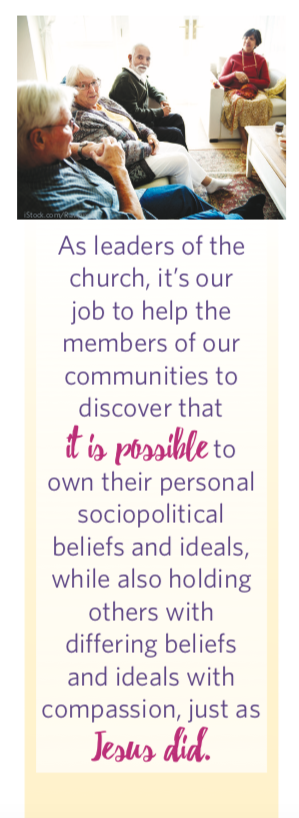
We do not have to abandon our sociopolitical ideals at the door of the church. In fact, I would argue that in order for us to be a healthy church, we must find compassionate and loving ways to help our congregations and our communities to engage in sociopolitical conversations that truly affect public policies and public life. As leaders of the church, it’s our job to help the members of our communities to discover that it is possible to own their personal sociopolitical beliefs and ideals, while also holding others with differing beliefs and ideals with compassion, just as Jesus did.
 Frank Rogers, professor of spiritual formation at Claremont School of Theology in California, has created a contemplative practice, rooted in the compassionate life of Christ, that helps to ground people in their own compassionate core in order to engage compassion for others, even very difficult others. He founded the Center for Engaged Compassion (CEC) which, as their website describes, “offers unique processes of ‘engaged compassion’ that transform the desire to help others into practical actions that change the world for good. … The CEC has helped cultivate compassion in a wide variety of settings — including those of prison populations, terrorized communities in Zimbabwe, congressional staff on Capitol Hill, children in schools, and chaplains in hospitals.”
In his book, “Practicing Compassion,” Rogers explored the reality of pain and violence that confront all parts of our world: “terrorist bombings and retaliatory attacks, school shootings and playground bullying, domestic abuse, gangland killings, even molestation in our sacred institutions.” He explained how this violence affects our relationships, from micro-relationships between family and neighbors, to macro-relationships such as “adversaries dissenting in our political spaces.” He described that there is a lot of “mad in our world,” madness rooted in a lack of love and compassion for self. That lack of love and compassion, whether rooted in what we’ve done or what life has done to us, keeps us from being able to cultivate compassion for others.
Rogers expounded:
“In spite of all the aloneness, alienation, cruelty, and coldness that pervade our broken planet, wellsprings of kindness and goodwill, like underground pools in the desert, offer healing, renewal, and sustenance. Compassion is birthed out of these springs. To give love, we have to know love. To be moved by the suffering and joy of another, our own suffering must be seen and our joy the object of someone’s delight. In the absence of love, the heart hardens; in the presence of love, even the hardest of hearts can grow soft like clay massaged in a potter’s hands.”
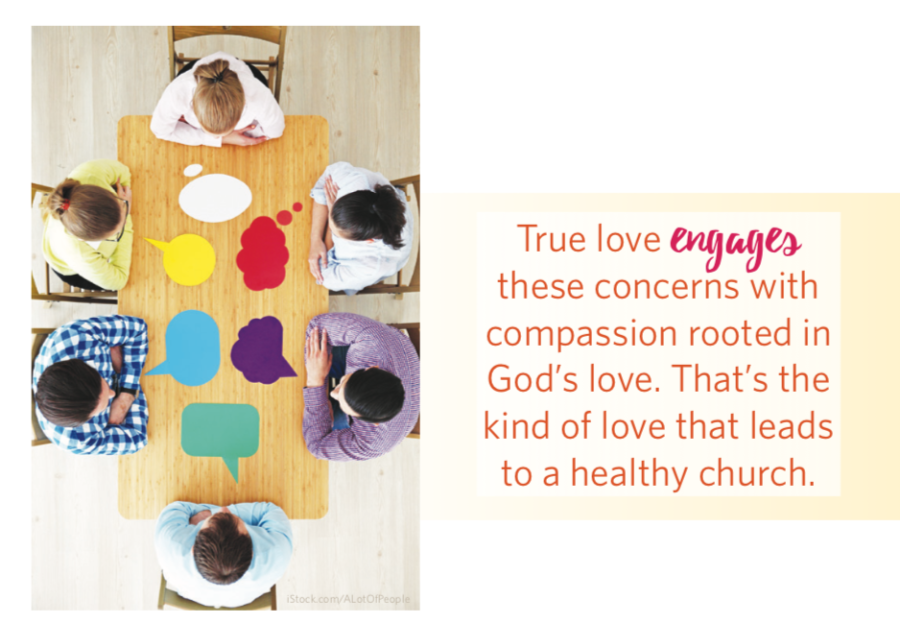
Throughout history, the church has endeavored to be a place of safe and sacred space. My colleagues who “love their congregation” while avoiding issues involving politics truly believe they are offering that safe and sacred space. But true love from pastors toward their congregations doesn’t involve avoiding conflict or difficult issues. True love doesn’t avoid addressing injustice, oppression or exploitation. True love engages these concerns with compassion rooted in God’s love. That’s the kind of love that leads to a healthy church.
A healthy church is one where this love, which comes from God, is manifested not in avoidance of difficult sociopolitical issues, but in the ability to engage compassion as deep and painful issues affecting our communities, our nation and our world are intentionally confronted. A healthy church is one that models for the world what it means for us to truly believe that all people are children of God, worthy of compassion and love. A healthy church is one where we do not leave our sociopolitical ideals at the door, but instead one where we own them while also holding others with differing beliefs and ideals with compassion, just as Jesus did.
 As we address the conflict that is all too real in the intersection of faith and public life, instead of avoiding it, we as faith leaders are truly helping to create safe and sacred space. As we confront difficult issues at the intersection of faith and public life with compassion, we open up the possibility for healing in the midst of deep brokenness that confronts our world. As we cultivate compassion for those on the other side of the political aisle, we can begin to repair the moral fabric of our nation that has been torn apart by bigotry and hatred and partisan politics. As bearers of Christ to the world, this is our calling: to be engaged in sharing God’s love and God’s grace in the intersection of faith and public life.
 Kris Schondelmeyer is a pastor serving in the Presbytery of Philadelphia.