
We are all tired of it. We are tired of the handwringing, blaming, wailing and general angst over the demise of church-as-we-have-known-it. We’ve been to the conferences and continuing education events wherein the 500-year cycle of large-scale church change has been analyzed up one side and down the other. We’ve read the books and engaged substantive dialogue with colleagues and congregations. We’ve observed congregations react and respond to the shifts in our culture impacting their expression of church. We’ve done the work of trying to make sense of this transition into the postmodern era. We’ve been there and done that. And it’s all growing wearisome at this point.
Thankfully, something else is rising as we move toward the latter side of the big shift in church. Christian disciples are yearning for more robust, engaged, life-giving community of faith experiences than what we have known. Now, it’s as though Christian disciples and churches are the butterfly emerging from the chrysalis, growing acquainted with this new body that looks so different than it did when we were caterpillars. Now the butterfly is learning what it means to have wings. There’s a strange desire pumping through its body pushing it to jumping off its perch. This impulse to look upwards, to launch, to step out into thin air, leaving the comfort of the known behind cannot be denied.
 So as we find ourselves moving toward the other side of the modern to postmodern era, something is rising in God’s church. When we look back, we recognize hints of it all along the trail. Over the last 30 years we’ve seen the rise of the emergent church, missional church, new monasticism and now divergent churches. But some of us are observing something different rising now, perhaps something more primal. What’s rising is not so much new paradigms or church models, but rather what comes before new forms take shape. There seems to be a longing, yearning or desiring for something deep and significant regarding church. These deeply felt desires push us toward new expressions of church.
Many long for more invigorated, engaged expressions of church. We’re looking for changes in form or shape of church; this is more about the spirit of church, the character, the experience. These are changes in the heart of churches with a yearning for robust church experience.
But “robust church” doesn’t describe the next best model for being church in this postmodern world. A rising robust church is about deeper waters than paradigmatic expression. Early in the creation stories, as God hovers over the waters, we sense God’s creative energy gathering and rising, breaking out in creativity. Later, on the day of Pentecost, the Spirit again gives birth to something new. So now, rather than being consumed by the deformation or deconstruction of church-as-we-have-known-it, robust church is rising. Postmodern disciples of Jesus find themselves longing for expressions of church: alternative story communities, deeply rooted communities, strong group communities, aspirational vision communities, contextually shaped communities or simply structured communities.

Alternative story communities
Certainly, themes rise in popular culture during every generation, with corresponding myths supporting them. Some popular myths circulating in our cultural milieu in postmodern America might be described as:
- Differences break relationship and community. When your perspective is different than mine, then we are opponents or perhaps even enemies. When your perspective is different than mine, then we cannot be friends, colleagues or church together.
- Uniformity and conformity are necessary ingredients of unity.
- Fear is a legitimate and primary driver for how we relate to our communities and larger world.
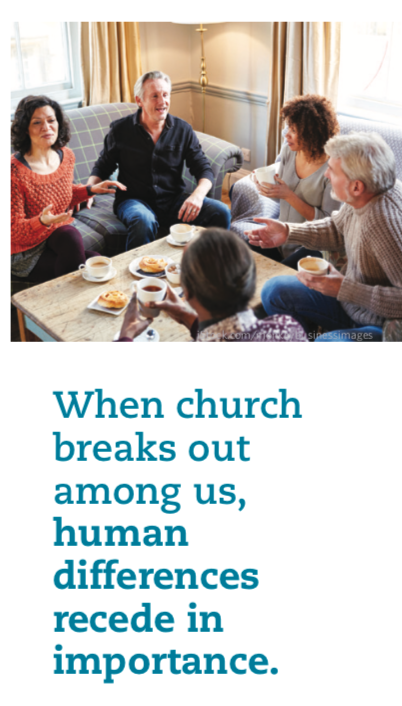 People living in the Way of Jesus find themselves chafing in response to these myths, intuitively recognizing there’s something wrong with this toxic mix. Instead, those leaning into a more robust expression of church are claiming their countercultural voices. They believe in the radical idea that God is love and we are called to be demonstrations of God’s love in this world. If ever this world needed communities of people who are living examples of being community regardless of differences, it is now. So many of us yearn for our churches to embrace their identities as contrast communities, banishing fear of being countercultural.
Now, more than ever, this world needs living demonstrations of what it is to be in relationship with others who are different. When church breaks out among us, human differences recede in importance. Those longing for a new and better way dare to practice radical hospitality with each other, embodying the love of Jesus Christ in a culture that has no idea how to be in relationship with those who don’t agree on most everything. During the 20th century, the church in the U.S. was often a companion and even purveyor of popular culture. Now, the church is becoming more countercultural than ever, living into its identity as a contrast community. Christ-followers on this side of the postmodern transition are not afraid of appearing countercultural or even unconventional, embracing their identity as a contrast community of Christian disciples.
Deeply rooted communities
Remember the phrase “seeker churches”? They were driven by the idea that stripping down worship centers, popularizing worship and generally “de-churchifying” ourselves would open the door for many to experience God. We postmodern followers of Jesus are hungry for spiritual experience deeply rooted in the ancient Christian story. In our rapidly changing world, knowing we are standing on the shoulders of all those saints who have gone before us strengthens our resolve in the present. Robust church is not hesitant nor even slightly apologetic about being deeply rooted in the Christian story. Robust church is firmly rooted in the ongoing and unfolding story of Jesus Christ in our world.
There is a difference though in how robust church rising claims its identity as deeply rooted in Christian heritage. During the modern era, the thinking was that since God doesn’t change, we don’t either. Expressions and forms of church were maintained and guarded due to generalizations about the unchanging nature of God. Now though, robust church rising claims its identity as distinctly Christian, while its expression of church is more flexible. Robust church continues the rituals of our faith tradition (like communion and baptism) as have our kind for generations, yet the way these rich faith traditions take shape are varied.
Strong group communities
Thinking of church as an association of like-minded individuals may have worked before, but now Christian disciples yearn for deeper engagement and connection with their sacred partners in church. In fact, the phrase “church membership” is growing increasingly irrelevant. Fewer people are interested in membership when it comes to involvement with any organization — church included. The “rights and privileges” of membership don’t resonate with the way postmodern people understand the world.
 Simultaneously, those living in the Way of Jesus on this side of the postmodern transition are hungry for stronger-than-ever connection as church community. Social scientists are regularly studying what makes for strong versus weak groups, recognizing strong group culture includes high commitment, engagement and participation. Robust church rising in this 21st century will be a strong group culture, connecting and engaging its people in significant community. When we Christian disciples realize we really are a contrast community, advocating for a better way that is less culturally mainstream, our need for Christian community skyrockets. When we are engaged in that kind of community and world transformation effort, that’s when we realize we need sacred partners in this journey. Robust church rising recognizes we cannot sustain living in the Way of Jesus alone; we needing strong and vigorous connections with each other as church.
Aspirational vision communities
Two dynamics contributed to the church promoting a less aspirational vision for humankind during the latter 20th century. First, we lapsed into the tendency to define what we were about through describing what we were against. Typically, the list included many issues of personal piety and morality. It’s difficult to maintain momentum when we drill-down too far in that direction, proclaiming a negative vision. Second, the popular story of the Christian community was something like, “Let’s get saved so we can escape to heaven before God burns the entire planet.” Liberation of the oppressed, care for the poor or health of the ecosystem are nearly forgotten when this is our future vision.
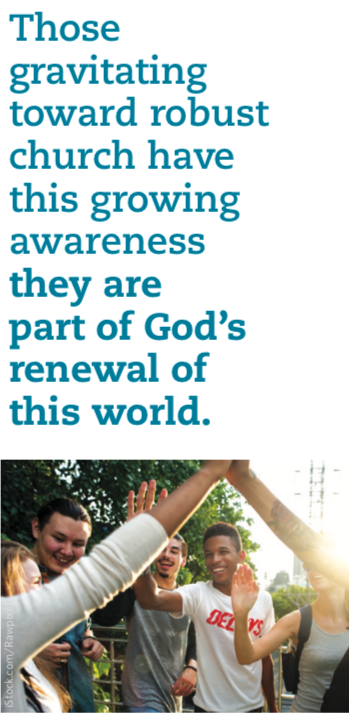
Now, Christian disciples find themselves returning to primal passages of Scripture, including the Lord’s Prayer. “Thy kingdom come, thy will be done, on earth as it is in heaven,” we pray. Those gravitating toward robust church have this growing awareness they are part of God’s renewal of this world. They interpret Scripture to mean God has good hopes and dreams for God’s creation, including planet earth. They believe God’s reign and commonwealth could come more fully on earth as it is in heaven — that this is actually God’s intention. Strangely and amazingly, God has chosen to partner with us in God’s world makeover endeavor. Those drawn to robust church rising recognize they are partners with God in this mission. Many Christian disciples are coming alive as they discover they are active participants in God’s kingdom coming on earth, as it is in heaven. Robust church includes a winsome, life-giving vision for humankind and planet earth.
Contextually shaped communities
Before the postmodern transition, culture was homogenous enough that we could design ways of being church in our denomination’s home office followed by replicating the paradigm across the land. During more stable times, this approach to being church is more possible. But now, too much has changed. Tim Shapiro and Kara Faris of the Center For Congregations recently authored “Divergent Church,” a study of new faith communities rising up. A very clear insight from their work is that religion cannot be franchised; it’s always contextual. Many denominations are shifting their roles, focusing on cultivating contextualization by churches in their communities rather than imposing form and structure.
We can see the desire to “go local” in so many areas of our lives. That Christian disciples are also yearning for churches who are symbiotically taking shape right alongside community dynamics is not surprising. Certainly we see the diversity of churches in Paul’s letters collected into the New Testament. In the same way, churches in various cities may share a common commitment to the mission of God to remake this world, yet their local expression of church may look very different. Postmodern disciples recognize churches are at their best as they take on local customs, music and language as they take shape and form.
Simply structured communities
 Americans after World War II were galvanized toward building a better world, including building organizations. Organizational structures were standardized and then transferred from one organization to another, the church included. This was one of the shifts during the postmodern transition: the deformation of complex organizational structures. With the demise of membership culture, churches cannot find enough members willing to serve lengthy committee or session terms. Many churches are shedding their excessive structures like heavy parkas during the spring warm-up. Everyone, including churches, is simplifying.
Rather than structures that endure over time, robust churches are moving toward channels that guide the church’s energies. Adaptability and flexibility are great assets in a quickly changing environment, so robust churches don’t want to be constrained by undue structure impeding movement. Remember the early expressions of church – more movement than institution? Postmodern disciples are caught up in living in the Way of Jesus, needing structures that support vigorous movement and engagement. Back in the 1990s, business guru Peter Senge predicted that the organizations that would survive and thrive beyond the year 2000 would be those who can learn the fastest. Simple, adaptive and flexible structures support rather than constrain life and movement in robust churches.
Yearning, longing, desiring
As church-as-we-have-known-it fades, God is not finished. The remake of planet earth is ongoing, with God’s church as a working partner. Some Christian disciples didn’t make it through the transition to church-as-it-is-becoming (such as many of the “dones” in the “nones and dones”), giving into the angst and frustration of change. For many others, the cultural winds of change are blowing on the dormant embers of church, fanning them into flame. For so many Christ followers, there is no way we want to miss out on robust church rising.
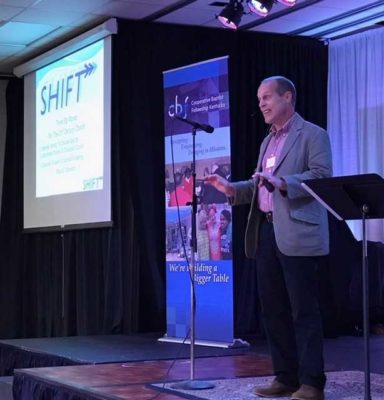 Mark Tidsworth serves as president of Pinnacle Leadership Associates (pinnlead.com) based in Columbia, South Carolina, which serves pastors, church staff, churches and denominations. He is the author of several books including “Farming Church: Cultivating Adaptive Change in Congregations.”