Many churches in the United States, from mainline to evangelical and beyond, host a Stewardship Sunday every year. Usually in the fall, Stewardship Sunday typically signifies that a congregation’s stewardship season is underway. The day often includes a series of elements that most churchgoers have come to know well: testimonials during worship from church members who tithe, one brave sermon on money based on a Scripture that includes the phrase “gave her last mite,” “cheerful giver” or “rich young ruler” and an afternoon all-church meeting about the budget.
While nothing about Stewardship Sundays is inherently bad, the catch is around what they (and the approach they so often represent) say about the real meaning of stewardship. Personal testimony is inspiring. Talking about money is a critical part of Christian community. Budgets are necessary planning tools. But were you to attend a “stewardship” service, you’d likely leave with the impression that stewardship is mostly the same as fundraising and describes an event or campaign that happens once a year, involves giving envelopes and a pledge drive and is designed for the purpose of asking congregants to help offset church expenses.
 That’s problematic because the core of stewardship isn’t money. It’s love. Stewardship isn’t an event or campaign. It’s a spiritual practice.
Of course, stewarding financial resources is part of stewardship. But to practice Christian stewardship and be moved by it is to consider how we shepherd our whole lives – through word and habit, and with God and each other – to be expressions of gospel love in the world.
The challenge of Jesus is nothing less than to question every system in which we take comfort that is not love. A holy practice of stewardship helps us see our dependence on those systems and slowly release our grip on their handles. Christ’s gospel calls for an alternative way of being in the world that places love at the center — not money, power, validation, possessions, popularity or even security.
When the value of everything we thought we needed changes, we become free to do things we simply couldn’t do while we were carrying the heavy weights of the economies we’re so used to. In love, we feel unweighted enough to share our resources with abandon; speak truth to power without worry for consequence; stand with the foreigner who is knocked down by oppressive systems; proclaim that all human beings are worthy just because God created them; and lay down our lives for causes of justice.
Exploring Christian stewardship within a congregational setting, then, involves inviting members of the community into an ongoing spiritual practice of self-giving that supports a release from every system that is not love. The spiritual practice of stewardship forms the way we see the world and ourselves within it as people of faith. It also hones each virtue muscle on Paul’s list of spiritual fruits: love, joy, peace, forbearance, kindness, goodness, faithfulness, gentleness and self-control — in addition to generosity and gratitude. It calls us to steward every part of who we are, not just money, for love’s sake.
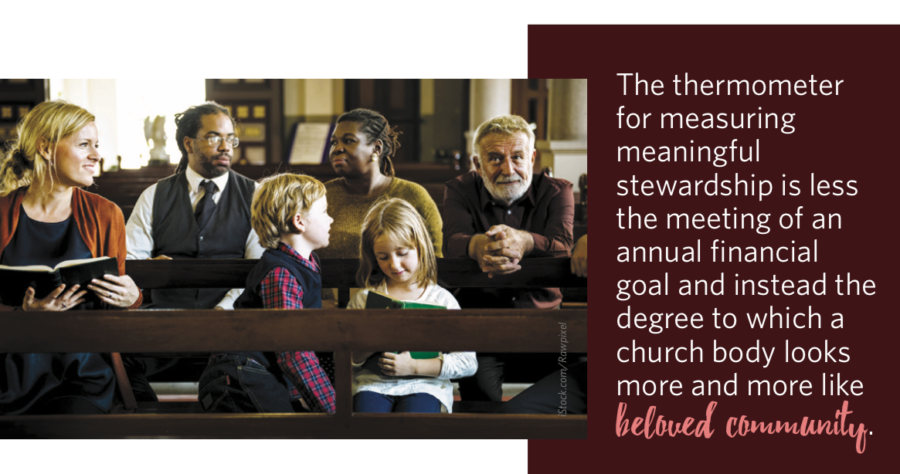
Like all spiritual practices, including prayer or regular worship attendance, stewardship isn’t a one-time event or even seasonal. It’s an ongoing commitment with endless opportunity for growth and increased attunement to God’s call. What’s more, the practice is valuable outside of financial goals. If we quadruple our church bank accounts but aren’t transformed into a community of people who are kinder, gentler, more ready to welcome the stranger, more forgiving and more committed to justice, then we may have practiced fundraising, but we didn’t find ourselves playing in the deepest wells of real stewardship where real change lives. The thermometer for measuring meaningful stewardship is less the meeting of an annual financial goal and instead the degree to which a church body looks more and more like beloved community.
We are convinced that business as usual when it comes to how congregations engage stewardship threatens to strip stewardship of its fuller, more theologically robust meaning. We’re convinced, too, that this missed opportunity can have dire consequences: namely, the development of disciples who may respond fervently to the yearly ask to fill out pledge cards but miss a deeper call of Christ to inner transformation (including rethinking how they value and use their money).
What does it look like to create experiences that help our congregations engage a holistic practice of stewardship?
Here are some of the methods that we’re trying in our context that have been helpful in that they are integrated year-round and rooted in an understanding of stewardship as a spiritual practice for transformation. We think of the day-to-day work of stewardship in our church as creating lots and lots of invitations for learning about and participating in stewardship practice as a way of life. Our approach involves some parts related to the stewarding of money, but is ultimately broader and deeper in its focus.
Year-round opportunities for deepening
Riverside Church has a consistent, year-long stewardship campaign: the Grateful Campaign. It incorporates a myriad of ways for church members to think about using every resource of their lives for love. Through liturgy in weekly worship and preaching, specially curated educational programming, weekly communications, all-church volunteer opportunities and weekly fellowship activities, we aim to facilitate fundraising and formation in our community, introducing the congregation to the diverse tenets of stewardship. While we do retain some aspects of the traditional church fundraising model (like providing commitment cards, giving envelopes and a recurring gift option online), no singular activity is billed as the climax of the stewardship experience. The design of our shared life together is used to amplify, in an integrated way, a call to a life of stewardship throughout the year. We talk about giving, but we also emphasize hospitality, forgiveness, generosity, risk-taking and selflessness as part of the vocabulary of stewardship.
Giving and serving
 A central pillar of our approach to a holistic practice of stewardship is the inseparable pairing of giving and serving. Holding these practices together helps us emphasize a life of self-giving as key to discipleship. To make this spiritual link clear, our stewardship campaign includes large group service projects in the local neighborhood for the congregation called Grateful Days of Service. We have partnered with our local park conservancy for gardening and planting, and we have also coordinated volunteers for Riverside’s own programs for neighborhood kids. Whenever we host an event, we open with prayer and a reminder of the relationship between giving and serving. In addition, we launched a volunteer sign-up portal that allows members to easily identify volunteer opportunities in our church community, like serving at the food pantry or sorting donated clothes. As part the Grateful Campaign, we challenge the community to complete a certain number of volunteer activities during the year.
Community and culture building
Stewardship is as much an individual spiritual practice as it is shared in community. Strengthening the bonds of love among our congregants is our calling as pastors; community strength also contributes to higher levels of giving and serving. When we update the community on fundraising throughout the year, we do so in the form of parties called Grateful Gatherings. Through games, crafts and other interactive activities for all ages, we report on congregational giving, share the impact of our gifts in programs and ministries and incorporate a homily on the importance of stewardship as a way of life. (We also serve free food!) The idea is to ground communal conversation about stewardship in a spirit of joy, playfulness, shared table and a sense of abundance over scarcity.
Additionally, stewardship requires the heart, soul and mind. Our yearly educational series, the Grateful Curriculum, is a year-round offering of classes, workshops, small groups and book clubs for the whole community exploring themes of gratitude, generosity and practical information on the practice of stewardship. For example, we’ve offered a workshop to empower women with financial management tools; a multi-session book study on “Living into Community” by Christine D. Pohl; a roundtable where people shared their experiences of creating wills and legacy gifts; and a discussion on the practice of prayer.
Stewardship is intentional ministry
The work of stewardship is deeply pastoral and is an expression of ministry just like pastoral care or preaching. As ministers of stewardship, we delve deeply into study, theological prodding and engagement with Scripture to ground our approach. For example, when we were starting our Legacy Giving Ministry, we were determined to describe legacy gifts as gifts we “send ahead” instead of “leave behind” because we facilitate the creation of legacy gifts as a joyful, forward-looking blessing inspired by Jesus’ Great Commission. This insight came after several rounds of conversation and collective study together.
 Further, stewardship as ministry does not sideline strong administration and professionalism. In fact, quite the opposite. We value innovation, data-based decision making, technology and organized strategy, and we pursue cross-sector learning and professional development as pastors and nonprofit fundraisers. For example, we looked to adult educators for input on how adults learn best as we were building our first year-round curriculum and we regularly consult with fundraising professionals in secular and educational institutions. In leading this work, we see ourselves as stewards of this important part of ministry and gratefully feel responsibility to meet this work of ministry with excellence.
Growing edges
Just as stewardship is a practice without an answer or an end, our stewardship ministry at Riverside also feels its continuous growing edge. Even in our well-resourced setting, the work is at times challenging and demands much of us in terms of study, time, preparation, vulnerability, creativity and willingness to challenge our congregation toward a less than conventional approach.
We also get lots of feedback from those we serve as we try this new approach together. You ask for money too much. You ask for money too little. You don’t say thank you enough. Enough about hospitality and prayer — I just want to cut a check and call it a day. And our favorite, after talking about it every Sunday, in every newsletter, flyer and email, and in thousands of conversations for two years: The Grateful Campaign? Never heard of it.
But the majority of what we see speaks to the power of this approach: children give their toys during offering time because they heard us teach that stewardship means sharing what you love; after a year of Grateful Gatherings, hundreds of congregants come each time and look forward to joyfully learning together; there is a measurably increased sense from church members that our roles as pastors include stewardship as ministry (as opposed to being separate); vocabulary of stewardship is woven into nearly every Sunday worship service; and we’ve seen a substantial increase in financial giving from the community since we started this new way.
The beauty of holding this work in community is that it is evolving as we speak. We work on, wrestle with and pray about how we lead faithful and fruitful stewardship in our congregation. We accept failure as part of the life cycle of ministry and we stay open to the risks of innovation. Our commitment to the work comes from strong support of our senior leadership and our sense that developing stewards who take love seriously really matters for the health of our church and the world.
Imagine if every day was Stewardship Sunday in the fullest, deepest, holiest way possible. How might that enliven how we live, love and pursue the practice of stewardship?